Pitcher-plant mosquito
(Wyeomyia smithii)
Information
Conservation • Description • Habitat • Ecology • Distribution • Taxonomy
No Image Available
Conservation Status
IUCN Red List
not listed
NatureServe
NR - Unranked
Minnesota
not listed
Description
Pitcher-plant mosquito is a small mosquito. It occurs in the United States and southern Canada east of the Great Plains.
Pitcher-plant mosquito is an inquiline, an animal that lives in the home of another. It is found in bogs, fens, swamps and peatlands—wherever its host purple pitcherplant (Sarracenia purpurea) is found. Having co-evolved with its host, the mosquito completes its entire life cycle in close proximity to the plant.
Unlike tropical pitcher plants that secrete highly acidic, enzyme-rich cocktails to dissolve prey, the purple pitcher plant collects rainwater. This dilutes its digestive enzymes and creates a habitable micro-ecosystem for a variety of organisms. Several of these residents form a mutualistic processing chain.
When an insect drowns, it is first torn apart by “shredders” (midge and fly larvae), that break down the carcass into microscopic particles. This debris triggers a bloom of “decomposers” bacteria and rotifers which feed on those particles. The mosquito larvae act as the “filterers”, using their brush-like mouthparts to sweep the water for bacteria, rotifers, and "insect dust." By consuming these microorganisms, the mosquito helps “clean” the pitcher and converts solid waste into nitrogen-rich ammonia, which the plant can easily absorb.
Adults are small, ⅛″ (3 to 4 mm) in length.
The palps are reduced in both males and females, and the antennae on the male are not feathery (plumose). Males and females cannot be distinguished except by their genitalia.
The upperside of the middle segment of the thorax (scutum), which covers most of the thorax, is covered with broad, flattened, dark scales. The top of the head, the upperside of the abdomen, and the wings, are also covered with dark scales, sometimes with metallic reflections.
The sides of the thorax (pleuron) and the postpronotum are covered with shiny pale scales. The underside of the thorax and abdomen are covered with round, flattened, silvery white scales. There is a sharp dividing line between the dark and light scales, giving the entire body a distinctly bicolored appearance.
The legs are very long. The uppersides of the third and fourth segments (femur and tibia), and of the last part of the leg (tarsus), corresponding to the foot, are covered with dark scales. The underside of the femur, tibia, and tarsus, and all of the first leg segment (coxa), are covered with round, flattened, silvery white scales. The hind legs are held arcing forward high over the body, possibly mimicking antennae.
The larvae are creamy-white and somewhat translucent, often revealing a dark digestive tract. The head has specialized, brush-like mouthparts used to filter microorganisms from the pitcher fluid. The rear segment has large, sausage-shaped anal papillae (gills) used for salt balance. The southern populations has four gills but the northern population has only two. There is a short, blunt, hairy, breathing siphon at the tail.
Size
Total length: ⅛″ (3 to 4 mm)
Similar Species
This is the only mosquito larvae that lives inside Sarracenia purpurea pitchers.
Habitat
Bogs, fens, swamps and peatlands
Ecology
Season
Adults: June through fall
Larvae: Year round
Behavior
Females in the north do not drink blood.
Life Cycle
As winter approaches, the larvae enter a state of suspended animation known as diapause. They spend the winter months literally frozen solid within the ice cores of their host pitchers. When the spring thaw arrives, the larvae “wake up” and resume feeding.
Larva Food/Hosts
Bacteria, rotifers, and "insect dust"
Adult Food
Nectar and plant sap
Distribution
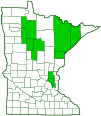
Occurrence
Taxonomy
Order
Suborder
Nematocera
Infraorder
Culicomorpha (Mosquitoes and Midges)
Superfamily
Culicoidea
Family
Culicidae (Mosquitoes)
Subfamily
Culicinae
Tribe
Sabethini
Genus
Wyeomyia
Northern and southern species
Pitcher-plant mosquito (Wyeomyia smithii) is found in purple pitcherplant (Sarracenia purpurea), and its range corresponds to the range of that plant. Some authorities recognize two pitcher-plant mosqiotoes; southern pitcher-plant mosquito (Wyeomyia haynei) and northern purple pitcherplant (Sarracenia purpurea ssp. purpurea).
Northern pitcher-plant mosquito larva has only 2 anal gills. The adult female does not drink blood. It is found exclusively in northern purple pitcherplant (Sarracenia purpurea ssp. purpurea), and its range corresponds to the range of that plant.
Southern pitcher-plant mosquito larva has four anal gills. The adult female has been known to drink blood. It is found exclusively in southern purple pitcherplant (Sarracenia purpurea ssp. venosa), and its range corresponds to the range of that plant.
The ranges of the two mosquitoes do not appear to overlap. Nevertheless, most sources do not separate the two species, and treat Wyeomyia haynei as a synonym of Wyeomyia smithii.
Subordinate Taxa
Synonyms
Aedes smithii
Wyeomyia haynei
Common Names
northern pitcher-plant mosquito
pitcherplant mosquito
pitcher-plant mosquito
Photos
Visitor Photos
Share your photo of this insect.
This button not working for you?
Simply email us at info@MinnesotaSeasons.com.
Attach one or more photos and, if you like, a caption.
Minnesota Seasons Photos
Slideshows
Slideshows
Videos
Visitor Videos
Share your video of this insect.
This button not working for you?
Simply email us at info@MinnesotaSeasons.com.
Attach a video, a YouTube link, or a cloud storage link.
Nicole Rojas-Oltmanns
Larvae Inside Pitcher Plants
Jan 22, 2026
Other Videos
Possible Pitcher Plant Mosquito (wyeomyia smithii) Sighting in S. Bugbat 20200405 133943
Inside Pitcher Plants
This is Wyeomyia smithii. it is amazing insects.
C6 Nature
Sightings
Visitor Sightings
Report a sighting of this insect.
This button not working for you?
Simply email us at info@MinnesotaSeasons.com.
Be sure to include a location.
Nicole Rojas-Oltmanns
7/28/2025

Location: Lake Bemidji State Park
mosquito larvae swimming inside pitcher.
Minnesota Seasons Sightings