Webbing clothes moth
(Tineola bisselliella)
Information
Conservation • Description • Habitat • Ecology • Distribution • Taxonomy
Hodges #
0426
Conservation Status
IUCN Red List
not listed
NatureServe
NNA - Not applicable
SNA - Not applicable
Minnesota
not listed
Description
Webbing clothes moth is a small exotic moth. It is native to the Western Palearctic, including Europe, and it has been accidentally introduced elsewhere. It is now cosmopolitan, occurring on every continent except Antarctica. The species is profoundly synanthropic, thriving specifically in human-made environments. Its spread has been facilitated by humans traveling to distant countries, unwittingly transporting the moth, larvae, or eggs in their belongings. It is especially common in large metropolitan areas around major cities, and it is rarely found in rural areas.
Webbing clothes moth is considered a pest, but its numbers are declining, at least in the UK, probably due to the increased use of synthetic fibers. Since it is synanthropic, it can occur anywhere where humans aggregate, store goods, or leave organic debris. This includes not only residential houses, but also textile warehouses and factories, antique shops and auction houses, museums, taxidermy studios, storage units, theaters, and costume shops. They are found in shipping containers and cargo holds, which were historically the primary conduits of their spread. They are a pest in libraries housing older books with casein-based glues and leather bindings. They may occasionally occupy the nests of birds or rodents, but these occurrences are almost exclusively limited to nests found in or on human dwellings.
The larvae feed on wool rugs and blankets, cashmere sweaters, horse-hair stuffed furniture, fur coats, and other materials made of animal-based fibers; on hair, feathers, and dead insects, including insect collections; and on bran, semolina and fine-ground flours, and biscuits. They also feed on dried, processed, or soiled sources of milk protein (casein). This is often in the form of milk spilled on a wool rug or furniture that hasn’t been perfectly cleaned. They spin tunnels or sheets of silken webbing to cover themselves as they feed.
Adults are active year-round since they inhabit primarily climate-controlled environments. They do not feed. Unlike many other moth species, they are averse to light; instead of fluttering around lamps, they prefer to remain in dark, undisturbed areas such as closets, baseboards, or the undersides of heavy furniture. They do not feed and are short-lived. At about room temperature (65° F [18° C], presumably in a controlled laboratory environment), females live up to 21 days and males live up to 37 days.
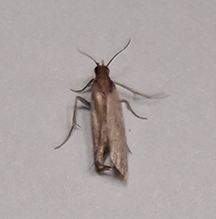
Adults are ¼″ (6 to 7 mm) in length and have a ½″ to ⅝″ (12 to 16 mm) wingspan. The forewing length is ⅛″ to ⅜″ (4 to 9 mm). The body is long and narrow.
The head is small and rusty yellow, and it is often tinged brown. There is a tuft of reddish-gold hairs on the top of the head. The compound eyes are dark and prominent; those of the male are noticeably larger than those of the female. The mouthparts are reduced and the maxillary palps, if present, are very short. The labial palps are long and curved upward in front of the face.
The thorax and abdomen are pale yellowish brown.
The forewings are long, lance-shaped, and golden buff with a distinctive satiny luster. They are held tent-like over the abdomen when at rest. There is no black spot in the median area, but the discal cell sometimes has a faint brownish dot. The fringe is long and pale. The hindwings are grayish yellow.
The legs are yellowish brown. On each leg, the fourth segment (tibia) has a long spur at the tip.
The larvae are white with a brown head capsule.
Size
Total length: ¼″ (6 to 7 mm)
Forewing length: ⅛″ to ⅜″ (4 to 9 mm)
Wingspan: ½″ to ⅝″ (12 to 16 mm)
Similar Species
Dark-collared tinea (Tinea apicimaculella) thorax is dark brown or black. On the forewing there is a narrow black streak through the central area and a black dot in the median area.
Habitat
Anywhere humans aggregate, store goods, or leave organic debris.
Ecology
Season
Year-round
Behavior
The larvae spin tunnels or sheets of silken webbing to cover themselves as they feed.
Adults are averse to light and prefer to remain in dark, undisturbed areas.
Life Cycle
If sufficient food is available, the larvae can mature in as little as 35 days. If not, they may take up to two years to mature.
Adults do not feed and are short-lived.
Larva Food/Hosts
Materials made of animal-based fibers, hair, feathers, dead insects, bran, flour, biscuits, and dried or processed, milk protein (casein).
Adult Food
Adults do not feed.
Distribution
Occurrence
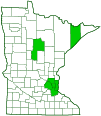
Common and widespread
Taxonomy
Order
Lepidoptera (Butterflies and Moths)
Superfamily
Tineoidea (Bagworms, Clothes Moths, and Allies)
Family
Tineidae (Fungus Moths, Clothes Moths, and Allies)
Subfamily
Tineinae
Genus
Tineola
Subordinate Taxa
Synonyms
Tinea bisselliella
Tinea crinella
Tinea destructor
Tinea flavifrontella
Tinea lanariella
Tineola crinella
Tineola destructor
Tineola furciferella
Tineola lanariella
Common Names
webbing clothes moth
Photos
Visitor Photos
Share your photo of this insect.
This button not working for you?
Simply email us at info@MinnesotaSeasons.com.
Attach one or more photos and, if you like, a caption.
Luciearl
Minnesota Seasons Photos
Slideshows
Slideshows
Tineola bisselliella
Cossus
Bướm Đêm - Tineola bisselliella , Họ Tineidae
Nico Nguyễn
Videos
Visitor Videos
Share your video of this insect.
This button not working for you?
Simply email us at info@MinnesotaSeasons.com.
Attach a video, a YouTube link, or a cloud storage link.
Luciearl
Webbing clothes moth 01
Jan 5, 2026
Webbing clothes moth 02
Jan 5, 2026
Other Videos
Clothes Moth Identification
Insects Limited
10 Fun Facts About Common Clothes Moths (Tineola Bisselliella) 🧥🦋
1minanimals
Clothes Moths Got Your Sweater? There’s a Wasp for That | Deep Look
Deep Look
Sightings
Visitor Sightings
Report a sighting of this insect.
This button not working for you?
Simply email us at info@MinnesotaSeasons.com.
Be sure to include a location.
Luciearl
12/15/2025
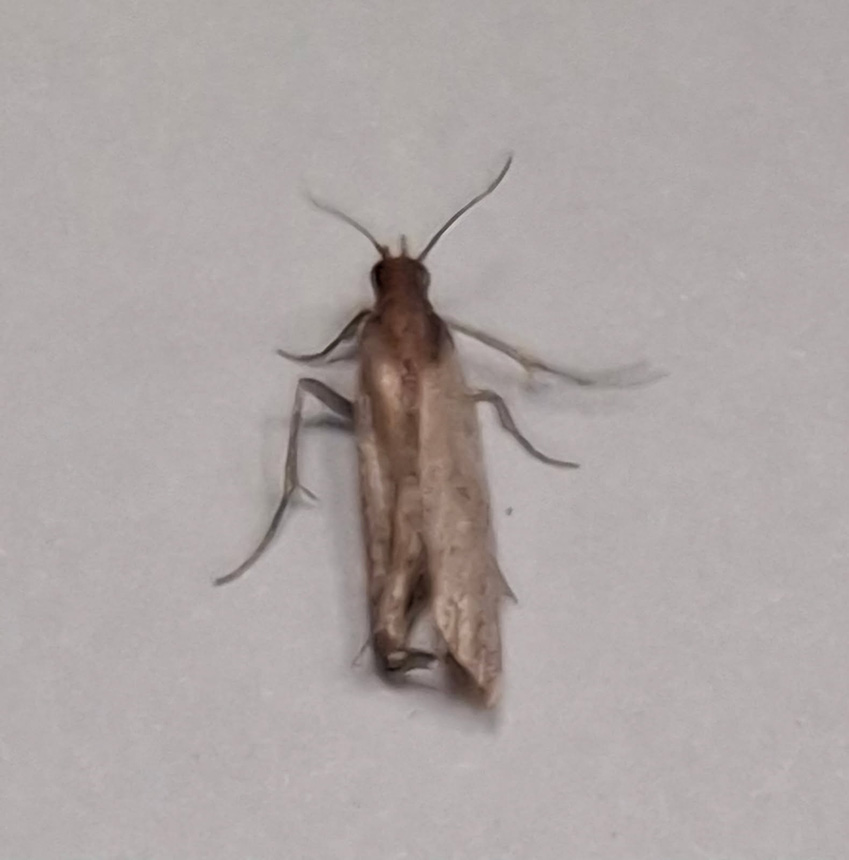
Location: Lake Shore, MN
… it just flew through my kitchen. I sprayed with a cleaning solution. It fell to the surface. Photo and video will be sent. It was euthanized after photo/video.
Minnesota Seasons Sightings