


Weevil wasp
(Cerceris halone)
Conservation • Description • Habitat • Ecology • Distribution • Taxonomy
Conservation Status
IUCN Red List
not listed
NatureServe
not listed
Minnesota
not listed
Description
Cerceris is a large genus of ground-nesting parasitic wasps. There are 871 currently recognized Cerceris species worldwide, about 30 species in North America north of Mexico, and at least 7 species in Minnesota. They are highly host specific, parasitizing only nut and acorn weevils (Curculio spp.).
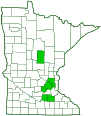
Cerceris halone is a medium-sized weevil wasp. It occurs in the United States from Maine to Virginia, west to North Dakota and eastern Kansas, and there is a separate (disjunct) population in eastern Texas. It occurs in southern Canada from Quebec to Manitoba. Larvae feed on paralyzed weevils. Adults feed on flower nectar and pollen.
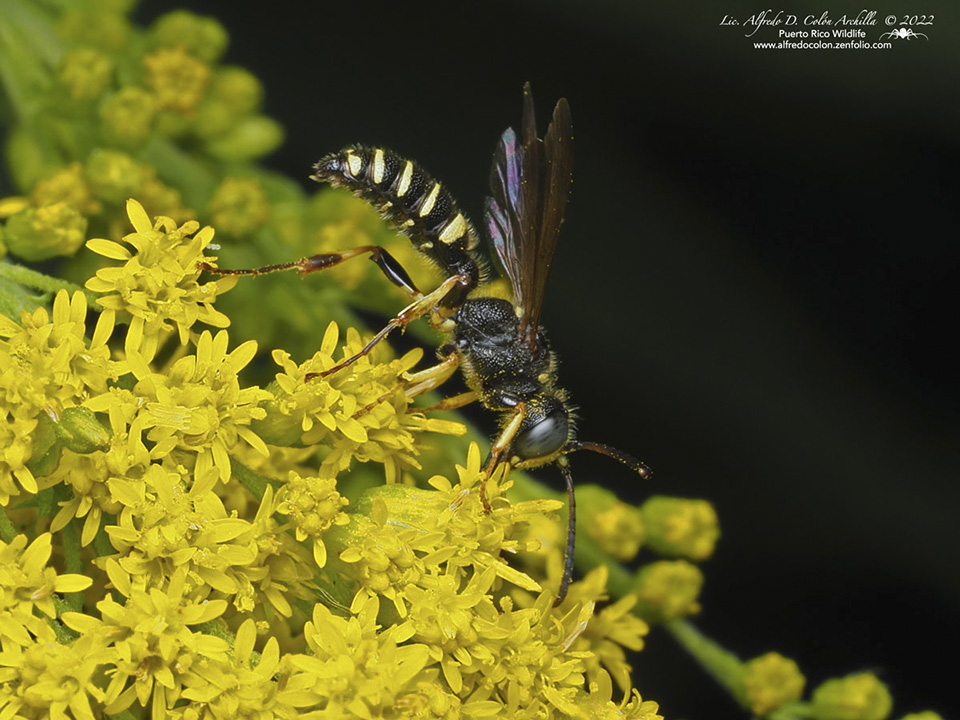
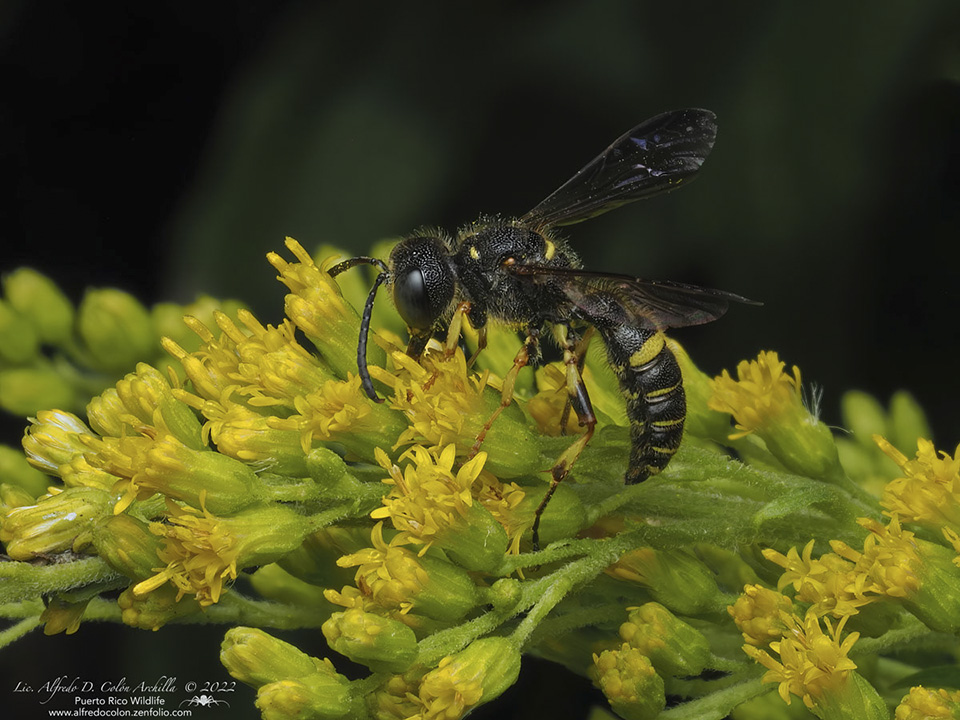
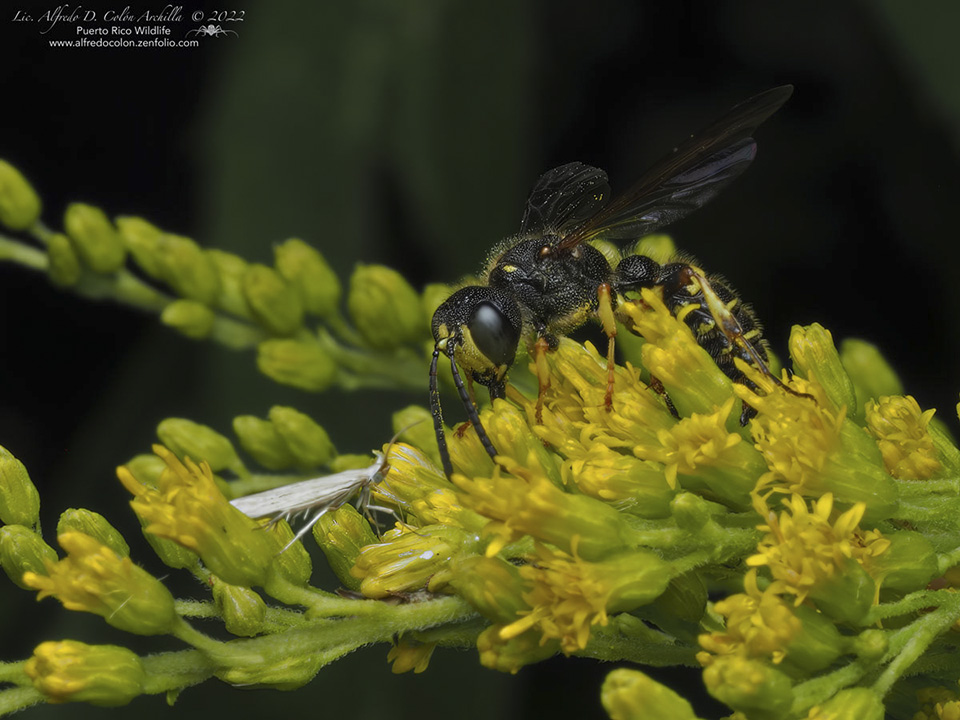
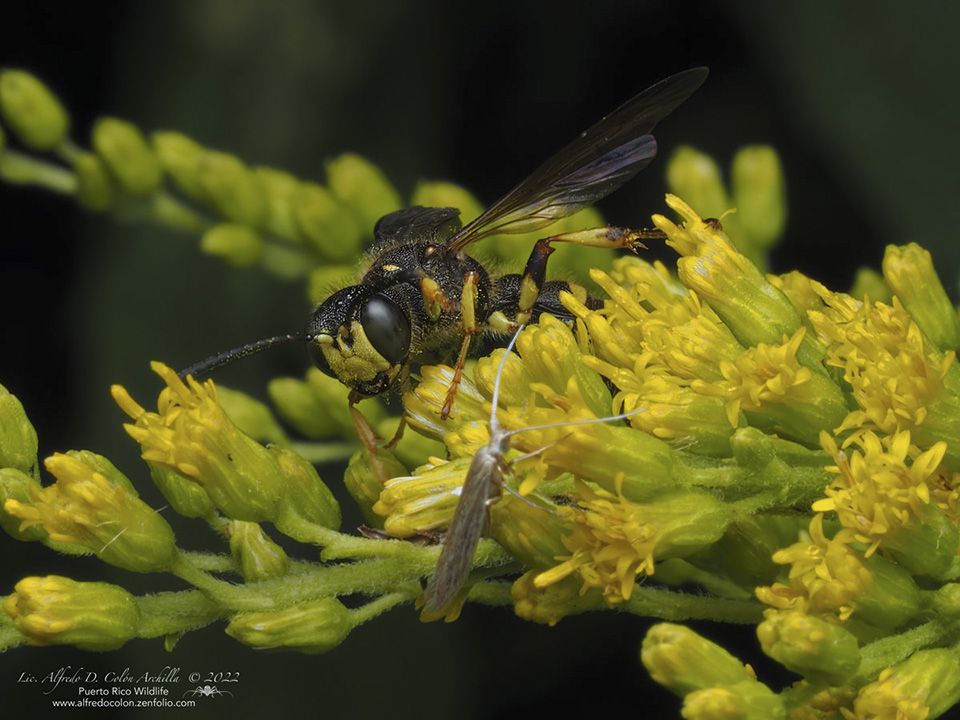
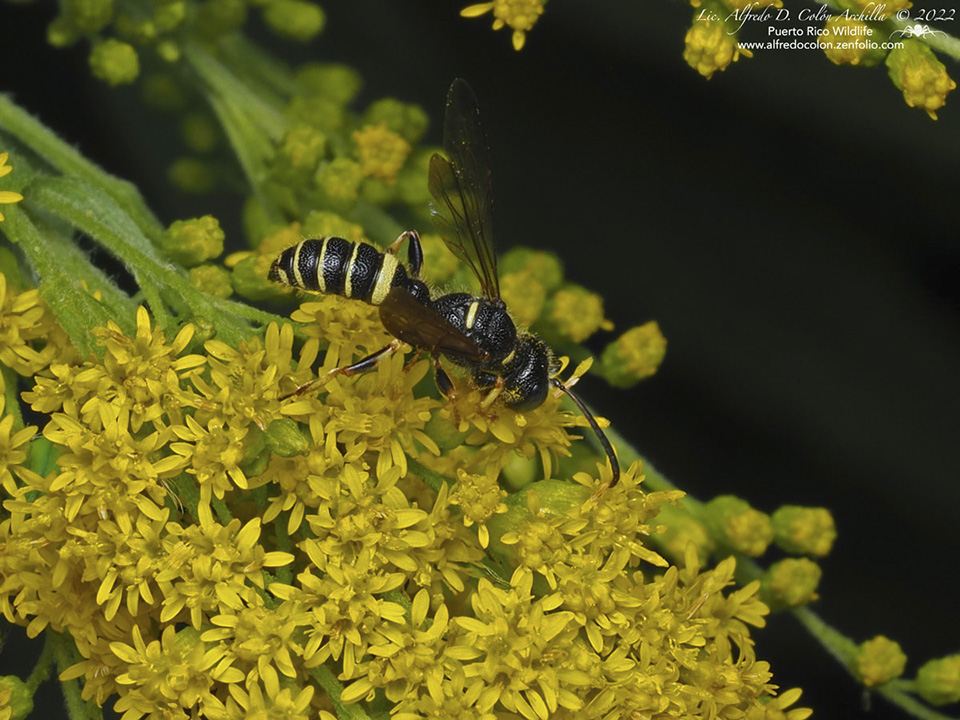
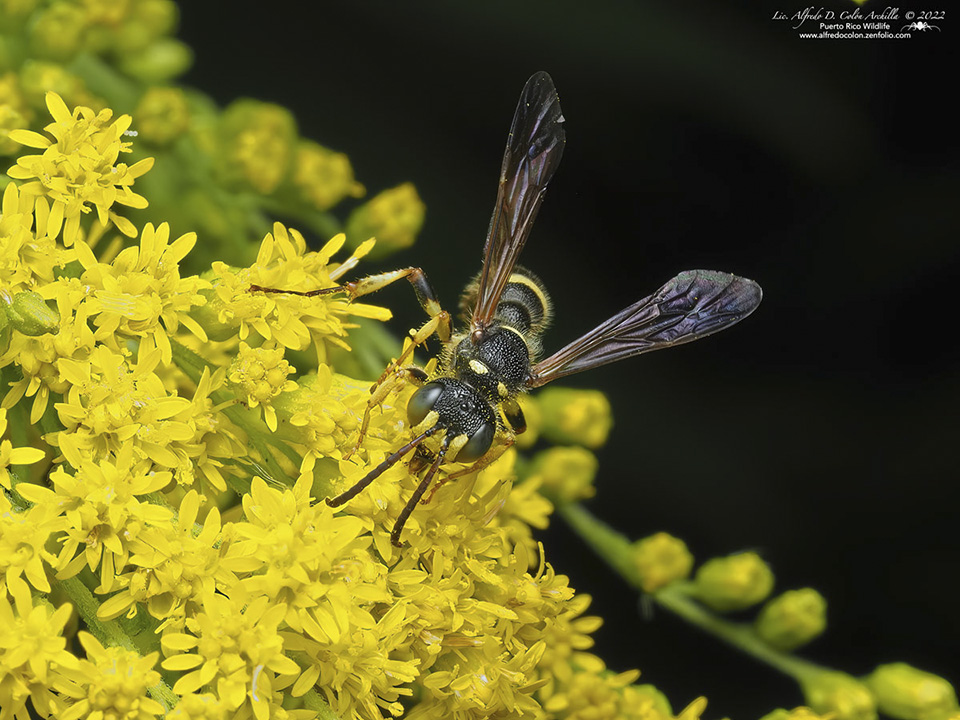
Adults are ½″ to ⅝″ (13 to 15 mm) in length and black with yellow markings.
On the female, the head is slightly wider than the thorax. The antennae have 12 segments and they are not elbowed. The first segment (scape) has a yellow patch on the underside. The face below the antennae bases is mostly yellow. The plate above the upper lip (clypeus) is black with two yellow spots. It has a distinct, elevated projection in the middle (medial carina) and there are tooth-like extensions on the lower margin. The medial carina is very short and broader than long, and its margin is crescent-shaped. The marginal extensions on the clypeus are angular and very large, and there is a depression between them. The base of each jaw (mandible) is yellow.
The thorax is black and has three segments, the prothorax, mesothorax, and metathorax. However, the first segment of the abdomen (propodeum) is fused to the thorax, giving the thorax the appearance of having four segments. The upper plate on the prothorax (pronotum) has a yellow band separated in the middle into two patches. The flap-like structure over each wing base (tegula) is yellow. The plate on the metathorax (metanotum) has a yellow band.
The abdominal segments are constricted at the front and rear margins. The upper side (tergite) of the second segment (T1) has two lateral yellow spots. T2 through T5 each have a yellow band on the rear margin. The band on T2 is broad and the front margin is deeply indented. The bands on T3, T4, and T5 are narrow. The last abdominal segment (pygidium) is only slightly narrowed at the base.
The legs are dark from the base to the middle of the femur, becoming yellow or amber from the end of the femur to the tip.
The wings are tinted brown.
On the male, the face is entirely yellow. The antennae have 13 segments.
Size
Total length: ½″ to ⅝″ (13 to 15 mm)
Similar Species
Habitat
Ecology
Season
July to September
Behavior
Females are solitary nesters, but usually several nests are found close together.
Life Cycle
The female burrows a vertical tunnel with up to ten horizontal branches (cells) in bare soil. She stings a weevil to paralyze it, places it in a cell, lays an egg, and seals the cell. When the egg hatches, the larva feeds on the still living but paralyzed weevil.
Larva Food/Hosts
Nut and acorn weevils (Curculio spp.)
Adult Food
Flower nectar and pollen
Distribution |
||
|
Sources |
|
| 12/16/2025 | ||
Occurrence |
||
|
||
Taxonomy
Order
Hymenoptera (Ants, Bees, Wasps, and Sawflies)
Suborder
Apocrita (Narrow-waisted Wasps, Ants, and Bees)
Infraorder
Aculeata (Ants, Bees, and Stinging Wasps)
Superfamily
Apoidea (Bees and Apoid Wasps)
Family
Crabronidae (Square-headed Wasps, Sand Wasps, and Allies)
Subfamily
Philanthinae
Tribe
Cercerini (Weevil Wasps and Allies)
Genus
Cerceris (Typical Weevil Wasps and Allies)
Subordinate Taxa
Synonyms
Cerceris architis
Cerceris salome
Cerceris shermani
Cerceris stigmosalis
Common Names
This species has no common name. The common name of the Genus Cerceris is Typical Weevil Wasps and Allies, and it is applied here for convenience.
Glossary
Carina
An elevated keel or ridge.
Clypeus
On insects, a hardened plate on the face above the upper lip (labrum).
Pronotum
The exoskeletal plate on the upper side of the first segment of the thorax of an insect.
Scape
In plants: An erect, leafless stalk growing from the rootstock and supporting a flower or a flower cluster. In insects: The basal segment of the antenna.
Tegula
A small, hardened, plate, scale, or flap-like structure that overlaps the base of the forewing of insects in the orders Lepidoptera, Hymenoptera, Diptera, and Homoptera. Plural: tegulae.
Tergite
The upper (dorsal), hardened plate on a segment of the thorax or abdomen of an arthropod or myriapod.
Visitor Photos
Share your photo of this insect.
This button not working for you?
Simply email us at info@MinnesotaSeasons.com.
Attach one or more photos and, if you like, a caption.
Alfredo Colon |
||
 |
 |
|
 |
 |
|
|
 |
|
MinnesotaSeasons.com Photos
|

Slideshows

Visitor Videos
Share your video of this insect.
This button not working for you?
Simply email us at info@MinnesotaSeasons.com.
Attach a video, a YouTube link, or a cloud storage link.
Other Videos
Weevil Wasp (Crabronidae: Cerceris halone) in Burrow
Carl Barrentine
Weevil Wasp (Crabronidae: Cerceris halone)
Carl Barrentine
Cerceris halone ACORN WEEVIL WASPS bring weevils to burrows. 9080607
Rob Curtis

Visitor Sightings
Report a sighting of this insect.
This button not working for you?
Simply email us at info@MinnesotaSeasons.com.
Be sure to include a location.
Alfredo Colon
8/18/2022

Location: Albany, NY
Alfredo Colon
8/8/2022

Location: Albany, NY
Minnesota Seasons Sightings