



Sullivant’s milkweed
(Asclepias sullivantii)
Conservation • Wetland • Description • Habitat • Ecology • Use • Distribution • Taxonomy
Conservation Status |
|
|||||||
| IUCN Red List | not listed |
|||||||
| NatureServe | NNR - Unranked S2 - Imperiled |
|||||||
| Minnesota | Threatened |
|||||||
Wetland Indicator Status |
||||||||
| Great Plains | FAC - Facultative |
|||||||
| Midwest | FAC - Facultative |
|||||||
| Northcentral & Northeast | FAC - Facultative |
|||||||
Description |
||
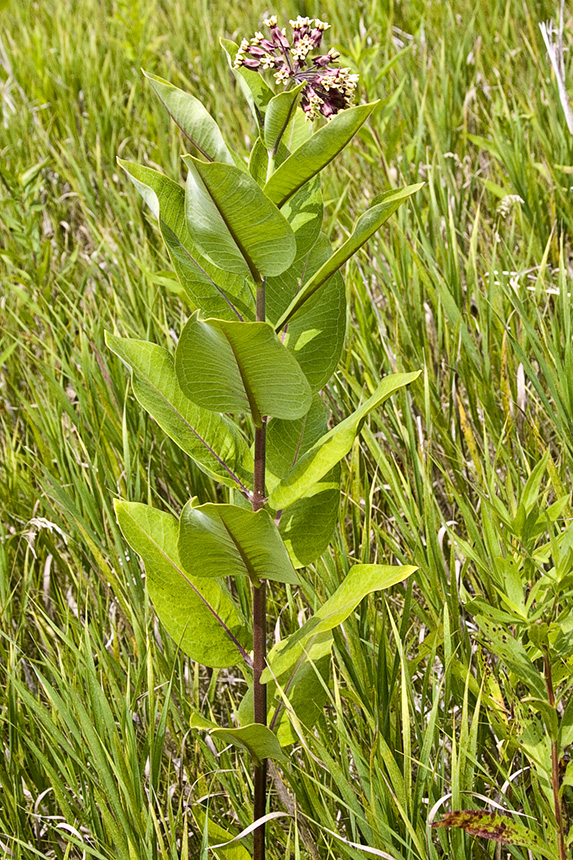
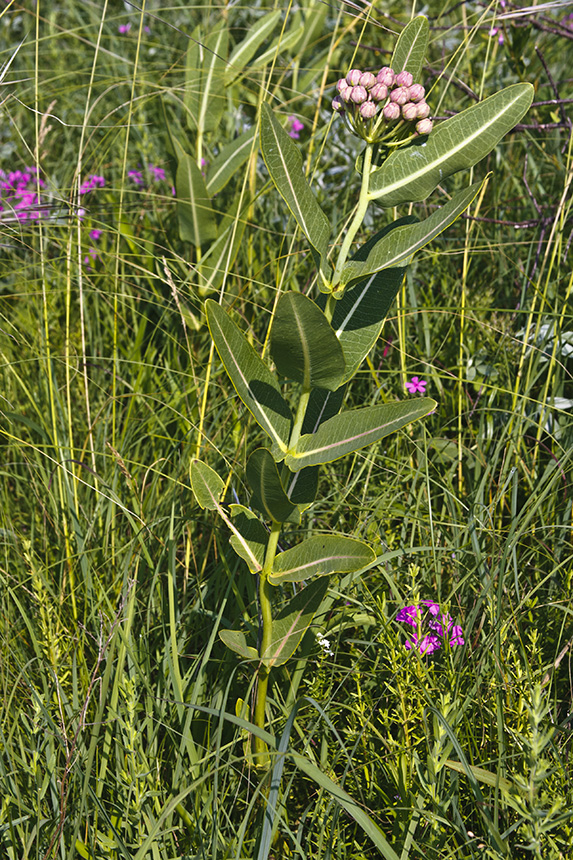
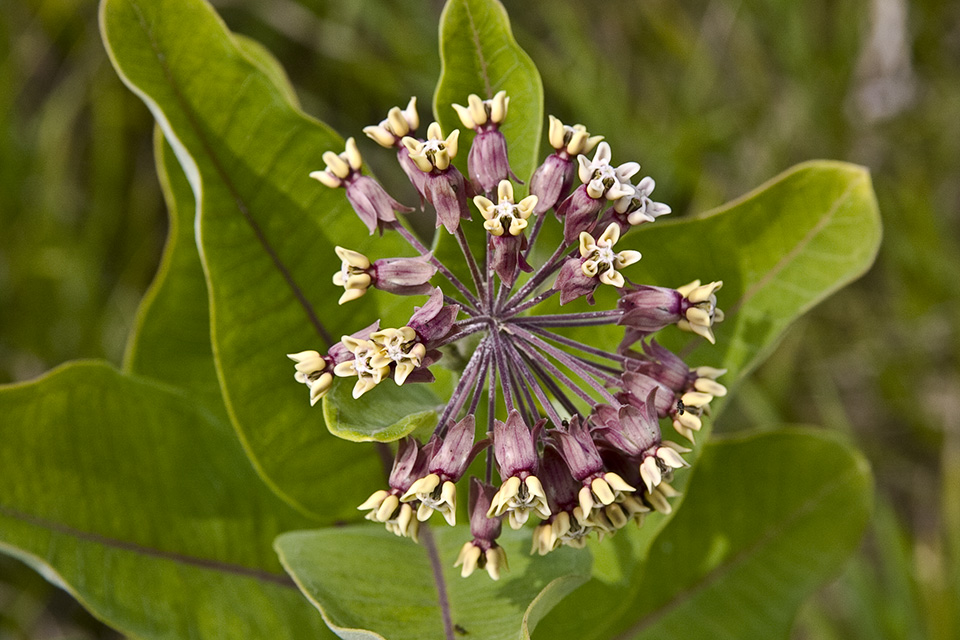
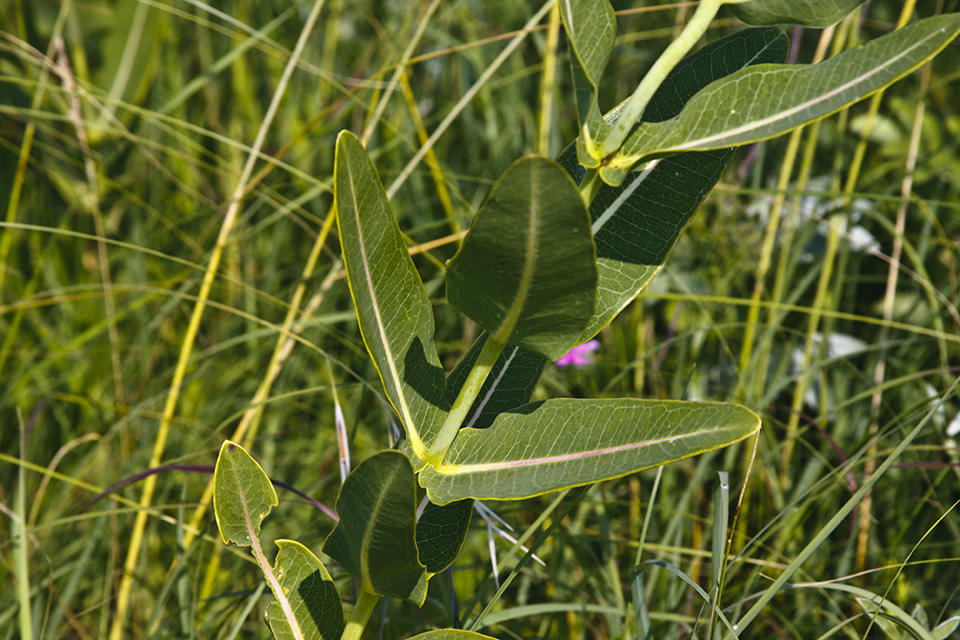
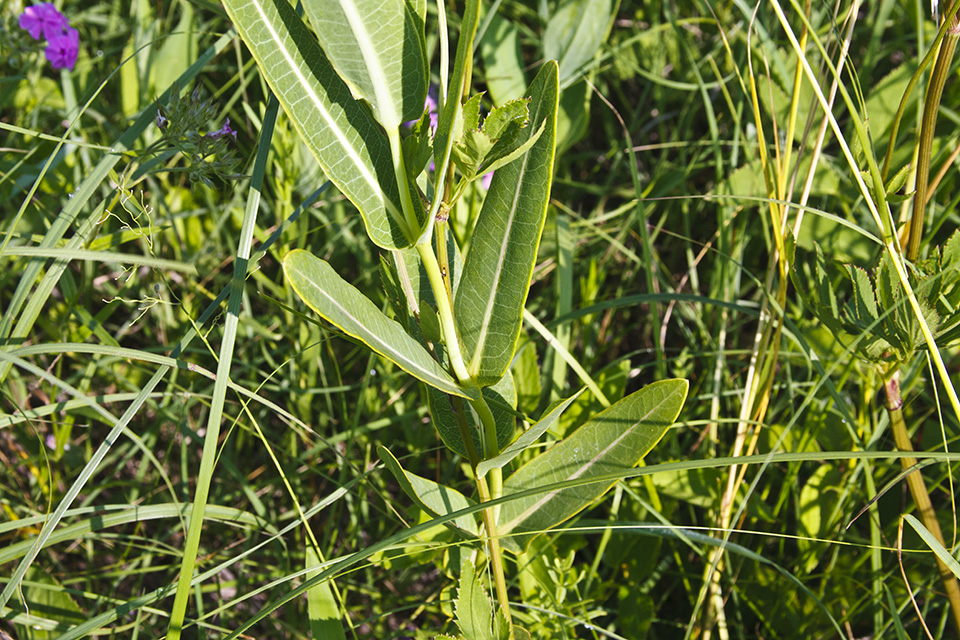
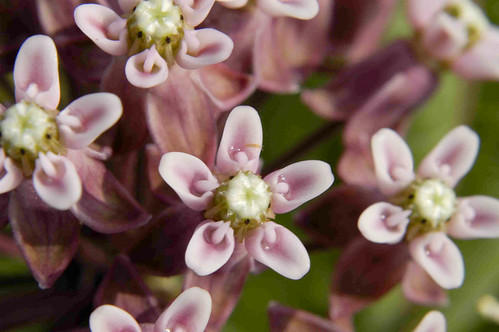
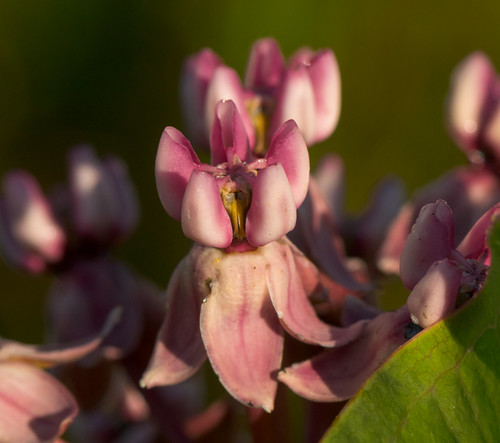
Sullivant’s milkweed is an erect perennial forb. A single stem rises from a deep, fleshy rhizome. It tends to occur in colonies. The leaves and stems contain a milky juice. The stems are erect and usually unbranched. They are stout (up to ⅜″ wide at the base), light green, hairless, and covered with a whitish, waxy bloom (glaucous). The leaves are opposite, thick, 2½″ to 6″ long, 1″ to 3½″ wide, egg-shaped to elliptic or oblong, and ascending. They are attached to the stem without leaf stalks or on very short leaf stalks. The tip of the leaf blade is somewhat acute. The base is broadly rounded or more or less heart-shaped and somewhat clasping the stem. The base does not overlap that of the adjacent leaf. The thick central vein is pinkish or reddish on mature leaves, pale green on younger leaves. The upper surface is softly hairy, the lower surface finely woolly. The margins are untoothed and slightly wavy. The inflorescence is 1 to 3 umbrella-shaped clusters (umbels) rising from the upper leaf axils at the top of the plant. The clusters are 3″ to 4″ in diameter and erect on a hairless, ½″ to 3″ long stalk. They typically have 15 to 40 flowers. The structure of the typical milkweed flower is unique and instantly recognizable. There are 5 petals bent backward at the base and hanging downward. Subtending the petals are 5 much shorter, light green, lance-shaped sepals. There are 5 stamens. Formed from the filament of each stamen is a petal-like appendage. The appendage consists of a tubular hood surrounding an awl-shaped horn in the center of the hood. The stamens and the stigma are fused together into a crown-like structure (gynostegium). Each stigma has a long slit designed to catch the legs of a pollinating insect. A small, dark, sticky gland above this slit is attached to pollen sacs from adjacent anthers. These glands are designed to break off as an insect pulls its leg free of the slit, and remain attached to the insects leg. The flowers are pollinated by larger insects strong enough to lift off with the pollen sacs attached. Smaller insects are caught in a death trap or leave behind their detached legs. The flowers of this plant are shaped like the typical milkweed flower. They are ½″ to ¾″ tall and ½″ wide. The petals are pinkish-purple and white at the base. They bend backward at the base, hang downward, then curl upward near the tip. They are separated from the hoods by a short but distinct column. The hoods are pink or pinkish-white. The horns are shorter than the hoods. They project from the hoods and are curved inwards. The fruit is a spindle-shaped pod. It is 3″ to 4″ long, about 1″ thick, and smooth or slightly warty. It is held erect or ascending on a downward-curved stalk. It opens on one side exposing the seeds to spreading by the wind. The seeds have a tuft of white, silky hairs at the tip. |
||
Height |
||
1′ to 3′ |
||
Flower Color |
||
Pinkish-purple and white |
||
Similar Species |
||
When in flower this plant strongly resembles common milkweed. When not in flower, it resembles Indian hemp. Common milkweed (Asclepias syriaca) is a much taller plant, 3′ to 6′ at maturity. The stems are hairy. The leaves are blunt-tipped, spreading roughly perpendicular to the stem, hairy below, with a central vein that is pale green, not reddish. The umbels are more dense, on a hairy stalk, and have 20 to 130 flowers. The flowers are smaller and less showy. The fruit is fatter and densely covered with warts. Indian hemp (Apocynum cannabinum) is a less robust plant. It has a dark stem and narrower leaves. The fruit is a long, skinny, dangling pod, and is joined at the top with other pods. |
||
Habitat |
||
Moderate moisture. Undisturbed tallgrass prairies. Full sun. |
||
Ecology |
||
Flowering |
||
June to August |
||
Faunal Associations |
||
Milkweeds are the only plants that Monarchs lay their eggs on. The eggs are laid on the underside of healthy young leaves. |
||
Toxicity |
||
This and other milkweeds contain cardiac glycosides and may be poisonous to both humans and livestock. |
||
Pests and Diseases |
||
|
||
Use |
||
|
||
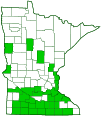
Distribution |
||||
|
Sources |
|||
| 5/31/2023 | ||||
Nativity |
||||
Native |
||||
Occurrence |
||||
Rare |
||||
Taxonomy |
|||
| Kingdom | Plantae (Plants) | ||
| Subkingdom | Pteridobiotina | ||
| Phylum | Tracheophyta (Vascular Plants) | ||
| Class | Magnoliopsida (Dicots) | ||
Order |
Gentianales (Gentians, Dogbanes, Madders, and Allies) | ||
Family |
Apocynaceae (dogbane) | ||
| Subfamily | Asclepiadoideae (milkweeds) | ||
| Tribe | Asclepiadeae | ||
| Subtribe | Asclepiadinae | ||
Genus |
Asclepias (milkweeds) | ||
Subordinate Taxa |
|||
|
|||
Synonyms |
|||
|
|||
Common Names |
|||
prairie milkweed smooth milkweed Sullivant milkweed Sullivant’s milkweed |
|||
Glossary
Axil
The upper angle where the leaf stalk meets the stem.
Clasping
Describing a leaf that wholly or partly surrounds the stem but does not fuse at the base.
Glaucous
Pale green or bluish gray due to a whitish, powdery or waxy film, as on a plum or a grape.
Gynostegium
A crown-like structure of plants of the genus Asclepias formed by the fusion of the anthers with the stigmas.
Linear
Long, straight, and narrow, with more or less parallel sides, like a blade of grass.
Rhizome
A horizontal, usually underground stem. It serves as a reproductive structure, producing roots below and shoots above at the nodes.
Umbel
A flat-topped or convex, umbrella-shaped cluster of flowers or buds arising from more or less a single point.
Visitor Photos |
|||||
Share your photo of this plant. |
|||||
| This button not working for you? Simply email us at info@MinnesotaSeasons.com. Attach one or more photos and, if you like, a caption. |
|||||
|
|||||
MinnesotaSeasons.com Photos |
|||||
Plant |
|||||
 |
 |
||||
Inflorescence |
|||||
 |
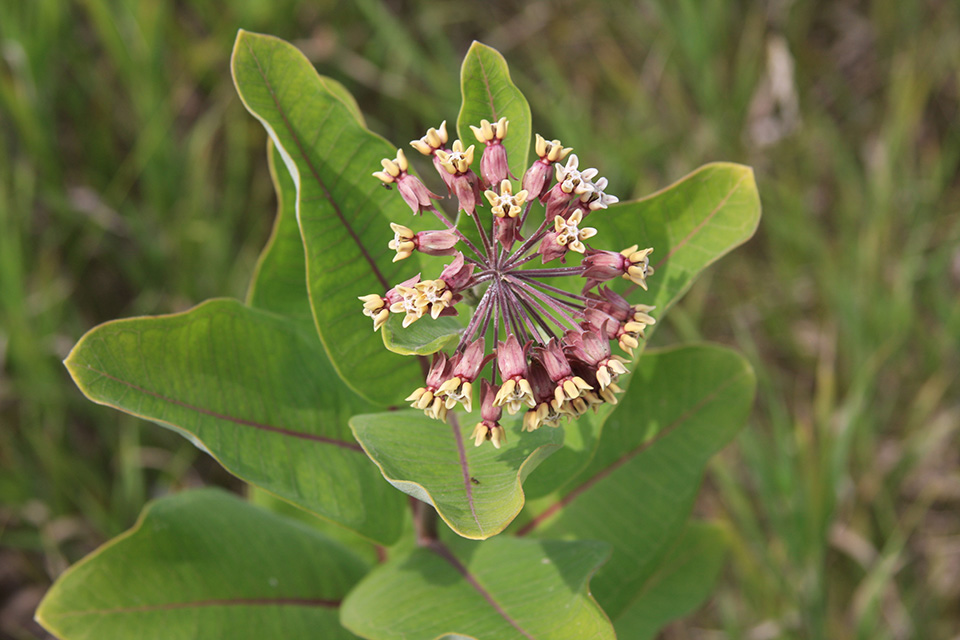 |
||||
Leaves |
|||||
 |
 |
||||

Slideshows |
||
| Asclepias sullivantii PRAIRIE MILKWEED Frank Mayfield |
||
|
||
| Asclepias sullivantii Joshua Mayer |
||
|
||

Visitor Videos |
|||
Share your video of this plant. |
|||
| This button not working for you? Simply email us at info@MinnesotaSeasons.com. Attach a video, a YouTube link, or a cloud storage link. |
|||
Other Videos |
|||
| Honeybee snagged by a Sullivant's milkweed flower. July 10, 2009. Marion Ohio, USA Robert Klips |
|||
About
Uploaded on Aug 21, 2009 Milkweed flowers have an unusual flower structure that includes a slit-like crevice into which pollen packets (pollinia) are inserted. Sometimes a bee gets her foot caught in the groove, and cannot escape. This tragedy is taking place at Killdeer Plains Wildlife Area in Marion County, Ohio on July 10, 2009. The plant is Sullivant's milkweed (Asclepias sullivantii). |
|||
| Firefly wanders about on milkweed flowers, July10, 2010 Robert Klips |
|||
About
Uploaded on Nov 18, 2010 A firefly, possibly Photinus pyralis, wanders about on an inflorescence of Sullivant's milkweed (Asclepias sullivantii) at Killdeer Plains Wildlife Area in Marion County, Ohio, USA, on July 10, 2010. |
|||

Visitor Sightings |
|||||
Report a sighting of this plant. |
|||||
| This button not working for you? Simply email us at info@MinnesotaSeasons.com. Be sure to include a location. |
|||||
|
|||||
MinnesotaSeasons.com Sightings |
|||||
|
Created: Last Updated: © MinnesotaSeasons.com. All rights reserved. |