


black cherry finger gall mite
(Eriophyes cerasicrumena)
Conservation • Description • Habitat • Biology • Distribution • Taxonomy
Conservation Status |
|
|||||||
| IUCN Red List | not listed |
|||||||
| NatureServe | not listed |
|||||||
| Minnesota | not listed |
|||||||
Description |
||
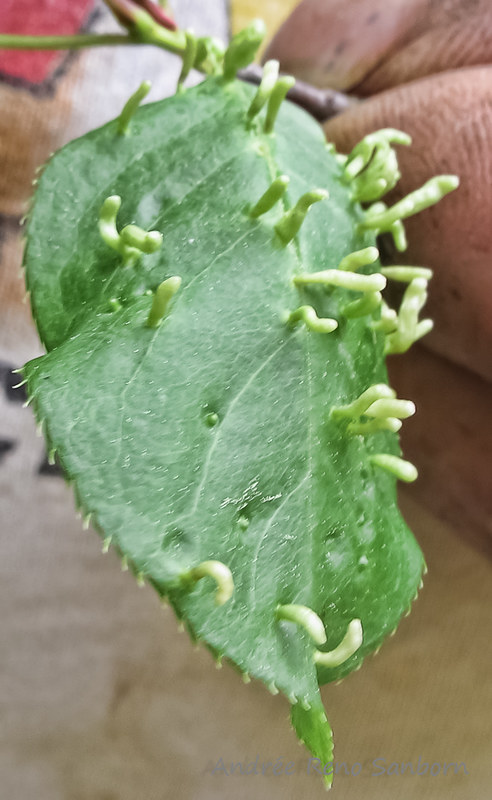
Eriophyid mites (Eriophyes spp.) are so small that they are almost impossible to see with the naked eye. Unless a scanning electron microscope is available, a morphological description of an adult individual is useless. The mite is most easily identified by the shape of the gall it produces and the plant species on which it is found. Black cherry finger gall mite is a highly specialized plant feeder. As its common name suggests, it is found exclusively on black cherry (Prunus serotina var. serotina). The pouch-type finger galls appear on the upper side of a black cherry leaf. They are solitary, though there are usually many galls on a single leaf. They are often crowded near the base of the leaf blade and near the midrib. Each gall is yellowish-green, brownish, or reddish; spindle-shaped; hollow; and ⅛″ to 5 ⁄16″ long. It is attached to the leaf blade by a slender stalk and is pointed or tapered at the tip. Adult mites appear in three morphologically distinct forms. The female that feeds in the growing season (protogyne), the male, which also feeds in the growing season, and the female that overwinters (deutogyne). |
||
Size |
||
Tiny, almost microscopic |
||
Similar Species |
||
| This is the only species that causes finger galls on black cherry. It is not found on other plant species. | ||
Habitat and Hosts |
||
black cherry |
||
Biology |
||
Season |
||
Several generations each year. The first galls develop April to July. |
||
Behavior |
||
|
||
Life Cycle |
||
The overwintering female (deutogynes) emerges with the leaf from the leaf bud in the March, “riding” the leaf out as it grows. As it feeds on the leaf, a chemical in its saliva causes the leaf cell to expand, forming a pouch. It then enters the pouch, lays its eggs, and dies. In May the eggs hatch, producing males and white, growing-season females (protogynes). These mites remain in the pouch through the summer. In July, red deutogynes appear. In September the gall dries and splits open, releasing all three forms of the mite. The deutogynes enter the buds to overwinter. |
||
Food |
||
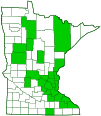
Distribution |
||||
|
Sources 7, 30. |
|||
| 12/14/2021 | ||||
Occurrence |
||||
Common |
||||
Taxonomy |
|||
| Class | Arachnida (arachnids) | ||
| Subclass | Acari (mites and ticks) | ||
| Superorder | Acariformes (mites) | ||
Order |
Endeostigmata | ||
Superfamily |
Eriophyoidea | ||
Family |
Eriophyidae (gall and rust mites) | ||
Subfamily |
Eriophyinae | ||
Tribe |
Eriophyini | ||
Genus |
Eriophyes | ||
The superfamily Eriophyoidea was formerly placed in the order Trombidiformes. A recent mitochondrial DNA study and phylogenetic analysis (Arribas et al., 2020) showed that the superfamily evolved earlier than Trombidiformes. It is sometimes now included in the order Endeostigmata. In modern taxonomic treatments Eriophyoidea is sister to the clade containing Trombidiformes. |
|||
Synonyms |
|||
Phytoptus cerasicrumena |
|||
Common Names |
|||
black cherry finger gall mite black cherry leaf gall mite eriophyid mite finger gall mite |
|||
Visitor Photos |
|||||
Share your photo of this arachnid. |
|||||
| This button not working for you? Simply email us at info@MinnesotaSeasons.com. Attach one or more photos and, if you like, a caption. |
|||||
|
|||||
MinnesotaSeasons.com Photos |
|||||
 |
|||||

Slideshows |
||
| Black Cherry Gall (Eriophyes cerasicrumena) Andree Reno Sanborn |
||
|
||
| Eriophyes cerasicrumena - fungi kingdom Fungi Kingdom |
||
About
Published on Jan 23, 2015 Eriophyes cerasicrumena - fungi kingdom |
||
Visitor Videos |
|||
Share your video of this arachnid. |
|||
| This button not working for you? Simply email us at info@MinnesotaSeasons.com. Attach a video, a YouTube link, or a cloud storage link. |
|||
Other Videos |
|||
| Leaf Galls on Black Cherry Tree ( Eriophyes cerasicrumena ) ThePlantVideos |
|||
About
Published on May 31, 2012 Camera used - Toshiba Camileo bw10 Leaf Gall, Black Cherry, Tree, Eriophyes cerasicrumena, |
|||

Visitor Sightings |
|||||
Report a sighting of this arachnid. |
|||||
| This button not working for you? Simply email us at info@MinnesotaSeasons.com. Be sure to include a location. |
|||||
| Jim Hundrup Throughout Summer of 2021 |
Location: Spokane County Washington First time I have seen this. It is active in 10-20 wild cherry plants on my 10 acre forest. |
||||
| Jeffrey Dolley 6/5/2020 |
Location: Brunswick, Maine |
||||
| larksnest12 6/18/2015 |
Location: Nottingham NH |
||||
MinnesotaSeasons.com Sightings |
|||||
Last Updated: