


Compton Tortoiseshell
(Nymphalis l-album)
Conservation • Description • Habitat • Ecology • Distribution • Taxonomy
Conservation Status
IUCN Red List
LC - Least Concern
NatureServe
N5 - Secure
S5 - Secure
Minnesota
not listed
Description
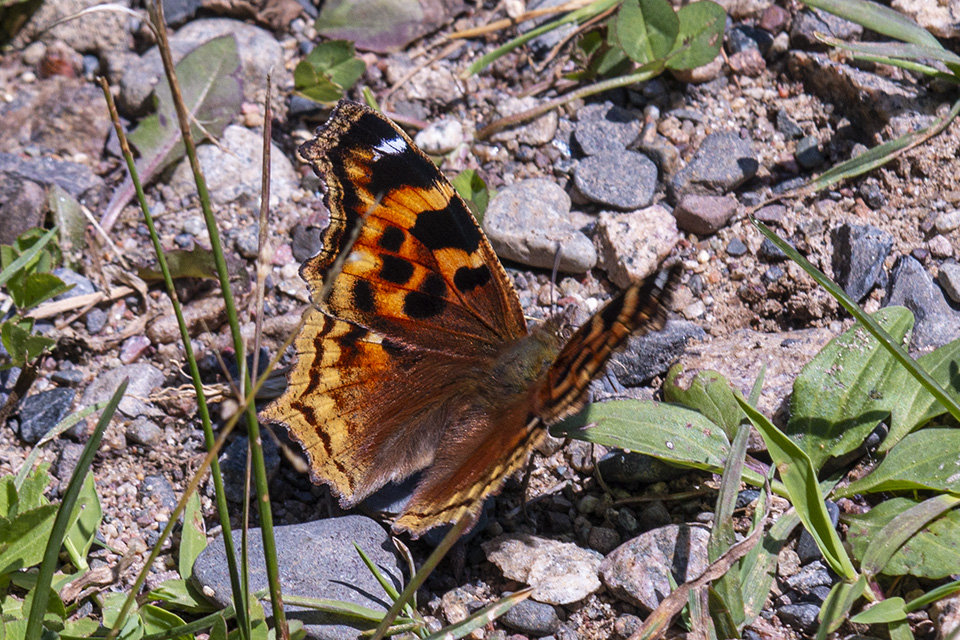
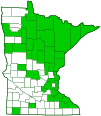
Compton Tortoiseshell is a brush-footed butterfly. It occurs across in Europe, Asia, and North America. In Canada it occurs throughout the country but is most common in the southern half. In the United States it is mostly restricted to the northern third of the country, from Maine to New Jersey in the east to Washington in the West. In Minnesota it occurs in the northeastern two-thirds of the state but is most common in the Arrowhead region. It is found in coniferous, deciduous, and mixed forests, in orchards, and in suburbs.
Compton Tortoiseshell is a medium-sized butterfly but one of the largest Brush-footed Butterflies. Adults have a 2 9⁄16″ to 3 1⁄16″ (64 to 78 mm) wingspan. The margins of all four wings are jagged. The hindwings each have a small, tail-like projection.
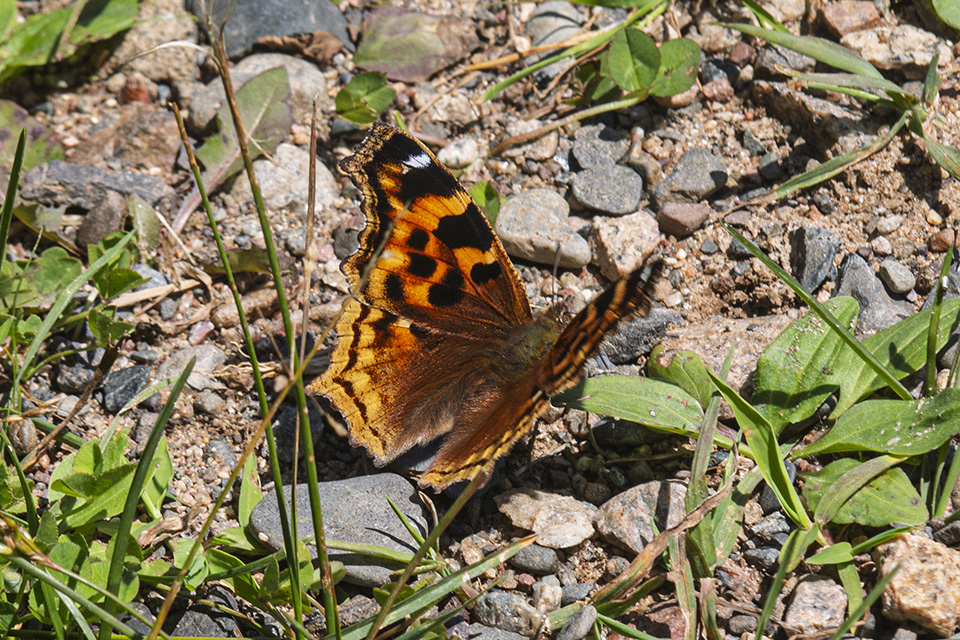
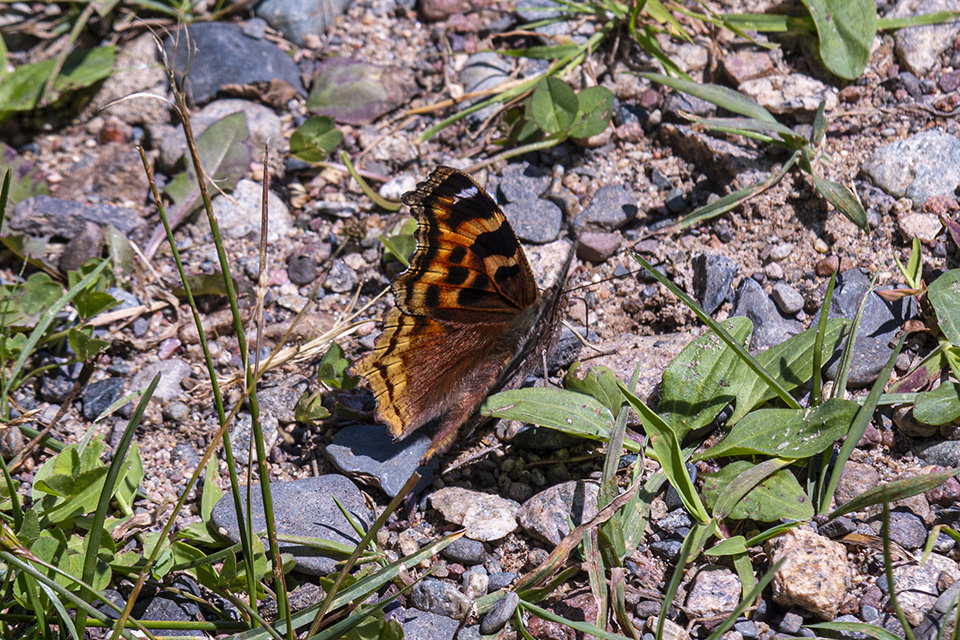
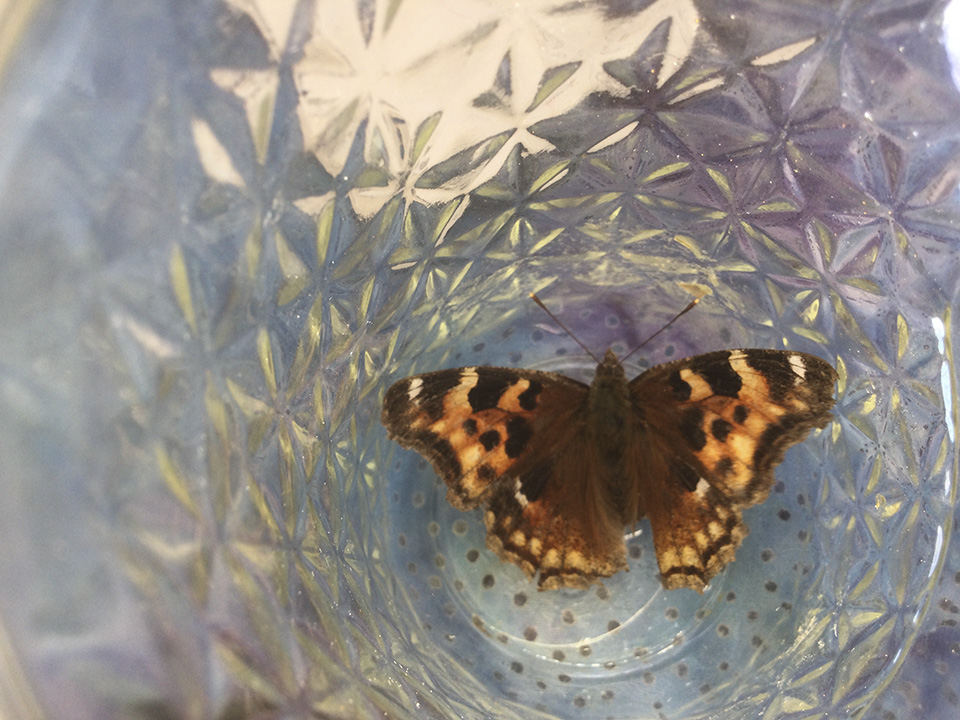
On the forewing the basal area is dark brown. The base color of the remainder of the forewing is rusty-orange to yellow. There is a black spot in the discal area and an S-shaped black band in the median area. In the post-medial area there are three black spots and also a black patch on the leading edge (costal margin). In the subterminal area there is a row of golden-yellow spots, a thin dark band, and a black patch at the wingtip (apex). A small white spot separates the black postmedial and subterminal patches.
The hindwing is similar but with just two black patches separated by a white spot, no black spots, and a thin black subterminal line.
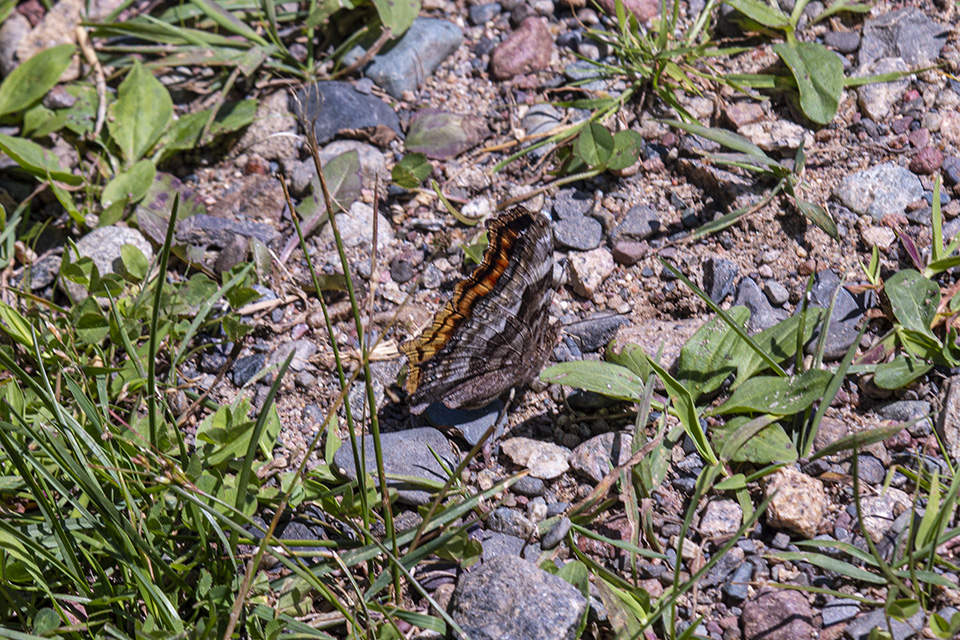
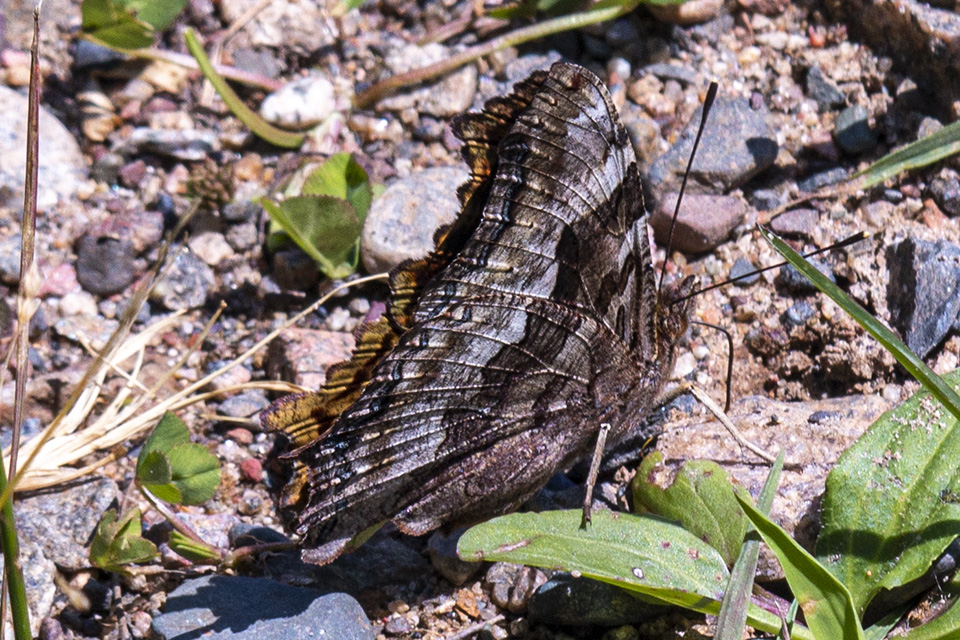
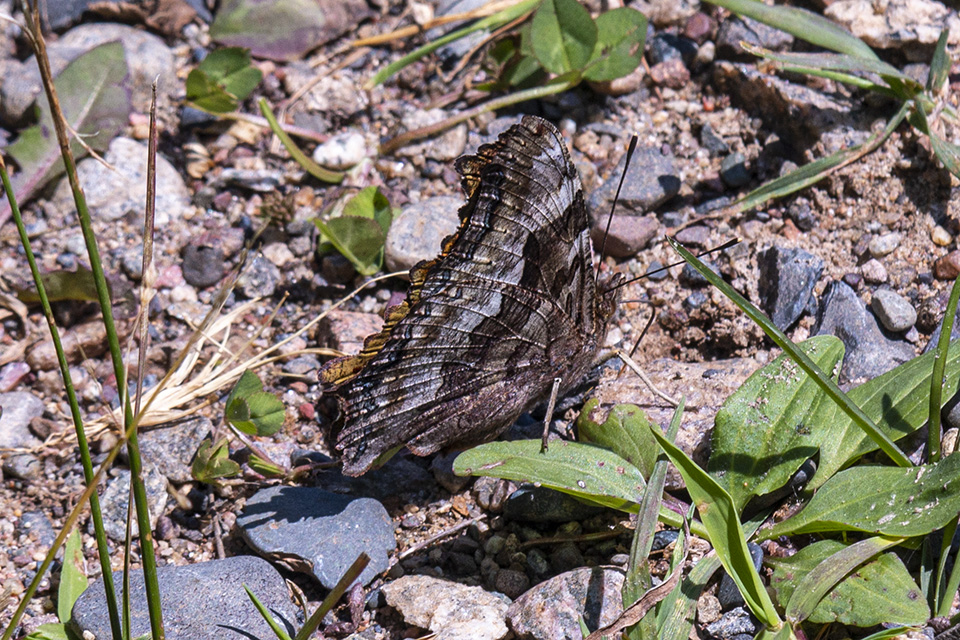
The underside of both wings is mottled dark and light brown. There is a small silvery mark in the middle of the hindwing, but it is inconspicuous and easily overlooked if not searched for.
Size
Wingspan: 2 9⁄16″ to 3 1⁄16″ (64 to 78 mm)
Similar Species
Habitat
Coniferous, deciduous, and mixed forests
Ecology
Season
One generation per year: April through late May, late-June through July, and late August through late October.
Behavior
Larvae feed in groups
Life Cycle
Compton Tortoiseshell is one of the first butterflies to be seen in early spring. Adults emerge from hibernation in late March to early April. They fly until late May, during which time they mate and the female lays small clusters of eggs on willow, poplar, and birch trees. When the eggs hatch the caterpillars feed on the leaves. Adults of the new generation emerge from late June to early July. They often estivate in mid-summer and become active again in September. In late October they hibernate in a hole in a tree or in a protected area on a building.
Larva Food/Hosts
Leaves of willow, poplar, and birch trees.
Adult Food
Flower nectar, sap, and the juices of rotting fruit
Distribution
Sources
7, 21, 24, 27, 29, 30, 75, 82, 83.
Biodiversity occurrence data published by: Minnesota Biodiversity Atlas (accessed through the Minnesota Biodiversity Atlas Portal, bellatlas.umn.edu, 12/21/2025).
Quinn, Edward. M., and Ron Danielson. April 27, 2009. A Survey of Lepidoptera in Three Priority Areas of the Minnesota State Parks System. https://files.dnr.state.mn.us/eco/nongame/projects/consgrant_reports/2009
/2009_quinn_danielson.pdf.
Occurrence
Common
Taxonomy
Order
Lepidoptera (Butterflies and Moths)
Superfamily
Papilionoidea (Butterflies)
Family
Nymphalidae (Brush-footed Butterflies)
Subfamily
Nymphalinae (Checkerspots, Anglewings, Peacocks, and Allies)
Tribe
Nymphalini (Ladies, Anglewings, and Allies)
Genus
Nymphalis (Tortoiseshells)
Genus
The correct placement of this species is a matter of ongoing debate. It was originally described as Papilio vaualbum in 1775. It was historically placed in various genera but has been widely treated as Nymphalis in modern literature. Almost all sources today place it in the genus Nymphalis, but GBIF places it in Polygonia.
Species
The correct species epithet is also a matter of ongoing debate. It has long been known as Nymphalis l-album, and that is the name found in older North American field guides. Many modern taxonomists use the name Nymphalis vaualbum, and a few sources use the name Polygonia vaualbum.
Some sources argue that the species epithet “vaualbum” has been demonstrated as invalid because when it was submitted it “was not accompanied by a description, definition or indication,” and the oldest valid name is Papilio l-album. Moving it to the currently accepted genus, the full species name becomes Nymphalis l-album (Esper, 1781).
Some sources point out that the name Nymphalis vaualbum is older, and therefore has priority. They argue that even if the 1775 name is shaky, it was “validated” by later usage or that the brief mention did constitute an “indication.”
More recently, molecular studies have suggested that the Compton Tortoiseshell is more closely related to the Commas (Polygonia) than to Tortoiseshells (Nymphalis), and should be moved to that genus.
Nymphalis l-album is the name used by ITIS, NCBI, BugGuide, Moth Photographers Group, iNaturalist, and A Catalogue of the Butterflies of the United States and Canada (the “Pelham Catalog”). iNaturalist generally follows the Pelham Catalog, which is why those two sources align
Nymphalis vaualbum is the name used by Butterflies and Moths of North America and Discover Life.
Polygonia vaualbum is the name used by GBIF, Catalogue of Life, and The Global Lepidoptera Names Index.
Subordinate Taxa
Compton Tortoiseshell (Nymphalis l-album j-album) 
Compton Tortoiseshell (Nymphalis l-album l-album)
Compton Tortoiseshell (Nymphalis l-album ssp. samurai)
Synonyms
Aglais watsoni
Nymphalis vaualbum
Papilio l-album
Papilio vaualbum
Polygonia vaualbum
Roddia l-album
Roddia vaualbum
Vanessa j-album
Vanessa samurai
Vanessa vau-album
Common Names
Compton Tortoiseshell
fralse comma
Glossary
Costal margin
The leading edge of the forewing of insects.
Estivate
Enter a period of reduced metabolic activity in the summer, similar to hibernation.
Visitor Photos
Share your photo of this insect.
This button not working for you?
Simply email us at info@MinnesotaSeasons.com.
Attach one or more photos and, if you like, a caption.
Sedna Cedarstone
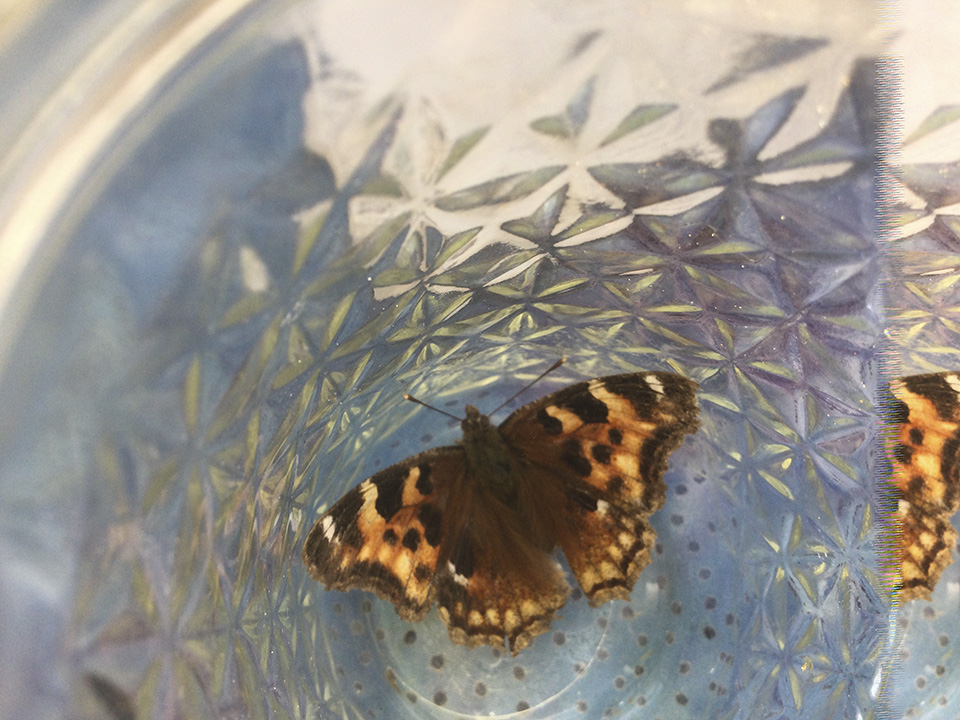
Just found up agains window inside. Temp outside 27. Will tuck it down in greenhouse. Can you ID please? Thanks
MinnesotaSeasons.com Photos


Slideshows
Title
Author

Visitor Videos
Share your video of this insect.
This button not working for you?
Simply email us at info@MinnesotaSeasons.com.
Attach a video, a YouTube link, or a cloud storage link.
Other Videos
1000’s of Butterflies- Compton Tortoiseshell (Nymphalis vaualbum)
Lake Superior Lycan
エルタテハ Nymphalis l-album /Nymphalis vaualbum 長野県烏帽子岳 2018/07/20 Eboshidake Nagano, Butterfly of Japan
nonno

Visitor Sightings
Report a sighting of this insect.
This button not working for you?
Simply email us at info@MinnesotaSeasons.com.
Be sure to include a location.
Sedna Cedarstone
11/21/2021
Location: Cook County
Just found up agains window inside. Temp outside 27. Will tuck it down in greenhouse. Can you ID please? Thanks
Minnesota Seasons Sightings