Forest locust
(Melanoplus islandicus)
Information
Conservation • Description • Habitat • Ecology • Distribution • Taxonomy
Conservation Status
IUCN Red List
not listed
NatureServe
N5 - Secure
Minnesota
not listed
Description
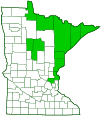
Forest locust is a small, flightless, spur-throated grasshopper. It occurs in North America in the United States from Pennsylvania to Virginia, west to Minnesota and Iowa, and in Canada from southern Quebec to southern Manitoba. Adults are found from July to September in moderately moist to moderately dry forests, on shaded edges, openings, and trails. Colonies are usually small and scattered. It has protected status in Wisconsin, where it is listed as a Special Concern species. It is not given protected status in Minnesota.
Forest locust is one of a group of five nearly identical species (Mancus Species Group) that can be distinguished only by their distribution and by details of the male reproductive structures.
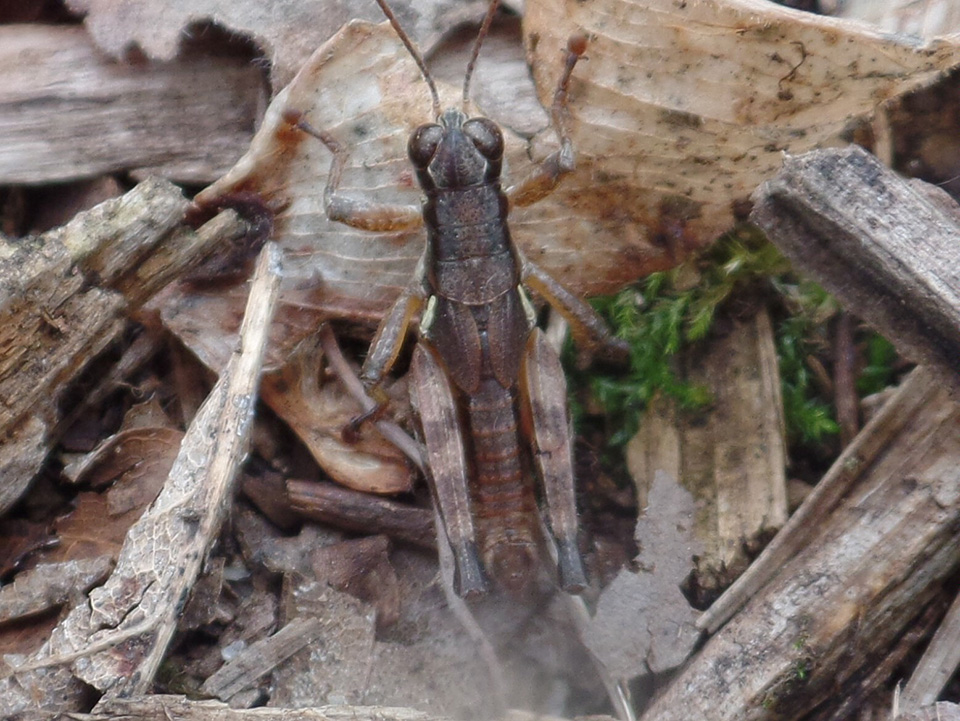
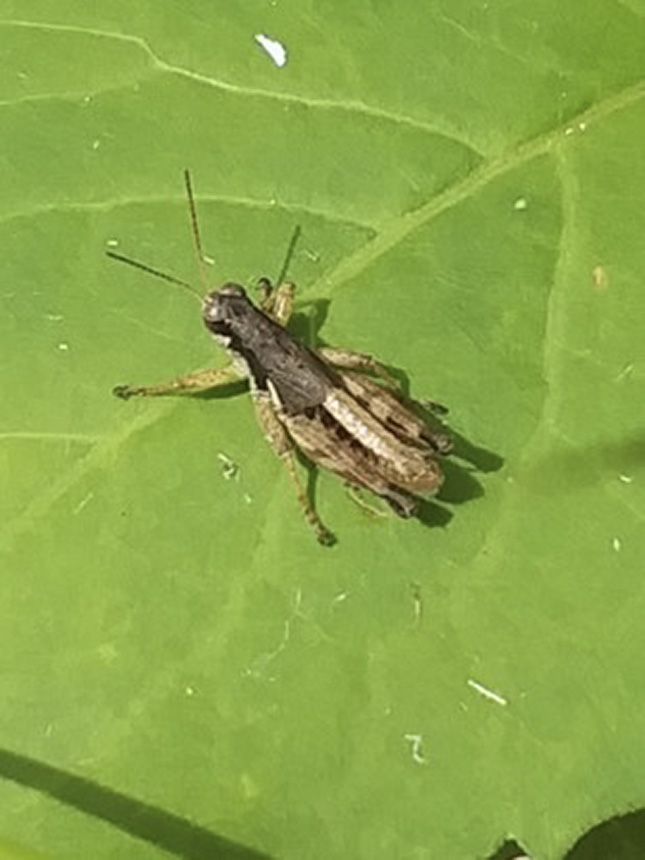
The head is not large, but it is slightly wider than the exoskeletal plate covering the thorax (pronotum). The top of the head is rounded in profile. The face is nearly vertical and pale greenish or yellowish. The antennae are no more than one-half the length of the body. There is a well-developed black stripe behind each compound eye that continues through the pronotum to the second abdominal segment.
The body color is brownish to blackish above with some greenish below. The pronotum is saddle-shaped, flat above with the sides abruptly angled downward. The upper side is blackish-brown, the sides are pale greenish at the bottom. The rear margin is broadly rounded. There is a distinct, spiny bump (spur) below at the base of the neck, between the base of the forelegs.
A broad, pale, greenish or yellowish stripe on the upper side of the abdomen runs the length of the abdomen. There are no contrasting cross bands. The first abdominal segment has a pair of flat, round, hearing organs (tympani) on the sides. The sensory appendages at the end of the abdomen (cerci) are not boot shaped. On the female the ovipositor is short.
The forewings (tegmina) are uniformly dark, broadly rounded, and very short, not extending past the rear edge of the second abdominal segment. They are about three-fourths the length of the pronotum. The edges are not rolled inward. The inner edges at the base are well separated, 1⁄32″to ⅛″ (1 to 3 mm) apart. The hindwings are clear.
On the hind pair of legs, the fourth segment (tibia) is usually pinkish, sometimes bright red. On all of the legs, the end section corresponding to the foot (tarsus) has three segments.
Size
Male: ½″ to ⅝″ (13 to 15 mm)
Female: ⅝″ to ⅞″ (17 to 21 mm)
Similar Species
Habitat
Forests edges and openings
Ecology
Season
July to September
Behavior
Life Cycle
Eggs overwinter
Nymph Food
Adult Food
Distribution
Sources
Biodiversity occurrence data published by: Minnesota Biodiversity Atlas (accessed through the Minnesota Biodiversity Atlas Portal, bellatlas.umn.edu. Accessed 1/17/2026).
Haarstad, J. 1990. The Acrididae of Minnesota. Final report submitted to the Minnesota Department of Natural Resources. 28 pp.
Hebard, Morgan. (1932). The Orthoptera of Minnesota. University of Minnesota. Minnesota Agricultural Experiment Station. Retrieved from the University of Minnesota Digital Conservancy, https://hdl.handle.net/11299/204015.
Occurrence
Scattered, not common
Taxonomy
Order
Orthoptera (Grasshoppers, Crickets, and Katydids)
Suborder
Caelifera (Grasshoppers, Locusts, and Allies)
Infraorder
Acrididea (Grasshoppers)
Superfamily
Acridoidea (Short-horned Grasshoppers and Locusts)
Family
Acrididae (Short-horned Grasshoppers)
Subfamily
Melanoplinae (Spur-throated Grasshoppers)
Tribe
Melanoplini
Genus
Subordinate Taxa
Synonyms
Melanoplus abortivus
Melanoplus mancus islandicus
Common Names
forest locust
island locust
island short-wing grasshopper
Photos
Visitor Photos
Share your photo of this insect.
This button not working for you?
Simply email us at info@MinnesotaSeasons.com.
Attach one or more photos and, if you like, a caption.
Luciearl
Minnesota Seasons Photos
Slideshows
Slideshows
Videos
Visitor Videos
Share your video of this insect.
This button not working for you?
Simply email us at info@MinnesotaSeasons.com.
Attach a video, a YouTube link, or a cloud storage link.
Other Videos
Sightings
Visitor Sightings
Report a sighting of this insect.
This button not working for you?
Simply email us at info@MinnesotaSeasons.com.
Be sure to include a location.
Luciearl
7/3/2022
Location: Fairview Twp, Cass County
Luciearl
9/28/2020

Location: Cass County
Minnesota Seasons Sightings