Summer fishfly
(Chauliodes pectinicornis)
Information
Conservation • Description • Habitat • Ecology • Distribution • Taxonomy
Conservation Status
IUCN Red List
not listed
NatureServe
NNR - Unranked
Minnesota
not listed
Description
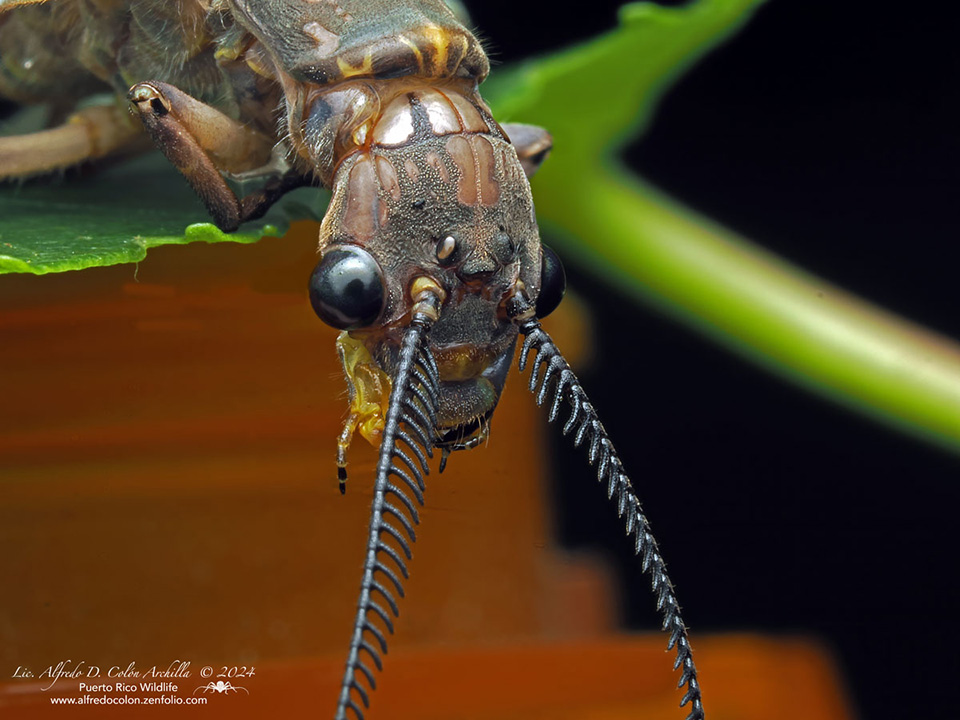
Summer fishfly is a large, short-lived, primitive-looking, winged insect. It occurs in the United States and southern Canada east of the Great Plains. It is uncommon in Minnesota, where it reaches the western extent of its range.
Larvae are found in a variety of aquatic habitats, including ponds, swamps, marshes, and springs. They take one to five years to reach maturity. They feed on both algae and small invertebrates, including crustaceans, clams, worms, and other insects.
Adults are found from late May to early July near larval habitats. They live only a few days to a week. They are active at dusk but remain hidden during the day. It is thought that they do not feed, though they have been collected in moth traps.
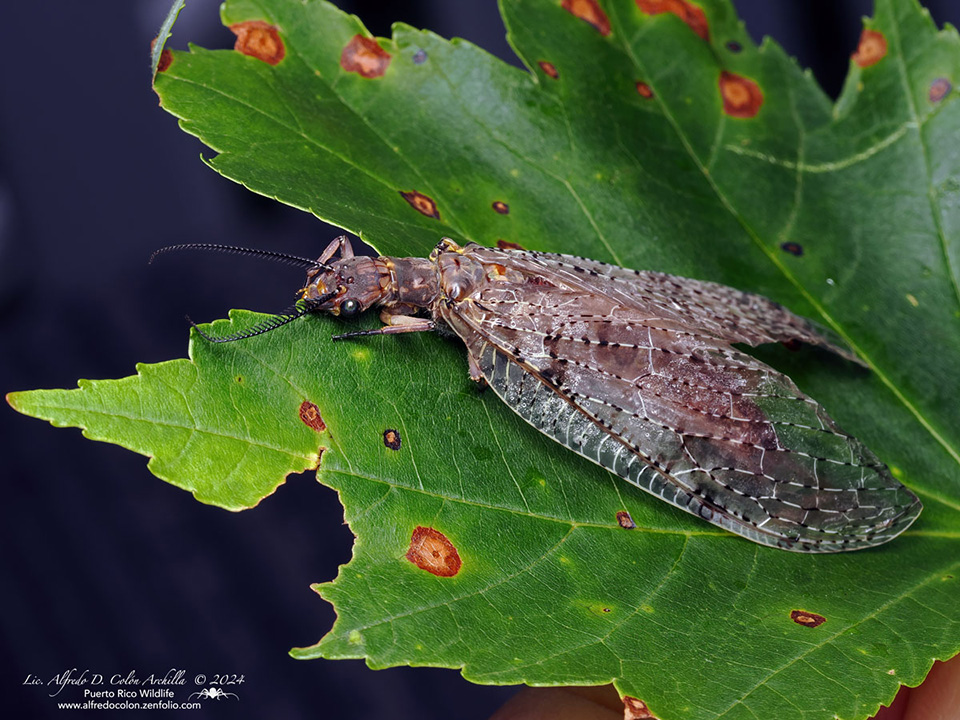
Adults are brownish-gray, 1⅜″ to 2″ (35 to 50 mm) in length, and have a wingspan of 2½″ to 3⅛″ (63 to 80 mm).
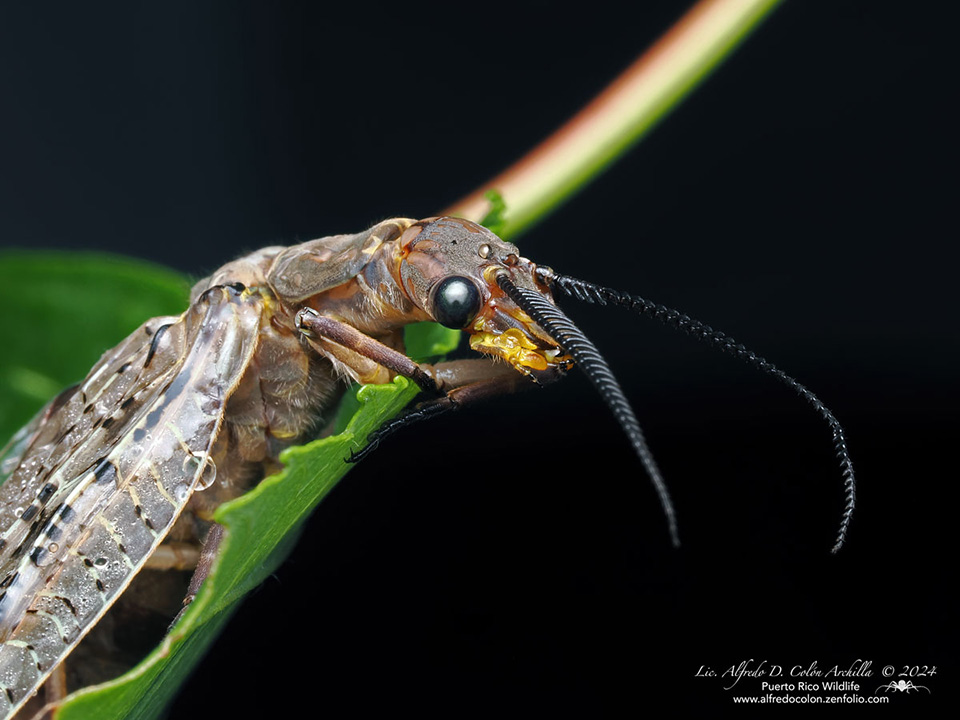
There are two large compound eyes on the sides of the head and three small simple eyes (ocelli) in a triangle on top of the head. The antennae are long, dark brownish-gray, and have many segments. On both males and females, they are comb-like, with a long branch on one side of each segment (pectinate). The mouthparts are adapted for chewing. The jaws (mandibles) on both sexes are always shorter than the length of the head. The back of the head (occiput) is dark brown with yellowish markings. On each side of the occiput there is a blotchy stripe in the middle (middorsal), a stripe on each side, and four short streaks between.
The thorax has three segments. It is brownish gray with dark brown to black markings and a few small yellow spots. The first segment (prothorax) is rectangular and slightly narrower than the head. It is brownish gray above with dark brown to black markings, including a large dark spot on each side.
The abdomen has ten segments. When viewed from the side the anal plate on the last segment is triangular.
The wings are delicate and very long, much longer than the body. They are clear and tinted pale brown, with no dark or white markings apart from the veins. The veins on the forewing are dark interrupted with white, appearing irregularly dashed. There are many slender cross veins near the leading edge (costal area). The media (M) vein has two branches, both of which reach the wing margin.
The hindwings are pleated, allowing them to be folded over the abdomen when at rest. The veins are mostly medium brown. Only the vein on the leading edge (costal margin) is dashed dark and white like the forewing.
The legs may be mostly yellowish or entirely dark. The last part of the leg (tarsus), corresponding to the foot, has 5 segments and is always dark. The fourth tarsal segment is cylindrical, not dilated.
Size
Total length: 1⅜″ to 2″ (35 to 50 mm)
Wingspan: 2½″ to 3⅛″ (63 to 80 mm)
Similar Species
Spring fishfly (Chauliodes rastricornis) head markings are dark on a light brown background. Female antennae are serrate, not pectinate. It typically flies in the spring. It is very common in Minnesota.
Habitat
A variety of aquatic habitats, including ponds, swamps, marshes, and springs
Ecology
Season
June and July in Minnesota (iNaturalist.org), May to August elsewhere
Behavior
Adults are active at dusk but remain hidden during the day. The wings are held roof-like and to the side of the abdomen when at rest. They are relatively weak fliers.
Life Cycle
The larva takes 1 to 5 years to reach maturity. After reaching maturity, it crawls onto land and pupates in moist soil under a log or rock. Adults emerge in the spring and live only a few days to a week.
Larva Food/Hosts
Algae and small invertebrates, including crustaceans, clams, worms, and other insects.
Adult Food
Adults probably do not feed.
Distribution
Occurrence
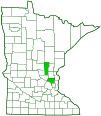
Common in eastern U.S., uncommon in Minnesota.
Taxonomy
Order
Megaloptera (Alderflies, Dobsonflies, Fishflies)
Family
Corydalidae (Dobsonflies and Fishflies)
Subfamily
Chauliodinae (Fishflies)
Genus
Chauliodes (Spring and Summer Fishflies)
Subordinate Taxa
Synonyms
Chauliodes virginiensis
Chauliodus virginiensis
Hemerobius pectinicornis
Hemerobius virginiensis
Hermes pectinicornis
Semblis pectinicornis
Common Names
summer fishfly
Photos
Visitor Photos
Share your photo of this insect.
This button not working for you?
Simply email us at info@MinnesotaSeasons.com.
Attach one or more photos and, if you like, a caption.
Minnesota Seasons Photos
Slideshows
Slideshows
Summer Fishfly (Chauliodes pectinicornis)
Andrée Reno Sanborn
Videos
Visitor Videos
Share your video of this insect.
This button not working for you?
Simply email us at info@MinnesotaSeasons.com.
Attach a video, a YouTube link, or a cloud storage link.
Other Videos
Just me, holding a Summer Fishfly (Chauliodes pectinicornis)
ParisVaughn
Larva of a Summer Fishfly AKA Hellgrammite (Chauliodes pectinicornis)
Nature in Motion
Fishfly (Chauliodes pectinicornis)
iPhoneEntomologist
Sightings
Visitor Sightings
Report a sighting of this insect.
This button not working for you?
Simply email us at info@MinnesotaSeasons.com.
Be sure to include a location.
Alfredo Colon
6/23/2024

Location: Albany, NY
Minnesota Seasons Sightings