Marsh meadow grasshopper
(Pseudochorthippus curtipennis)
Information
Conservation • Description • Habitat • Ecology • Distribution • Taxonomy
Conservation Status
IUCN Red List
not listed
NatureServe
N5 - Secure
Minnesota
not listed
Description
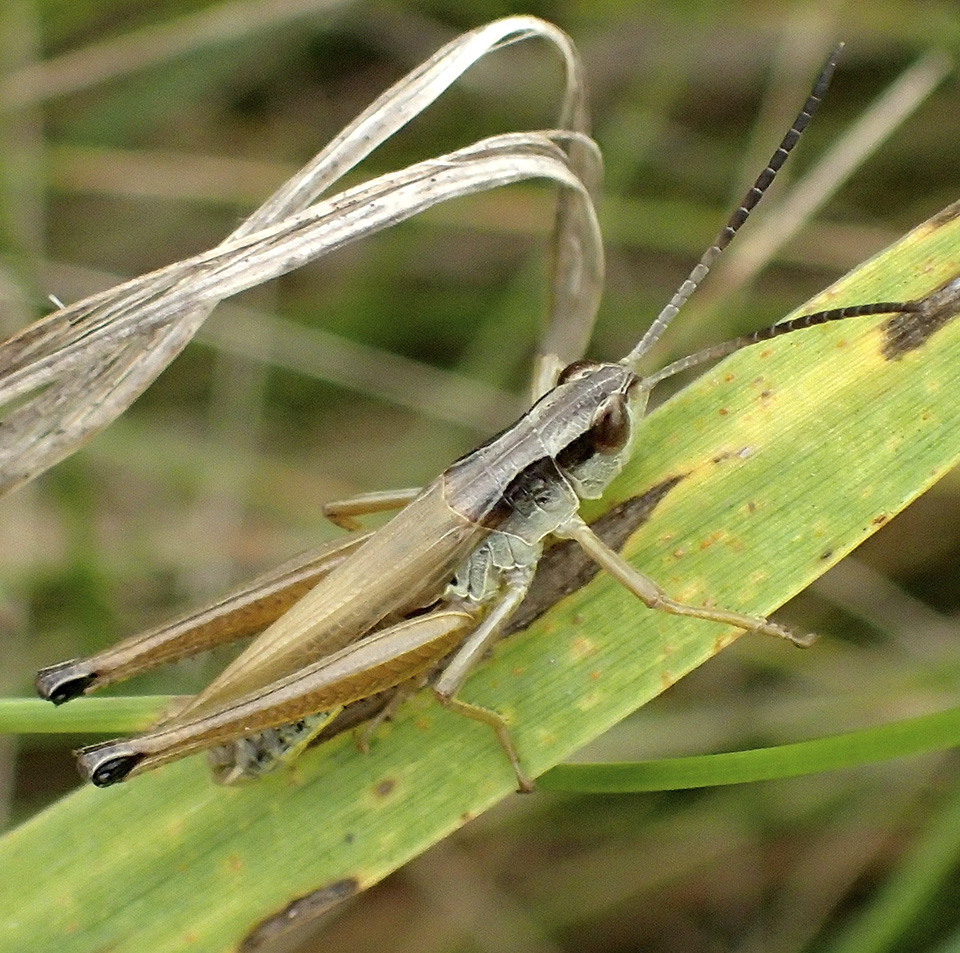
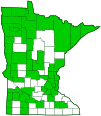
Marsh meadow grasshopper is a common, medium-small, stridulating, slantface grasshopper. It occurs in southern Canada and in the northern two-thirds of the United States. It is common throughout Minnesota. It is found from July through October or to the first frost in wet prairies, damp meadows, open woodlands, streamsides, roadside ditches, and moist depressions in fields (swales).
The female is ⅝″ to 15⁄16″ (15 to 24 mm) in length. The male is smaller, ½″ to ⅝″ (13 to 15 mm) in length.
The top of the head is triangular when viewed from the side, narrowly angled on the male, more broadly angled on the female. The face is distinctly slanted. On the upper part of the forehead (fastigium), there is a small but distinct narrow, oblong impression (foveola) on each side. The foveolae are visible when viewed from above. The antennae are flattened near the base. On the female they are shorter than the length of the head and front part of the body (pronotum) combined. On the male they are longer and thickened.
The body is slender and compressed. The color is highly variable. The upper side is usually light brown. The pronotum is saddle-shaped, flat above with the sides abruptly angled downward. A black bar on each side extends from behind the compound eye across the top half of the side (lateral lobe) of the pronotum. The sides of the body, the face, and the lower half of the lobes of the pronotum may be green, brown, or gray. Each segment of the abdomen is banded with green and black. When viewed from the side, the sides of the body appear spotted with black. The underside of the abdomen is yellow.
The forewings (tegmina) are light brown, oval, and variable in length. They are about three-fourths the length of the abdomen on most females and reach the tip of the abdomen on most males, but they may be shorter or longer on either sex.
On the hind pair of legs, the outer face of the robust, third segment (femur) is not banded. The fourth segment (tibia) is usually yellow, rarely orange. It has a row of 12 or 13 spines on the outer margin. The spines, at least at the tip, are black. The “knees”, the end of the femur and base of the tibia, are black.
Size
Male: ½″ to ⅝″ (13 to 15 mm)
Female: ⅝″ to 15⁄16″ (15 to 24 mm)
Similar Species
Habitat
Wet prairies, damp meadows, open woodlands, streamsides, roadside ditches, and swales
Ecology
Season
July to October (CCESR)
Behavior
Life Cycle
Nymph Food
Adult Food
Grasses and sedges
Distribution
Sources
Biodiversity occurrence data published by: Minnesota Biodiversity Atlas (accessed through the Minnesota Biodiversity Atlas Portal, bellatlas.umn.edu. Accessed 1/19/2026).
Haarstad, J. 1990. The Acrididae of Minnesota. Final report submitted to the Minnesota Department of Natural Resources. 28 pp.
Hebard, Morgan. (1932). The Orthoptera of Minnesota. University of Minnesota. Minnesota Agricultural Experiment Station. Retrieved from the University of Minnesota Digital Conservancy, https://hdl.handle.net/11299/204015.
Occurrence
Common throughout Minnesota
Taxonomy
Order
Orthoptera (Grasshoppers, Crickets, and Katydids)
Suborder
Caelifera (Grasshoppers, Locusts, and Allies)
Infraorder
Acrididea (Grasshoppers)
Nanorder
Acridomorpha
Superfamily
Acridoidea (Short-horned Grasshoppers and Locusts)
Family
Acrididae (Short-horned Grasshoppers)
Subfamily
Gomphocerinae (Slant-faced Grasshoppers)
Tribe
Gomphocerini
Genus
Pseudochorthippus
Superspecies
parallelus
Genus
This species was formerly classified as Chorthippus curtipennis. A recent molecular phylogenetic analysis of the parallelus group of the genus Chorthippus (Default, 2012) showed that the group is closer to Omocestus and Stenobothrus than to Chorthippus, and proposed placing the group in the new genus Pseudochorthippus.
Subordinate Taxa
marsh meadow grasshopper (Pseudochorthippus californicus)
marsh meadow grasshopper (Pseudochorthippus curtipennis) 
Synonyms
Chorthippus curtipennis
Locusta curtipennis
Stenobothrus acutus
Common Names
marsh meadow grasshopper
marsh meadow locust
meadow grasshopper
Photos
Visitor Photos
Share your photo of this insect.
This button not working for you?
Simply email us at info@MinnesotaSeasons.com.
Attach one or more photos and, if you like, a caption.
Babette Kis
Minnesota Seasons Photos
Slideshows
Slideshows
Marsh Meadow Grasshopper
Kingston Field Naturalists
Videos
Visitor Videos
Share your video of this insect.
This button not working for you?
Simply email us at info@MinnesotaSeasons.com.
Attach a video, a YouTube link, or a cloud storage link.
Other Videos
Marsh Meadow Grasshopper (Chorthippus curtipennis) stridulating
Andalyne Tofflemire
Sightings
Visitor Sightings
Report a sighting of this insect.
This button not working for you?
Simply email us at info@MinnesotaSeasons.com.
Be sure to include a location.
Babette Kis
9/15/2022
Location: Barnes Prairie remnant, Racine Co., WI
Minnesota Seasons Sightings