Sources
Biodiversity occurrence data published by: Minnesota Biodiversity Atlas (accessed through the Minnesota Biodiversity Atlas Portal, bellatlas.umn.edu. Accessed 12/25/2025).




(Enallagma annexum)
Conservation • Description • Habitat • Ecology • Distribution • Taxonomy
LC - Least Concern
N5 - Secure
SNR - Unranked
not listed
Northern bluet is a common and widespread, early season, blue-type bluet. It occurs across North America from Quebec to Alaska south to Virginia and Baja Mexico, but is absent from the southeast and south-central United States. It is common in Minnesota. It is found from late May to mid-August in marshes, bogs, and fens, on seasonal pools in the spring, and on shallow ponds with much vegetation.
Northern bluet is a small damselfly but a medium-sized bluet. Adults are 1″ to 1 9⁄16″ (26 to 40 mm) in length.
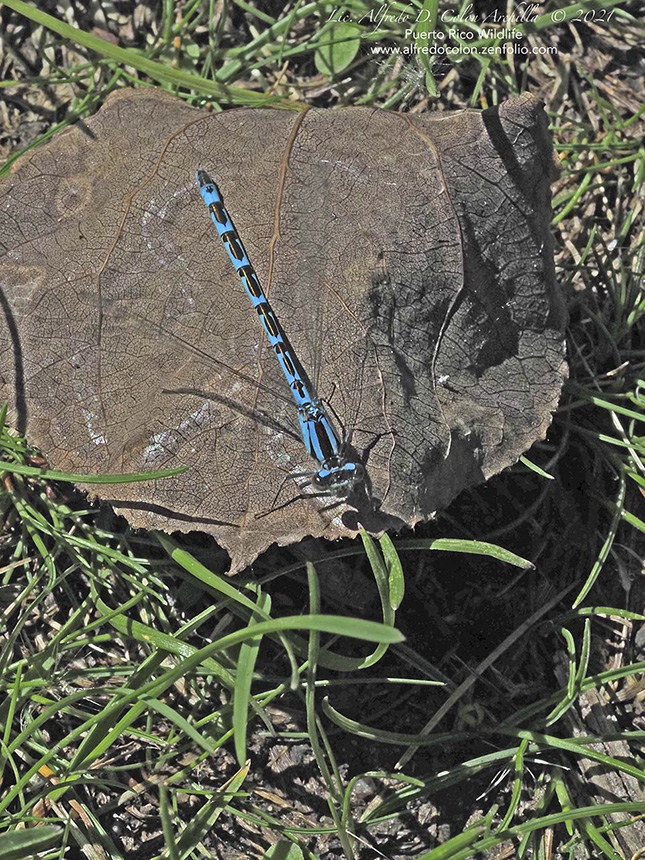
The thorax of the male has a broad black stripe on the upper side, a broad blue stripe each side of the middle, thin black shoulder stripes, and entirely blue sides.
The abdomen is slender and mostly blue. This is the feature that identifies this damselfly as a blue-type bluet. Abdominal segments 2 through 5 are mostly blue, 6 and 7 are mostly black, and 8 and 9 are entirely blue.
The head is black. The compound eyes are blue. Two blue spots on top of the head, one behind each eye, are very large, almost touching the eye.
The wings have a narrow, stalk-like base. They are clear except for a single dark cell (stigma) near the tip. The stigma is short and diamond-shaped.
The legs are slender and relatively short.
On the female the thorax markings are similar to the male but the pale areas are pale blue to greenish-yellow. The upper side of the abdomen is mostly black. There is often a pair of pale spots on top of abdominal segment 8.
Total length: 1″ to 1 9⁄16″ (26 to 40 mm)
Marshes, bogs, fens, vernal pools, shallow ponds
Late May to mid-August
Northern bluet, like all bluets, is a weak flier. It will fly a short distance from vegetation to capture prey. The wings are held over the body when at rest.
The female deposits eggs on the water while in tandem with the male, or inserts eggs in the submerged stems of vegetation while the male perches nearby. While doing this she may remain underwater for up to 90 minutes. The larvae spend a year underwater. Late stage (instar) larvae overwinter. Adults emerge in the spring.
Mosquito larvae, mayfly larvae, and other aquatic fly larvae
Tiny insects
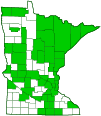
Common and widespread
Order
Odonata (Dragonflies and Damselflies)
Suborder
Superfamily
Coenagrionoidea
Family
Coenagrionidae (Narrow-winged Damselflies)
Genus
Enallagma (Bluets)
Aenallagma robustum
Agrion annexum
Enallagma robustum
northern bluet
Glossary
Stigma
In plants, the portion of the female part of the flower that is receptive to pollen. In Lepidoptera, an area of specialized scent scales on the forewing of some skippers, hairstreaks, and moths. In other insects, a thickened, dark, or opaque cell on the leading edge of the wing.
Species Status
Northern bluet was formerly included with vernal bluet as Enallagma cyathigerum. Recent research confirms that these are separate species. The two species cannot be differentiated in the field. Males are identified by microscopic examination of the genitalia. Northern bluet occurs only in North America. Vernal bluet occurs only in Europe and Asia.
This button not working for you?
Simply email us at info@MinnesotaSeasons.com.
Attach one or more photos and, if you like, a caption.


This button not working for you?
Simply email us at info@MinnesotaSeasons.com.
Attach a video, a YouTube link, or a cloud storage link.
Wandering Sole Images

This button not working for you?
Simply email us at info@MinnesotaSeasons.com.
Be sure to include a location.
5/30 to 6/1/2021
Location: Woodbury, MN