Sulphur-winged grasshopper
(Arphia sulphurea)
Information
Conservation • Description • Habitat • Ecology • Distribution • Taxonomy

Conservation Status
IUCN Red List
not listed
NatureServe
N5 - Secure
Minnesota
not listed
Description
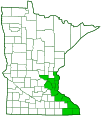
Sulphur-winged grasshopper is a small, early season, band-winged grasshopper. It occurs in the United States east of the Great Plains and in southern Ontario Canada. It reaches the western extent of its range in southeastern Minnesota. Adults are found from April to July in open woodlands with a grassy understory, in prairies, and on roadsides. In Minnesota it is most common on sparsely vegetated sandy soils and on bluff prairies.
Female adults are robust, 1⅛″ to 1½″ (28 to 38 mm) in length, and pale brown to dark brown. Males are more slender and smaller, ⅞″ to 1¼″ (23 to 31 mm) in length.
The face is vertical. On the upper part of the head (vertex) there is a deep depression (concavity) in the middle and a shallow depression (foveola) on each side. The concavity is as wide as long and is divided beyond the middle by a curved, low but distinct, horizontal ridge. The front of the concavity is strongly ascending. The foveolae are large, shallow, and triangular to rhomboidal. The upper part of the forehead (fastigium) is very narrow in front. The plate on the upper face (frontal costa) is long and narrow. There are three small simple eyes (ocelli), one below each foveola (lateral ocelli) and one near the middle of the costa (median ocellus). The costa is strongly narrowed above where it meets the vertex. It is less than half as wide at the vertex than it is below the median ocellus.
The plate over the thorax (pronotum) is saddle-shaped and has a distinct longitudinal ridge (carina) in the middle. The carina is raised and sharply compressed. There is a single transverse groove (suculus) across the pronotum, but it does not cut through the carina. The lateral lobes of the pronotum are squared. The rear margin is extended backward and triangular. It does not extend over the abdomen or beyond the base of the wings. The front margin is extended forward and rounded or broadly angled. The surface of the pronotum is rough and wrinkled. On the underside of the thorax there is no spur between the front legs.
The forewings (tegmina) are long, leathery, and densely veined. When folded over the body the top is often pale. On the male there is often a yellowish band at the tip.
The hindwings are membranous and are folded fan-like when at rest. They are sulphur yellow with a broad, curved, black band on the outer margin. The band extends toward the wing base on the inner margin.
The coloration of the third segment (femur) of the hind leg is variable. It may be dark brown with a pale ring at the tip or have alternating dark and light bands. The fourth segment (tibia) is dark with a yellow ring at the base.
Size
Female total length: 1⅛″ to 1½″ (28 to 38 mm)
Male total length: ⅞″ to 1¼″ (23 to 31 mm)
Similar Species
Habitat
Open woodlands, prairies, roadsides, and bluff prairies; sparsely vegetated sandy soils
Ecology
Season
One generation per year: April to July
Behavior
When seeking a mate, males and sometimes females produce a crackling or buzzing sound (crepitation) when in flight.
Life Cycle
Nymphs overwinter
Nymph Food
Adult Food
Mostly grasses, especially Kentucky bluegrass, but also other forbs
Distribution
Sources
Biodiversity occurrence data published by: Minnesota Biodiversity Atlas (accessed through the Minnesota Biodiversity Atlas Portal, bellatlas.umn.edu. Accessed 1/19/2026).
Haarstad, J. 1990. The Acrididae of Minnesota. Final report submitted to the Minnesota Department of Natural Resources. 28 pp.
Hebard, Morgan. (1932). The Orthoptera of Minnesota. University of Minnesota. Minnesota Agricultural Experiment Station. Retrieved from the University of Minnesota Digital Conservancy, https://hdl.handle.net/11299/204015.
Occurrence
Taxonomy
Order
Orthoptera (Grasshoppers, Crickets, and Katydids)
Suborder
Caelifera (Grasshoppers, Locusts, and Allies)
Infraorder
Acrididea (Grasshoppers)
Nanorder
Acridomorpha
Superfamily
Acridoidea (Short-horned Grasshoppers and Locusts)
Family
Acrididae (Short-horned Grasshoppers)
Subfamily
Oedipodinae (Bandwing Grasshoppers)
Tribe
Arphiini
Genus
Arphia
Subordinate Taxa
Synonyms
Arphia sulphuria
Gryllus sulphureus
Locusta sulphureus
Oedipoda sulphureus
Tomonotus sulphureus
Common Names
spring yellow-winged grasshopper
spring yellow-winged locust
sulphur-winged grasshopper
Photos
Visitor Photos
Share your photo of this insect.
This button not working for you?
Simply email us at info@MinnesotaSeasons.com.
Attach one or more photos and, if you like, a caption.
Nancy Lundquist
Minnesota Seasons Photos
Slideshows
Slideshows
Videos
Visitor Videos
Share your video of this insect.
This button not working for you?
Simply email us at info@MinnesotaSeasons.com.
Attach a video, a YouTube link, or a cloud storage link.
Other Videos
Sulphur-winged Grasshopper (Acrididae: Arphia sulphurea) Nymph
Carl Barrentine
Carolina Grasshopper (Acrididae: Dissosteira carolina) on Gravel
Carl Barrentine
Sulphur-Winged Grasshopper
Macro World
Sightings
Visitor Sightings
Report a sighting of this insect.
This button not working for you?
Simply email us at info@MinnesotaSeasons.com.
Be sure to include a location.
Nancy Lundquist
6/27/2023
Location: West St. Paul, in Dakota County
I have never seen anything grasshopper-like that small. If I hadn't been picking up some pieces of a toad house my granddaughter made I would never have seen it.
Minnesota Seasons Sightings