eastern garter snake
(Thamnophis sirtalis sirtalis)
| Conservation Status | IUCN Red List |
LC - Least Concern |
 |
||||
NatureServe |
N5 - Secure S5 - Secure |
||||||
| Occurrence | Common |
||||||
| Habitat | Wide variety of habitats. Moist, grassy places. Forests, forest edges, prairies, meadows, and other areas near water. |
||||||
| Lifespan | 5 to 10 years |
||||||
| Size | 14″ to 48″ |
||||||
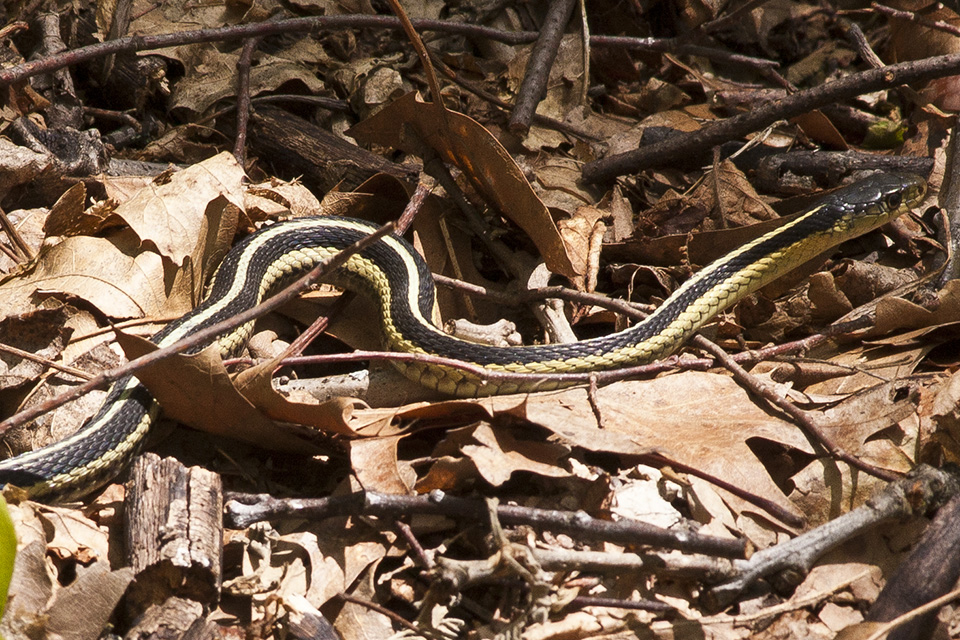
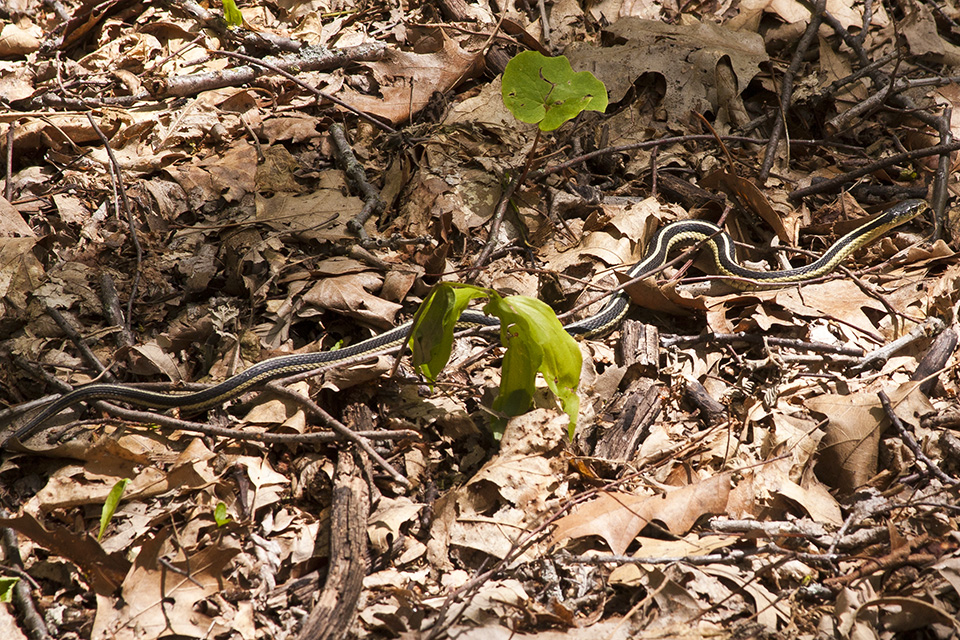
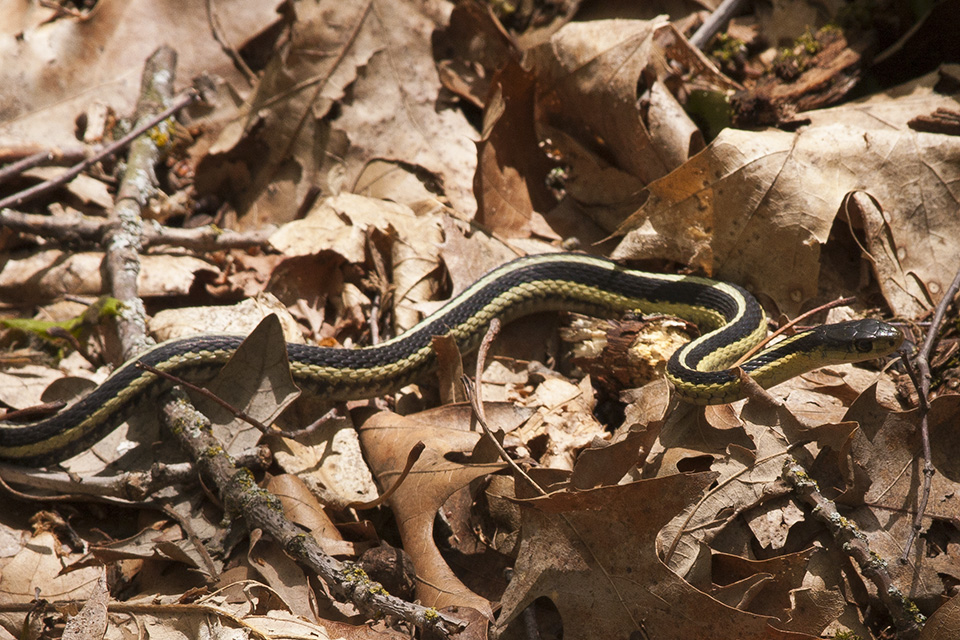
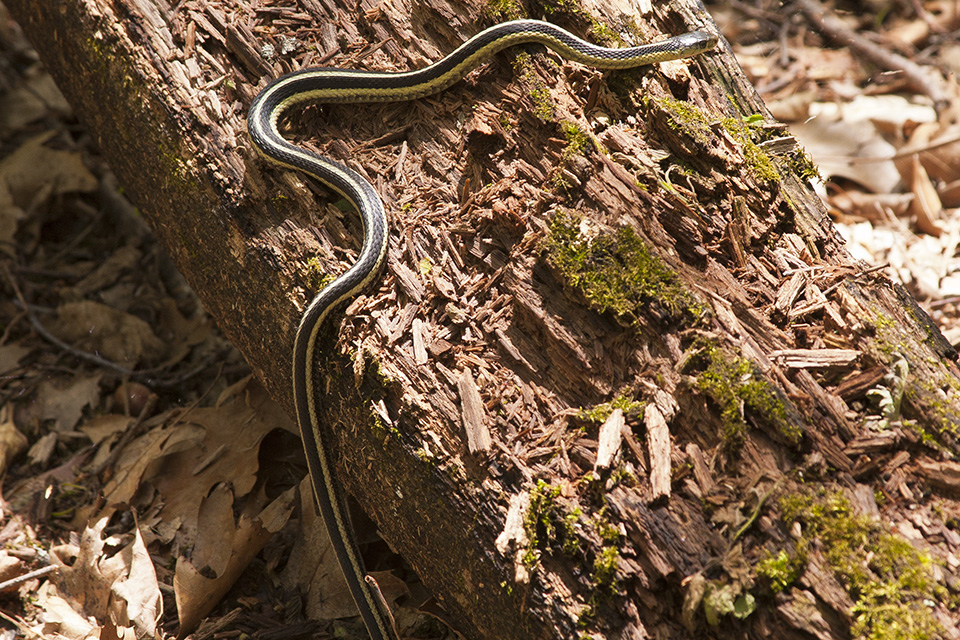
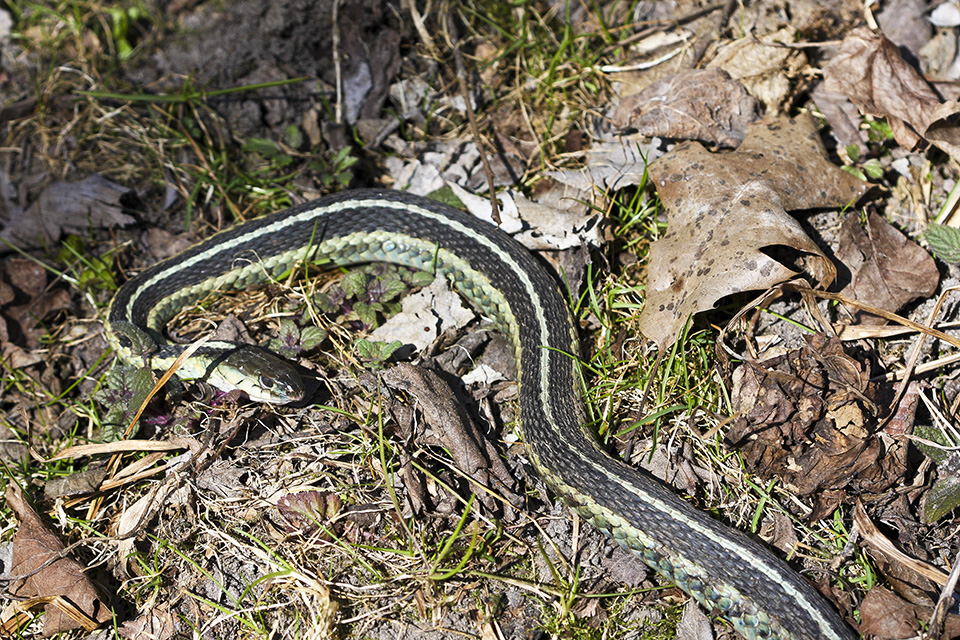
| Identification | This is a medium-sized, nonvenomous, typical snake. It is the most common snake in Minnesota. It can be from 14″ to 48″ long at maturity, though it is usually no more than 16″ in length. Males are slightly larger than females. The background color is variable and may be light brown to black or olive green. There are three pale stripes that run the length of the body. The central stripe is light yellow. The lateral stripes are cream-colored to pale yellowish, and are on the second and third scale rows counting up from the belly (ventral) scales. There are two rows of alternating black spots on each side between the central and lateral stripes. The spots may be prominent and invade the stripes, or may be obscured on dark colored individuals. Red skin may be visible between the scales when it stretched over recently consumed prey, but there are no red scales. At mid-body there are 19 to 21 rows of scales. The upper (dorsal) and lateral scales have a narrow raised ridge (keel) along the centerline. The belly is white and may be tinted yellowish or bluish. There is usually a row of small black spots at the ends of the ventral scales. These spots are partially hidden by overlapping ventral scales. The anal plate is not divided. Underneath the tail there are two rows of scales (subcaudal scales). The head and neck are uniformly dark usually with a pair of yellow spots. The scales above the mouth (labial scales) are the same color as the lateral stripe. Sometimes at most one or two labial scales have a bold black border. |
||||||
| Similar Species |
Plains garter snake (Thamnophis radix) lateral pale stripes are on the third and fourth scale rows counting up from the ventral scales. All labial scales have a bold black border. Lined snake (Tropidoclonion lineatum) is much shorter, only 8″ to 12″ long at maturity. The 3 stripes are off-white. There are 2 rows of dark, half-moon marks on the belly. In Minnesota it has been found only in Blue Mounds State Park. Red-sided garter snake (Thamnophis sirtalis parietalis) has bold red bars or spots on the side between the dorsal and lateral scales. |
||||||
| Food | Earthworms, amphibians, leeches, slugs, snails, insects, crayfish, small fish, bird eggs, mice, other snakes, and carrion. |
||||||
| Life Cycle | Overwintering plains garter snakes emerge from their overwintering sites in March. Females reach sexual maturity in 2 or 3 years. Breeding takes place in April or May. Gestation takes 83 to 102 days. In July to September the female gives birth to a litter of 4¾″ to 9½″ long, live young. The litter size is usually 10 to 20 but may be as few as 5 or as many as 60. The young are on their own from the day of their birth. In late October they gather in large numbers, sometimes with other species of snakes, in rodent burrows, abandoned ant mounds, or under sidewalks, to overwinter. As the temperature drops they enter a state of suspended animation (brumation). |
||||||
| Behavior |
|
||||||
| Distribution |  |
Sources: 7, 11, 13, 14. | |||||
| Comments | This is one of the most common snakes in Minnesota. |
||||||
| Taxonomy | Order: |
Squamata (amphisbaenians, lizards, and snakes) |
|||||
Suborder: |
Scleroglossa |
||||||
Infraorder: |
Serpentes (snakes) |
||||||
Superfamily: |
Colubroidea |
||||||
Family: |
Colubridae (colubrids, typical snakes) |
||||||
Subfamily: |
Natricinae |
||||||
| Synonyms | Coluber sirtalis |
||||||
| Common Names |
common garter snake eastern garter snake |
||||||

anal plate
In snakes: the large scale in front of and covering the anus. In turtles: one of the posterior plates of the lower shell (plastron). In Lepidoptera: the often hardened shield on the dorsal surface of the last (10th) segment of the abdomen.
ventral scales
On snakes, the row of enlarged, elongated scales extending on the belly from the neck to the anal plate.
Visitor Photos |
|||
Share your photo of this species. |
|||
MinnesotaSeasons.com Photos |
|||
 |
 |
||
|
 |
||
 |
 |
||
 |
|||

Slideshows |
||

Visitor Videos |
||
Share your video of this species. |
||
Other Videos |
||
| Wild Thamnophis sirtalis sirtalis eating Bufo americanus!! 1 June 2013 FlapsMemoir |
||
About
Published on Sep 20, 2013 This is actually six (6) varying, but related—save an adorable, happy ending—videos pasted together, but the feeding segment starts at the 2:04 mark and is most of the video. I strongly encourage You to read my notes below, too; some are just short clarifications of my lazy articulation or when I can't be heard well, while others—such as the 3:37 and 5:34 notes—detail elaborations, knowledge and trivia. I am nervous when on camera, even just speaking and not seen, especially when something as exciting or a first-time event like this is going on, so I cannot think clearly and leave a lot out and am not able to utilize my technical terminology well. Thanks, and enjoy!! 1:26 -- '...a good reference to my knee, my hand...' and fat *near* the tail; not 'fat tail', haha. Having watched this video a few times now, this specimen may have just been inflated/flattened to appear more threatening (defensive), and thus, either gender is possible (and therefore not necessarily a gravid female). 3:37 -- Where I talk about the rear fangs (and the Duvernoy's gland essentially, I just didn't mention per se), and in particular: the misbelief of "puncturing and deflating toads", I would like to provide an excerpt of greater elaboration, from Linda Krulikowski's amazing book: Snakes of New England: "The [Duvernoy's] gland is composed of branched tubules rather than simple groupings of cells, and is situated immediately under the skin, above and near the angle of the jaw. It is derived from the same tissue as tooth enamel. The Duvernoy's gland opens by a duct at the base of the posterior, enlarged teeth. The secretions from the glands flow down the enlarged, rear teeth and into the prey, by the chewing motions of the snake. The secretions are introduced slowly into the victim, by indirect pressure from the nearby jaw-closing muscles (Green. 1997: 78-95). The secretions of Duvernoy's glands are colorless, whereas true [= Viperidae, Elapidae] venom glands secretions are typically some shade of yellow. These clear secretions immobilize the victim and help the snakes digest the prey." "The secretions are introduced slowly into the victim, by indirect pressure from the nearby jaw-closing muscles (Green. 1997: 78-95)." This is where it looks like not just Heterodon, but also Thamnophis and Nerodia, as can be seen at the 5:09-10 mark (starts opening at 5:06), are "puncturing and deflating toads." "These clear secretions immobilize the victim and help the snakes digest the prey." As stated in my video, this jaw-closing action is trying to immobilize the prey via injecting venom, but also to expedite/aid the digestion process. Trivia Bit #1: Rear-fanged serpents are technically called opisthoglyphous, or in the case of a few genera such as Leioheterodon, aglyphous. Trivia Bit #2: Nerodia spp. don't inject venom; they possess an anti-coagulant instead, which induces bleeding/prevents the wounds from clotting. Thus, the prey bleeds, and consequently 'faints', faster. Id est, it is still being immobilized. 5:34 -- Where I talk about the white [milky] substance, a toxin, produced by toads' parotoid glands to distaste, sicken or even kill would-be predators, which many other amphibians (including some newts) produce via different means, it is technically called Bufotoxin with Bufo spp., such as this B. americanus was producing against this Thamnophis sirtalis sirtalis. Parotoid [alternatively, paratoid] vs. Parotid. It is technically the former with toads and other amphibians, but many sources will speak "parotid" which is actually a salivary gland in humans. This is an ongoing funny mistake by many authors and sources. Just a little trivia for You. And please excuse my mispronunciation; being a musician, I utilize "artistic license" on many words in Life. ;) Thamnophis complex = North American Garter and Ribbon Snakes 8:38 -- 'She is definitely on-guard.' 8:44 -- 'Wo, hey, [just] trying to get some footage of You, Girl.' 9:43/9:46 -- The white powdery substance on my (left) hand was the serpent's feces/musk. 10:18 -- 'Head scales' is quite commonly used; however, "plates", which consist of many differently-named groups around the head, is more proper. In Hognose Snakes of all three genera, they also have azygous scales which are situated immediately behind the rostral scale (the one which gives them their "Hog" nose), and which separate the internasals and prefrontals. 10:34 -- [Thamnophis] sirtalis sirtalis (shame on me for leaving out the actual genus name :P) |
||
| Eastern Garter Snake (Thamnophis sirtalis sirtalis) tomb0171 |
||
About
Uploaded on May 30, 2010 Eastern Garter Snake (Thamnophis sirtalis sirtalis) * Family: Colubridae, ** Garter snakes (genus Thamnophis) are one of the most common of snakes. Found in a variety of habitats, they are often the first snake a youngster sees and catches. Varying according to species, garters are generally striped against a plain or checkered background color. Often delicately or subtly colored More info: http://www.fcps.edu/islandcreekes/eco... |
||
| Garter Snake Foreplay (Colubridae: Thamnophis sirtalis sirtalis) Carl Barrentine |
||
About
Published on Apr 14, 2012 Three smaller male Eastern garter snakes compete to seduce a larger, unresponsive female during an unseasonably warm and humid mid-April day. Photographed at Fisher, Minnesota (14 April 2012). |
||

Visitor Sightings |
||||
Share your sighting of this species. |
||||
MinnesotaSeasons.com Sightings |
||||
Avon Hills Forest SNA Beaver Creek Valley State Park |
Minnesota Valley NWR Minnesota Valley State Recreation Area |
|||
Last Updated: