Canadian beaver
(Castor canadensis canadensis)
| Conservation Status | IUCN Red List |
LC - Least Concern |
 |
||||
NatureServe |
N5 - Secure SNR - Unranked |
||||||
Minnesota |
not listed |
||||||
| Occurrence | Common |
||||||
| Habitat | Lodges built on islands, banks of ponds,and shores of lakes |
||||||
| Lifespan | 10 to 12 years |
||||||
| Size | Head and body: 25″ to 30″ Tail: 9″ to 10″ |
||||||
| Identification | This is the largest rodent in North America. The head and body length is The body is stout. The powerful hind legs are longer than the front legs so the rear end is higher than the front end when the beaver walks. The coat is reddish-brown or blackish-brown, glossy, and thick. The hind legs and have webbed feet. The claw on the second toe is doubled and functions as a comb. The skull is disproportionately large. There are 20 teeth, including disproportionately large upper and lower incisors. The incisors are ¾″ to 1″ long and about ¼″ wide, and have chestnut brown enamel. The ears and nostrils are closable. The tail is broad and flat—paddle shaped. It is 9″ to 10″ long, naked, and scaly. |
||||||
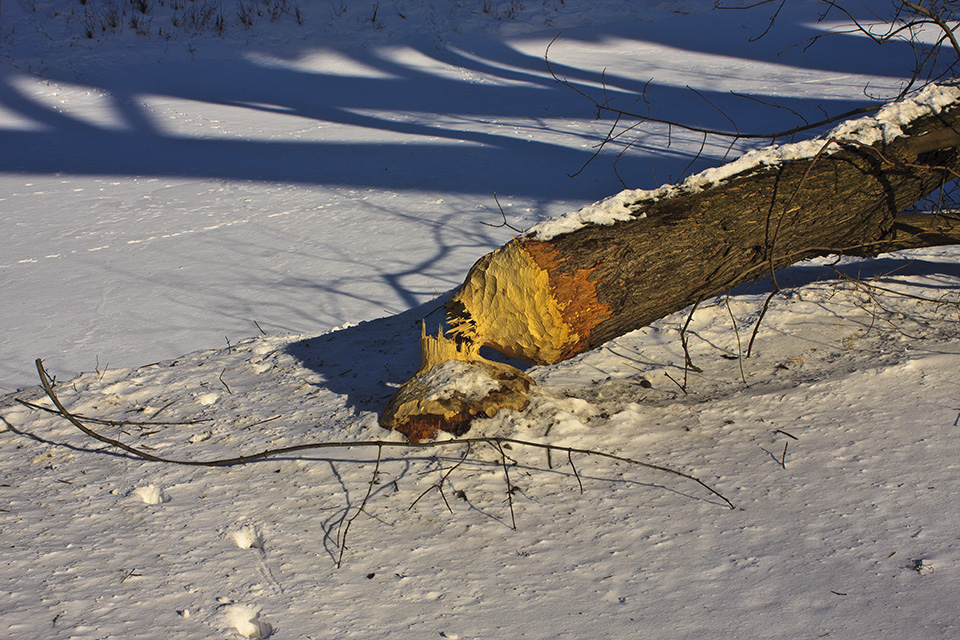
| Sign | Dams – A beaver will build a dam in a stream or river to slow the flow of water. Where sufficient stable water is available it will not build a dam but rather burrow into the bank. The front (downstream) side of a dam consists of large branches with the but ends facing downstream. Mud and debris make up the center of the dam. The back (upstream) side is made up of small branches. Lodges – A lodge is a large pile of branches covered with mud, debris, and aquatic vegetation. It can rise up to 10 feet above the pond floor. It is excavated from within. In the winter, vapor can often be seen rising from a thinly covered opening used for ventilation (smoke hole) at the top of the lodge. Lodges are usually built near or at the edges of lakes and ponds. Canals – A canal may be up to two feet wide and deep. It provides a safe water passage and can be used to help transport felled trees to the pond. Cut trees – After downing a tree or branch a beaver may completely strip the outer bark to get at the cambium. Tree stumps near pond edges may show ¼″ wide incisor marks. Scat – Beavers defecate in the water. |
||||||
| Similar Species |
The stout build, brown fur, and flat, broad, scaly tail make identification unmistakable. |
||||||
| Food | Bark, cambium, and small twigs of aspen, poplar, birch, maple, willow, beech, and alder. Aquatic vegetation. |
||||||
| Life Cycle | Beavers are mostly nocturnal, though they are occasionally seen during the day. They are usually found in colonies of 4 to 10 related individuals. Females usually breed first in their second year, sometimes in their third year. Gestation is 100 to 128 days. Between April and June the give birth to usually four or more kits, averaging five in Minnesota. The young remain with the parents until their second year, when they are either driven out or choose to leave. They usually relocate within six miles. The average life span is 11 years. |
||||||
| Behavior |
|
||||||
| Distribution |  |
Sources: 7, 13, 15. | |||||
| Comments | Subspecies |
||||||
| Taxonomy | Order: |
Rodentia (rodents) |
|||||
Suborder: |
Castorimorpha (beavers, gophers, kangaroo rats, pocket mice, and relatives) |
||||||
Family: |
Castoridae (beavers) |
||||||
Subfamily: |
Castorinae |
||||||
| Subordinate Taxa | Acadian beaver (Castor canadensis acadicus) Admiralty beaver (Castor canadensis phaeus) Bailey's beaver (Castor canadensis baileyi) Canadian beaver (Castor canadensis idoneus) Canadian beaver (Castor canadensis rostralis) Canadian beaver (Castor canadensis sagittatus) Carolina beaver (Castor canadensis carolinensis) Colorado beaver (Castor canadensis concisor) Colorado River beaver (Castor canadensis repentinus) Cook Inlet beaver (Castor canadensis belugae) Duchesne River beaver (Castor canadensis duchesnei) golden beaver (Castor canadensis subauratus) Labrador beaver (Castor canadensis labradorensis) Missouri River beaver (Castor canadensis missouriensis) Newfoundland beaver (Castor canadensis caecator) northeastern beaver (Castor canadensis canadensis) Pacific beaver (Castor canadensis leucodontus) pallid beaver (Castor canadensis pallidus) Rio Grande beaver (Castor canadensis mexicanus) Shasta Mt beaver (Castor canadensis shastensis) Sonora beaver (Castor canadensis frondator) Taylor's beaver (Castor canadensis taylori) Texas beaver (Castor canadensis texensis) Washington beaver (Castor canadensis pacificus) woods beaver (Castor canadensis michiganensis) |
||||||
| Synonyms |
|
||||||
| Common Names |
Canadian beaver |
||||||


cambium
A layer of softer growing tissue, one to several cells thick, under the bark of trees.
Visitor Photos |
|||
Share your photo of this species. |
|||
MinnesotaSeasons.com Photos |
|||
Animal |
|||
|
|||
Dam |
|||
 |
 |
||
 |
|||
Lodge |
|||
 |
|||
Sign |
|||
 |
 |
||

Slideshows |
||

Visitor Videos |
||
Share your video of this species. |
||
Other Videos |
||
| Curious Beaver (Castor Canadensis) - April's Video April Severin |
||
About
Uploaded on Jan 20, 2009 Beaver (Castor canadensis) tries to climb ashore on thin ice. Please note a point-and-shoot digicam was used for this video. Thanks. Video © April Severin |
||
| North American Beaver - Tail Slap @ Iron Mtn. JCVdude |
||
About
Uploaded on Sep 23, 2010 The beaver (genus Castor) is a primarily nocturnal, large, semi-aquatic rodent. Castor includes two extant species, North American Beaver (Castor canadensis) (native to North America) and European Beaver (Castor fiber) (Eurasia). Beavers are known for building dams, canals, and lodges (homes). They are the second-largest rodent in the world (after the capybara). Their colonies create one or more dams to provide still, deep water to protect against predators, and to float food and building material. The North American beaver population was once more than 60 million, but as of 1988 was 6--12 million. This population decline is due to extensive hunting for fur, for glands used as medicine and perfume, and because their harvesting of trees and flooding of waterways may interfere with other land uses. Beavers are known for their natural trait of building dams on rivers and streams, and building their homes (known as "lodges") in the resulting pond. Beavers also build canals to float build materials that are difficult to haul over land. They use powerful front teeth to cut trees and other plants that they use both for building and for food. In the absence of existing ponds, beavers must construct dams before building their lodges. First they place vertical poles, then fill between the poles with a crisscross of horizontally placed branches. They fill in the gaps between the branches with a combination of weeds and mud until the dam impounds sufficient water to surround the lodge. A beaver skeleton A beaver skeleton on display at The Museum of Osteology, Oklahoma City, Oklahoma. They are known for their alarm signal: when startled or frightened, a swimming beaver will rapidly dive while forcefully slapping the water with its broad tail, audible over great distances above and below water. This serves as a warning to beavers in the area. Once a beaver has sounded the alarm, nearby beavers dive and may not reemerge for some time. Beavers are slow on land, but are good swimmers that can stay under water for as long as 15 minutes. Beavers are herbivores, and prefer the wood of quaking aspen, cottonwood, willow, alder, birch, maple and cherry trees. They also eat sedges, pondweed, and water lilies. |
||
| North American Beaver.mov RDWildlife |
||
About
Uploaded on Oct 3, 2011 During our careers, we have spent a tremendous amount of time in and around beaver (Castor canadensis) habitat. While it has been very common to see beaver at a distance in the water, they generally reserve their land travels for night time. So yesterday, we were surprised and delighted to see this beaver just a few feet away browsing on willow. This stretch of the Rio Grande is currently dry, thereby causing this beaver to adapt to living alongside the highway in a small storm water drainage area. If you watch closely, you'll notice multiple bite marks and damage to the left eye. We believe he likely escaped one of our many native predators (no water, no protection). Our company provides non lethal beaver management solutions, call us today 505.818.7396 or visit www.rdwildlife.com to learn more. |
||

Visitor Sightings |
||||
Share your sighting of this species. |
||||
MinnesotaSeasons.com Sightings |
||||
Cannon River Turtle Preserve SNA |
Minnesota Valley NWR Minnesota Valley State Recreation Area |
|||
Last Updated: