Field pussytoes - Species Profile
Conservation • Wetland • Description • Habitat • Ecology • Use • Distribution • Taxonomy
Conservation Status
IUCN Red List
not listed
NatureServe
N5 - Secure
SNR - Unranked
Minnesota
not listed\
Wetland Indicator Status
Great Plains
FACU - Facultative upland
Midwest
UPL - Obligate upland
Northcentral & Northeast
UPL - Obligate upland
Description
Field pussytoes is an erect, perennial forb that rises on a basal rosette of leaves and a flowering stem from fibrous roots and stolons. It often forms colonies.
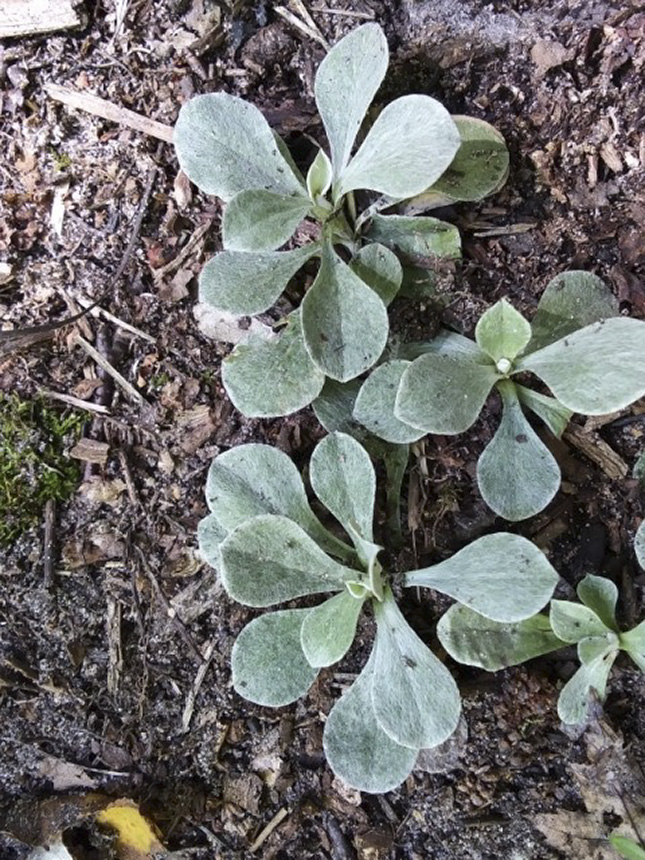
The stolons are 1″ to 7″ long, slender, densely wooly, and leafy. They recline on the ground with the tips ascending. They root at the nodes, forming new plants.
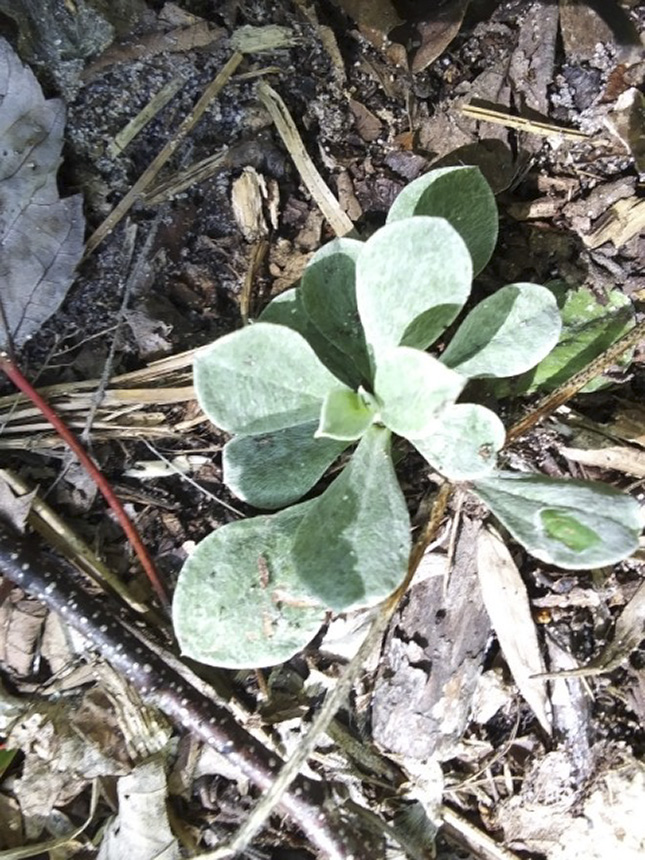
Basal leaves are narrowly inversely lance-shaped to narrowly inversely egg-shaped or narrowly spoon-shaped, 1″ to 2½″ long, and ¼″ to 11 ⁄16″ wide. They are rounded or broadly pointed at the tip, and have an abrupt, short, sharp point at the tip. They taper gradually to the leaf stalk at the base. The upper surface is gray and moderately to densely covered with short, matted or tangled, soft, woolly hairs. It becomes green and hairless or nearly hairless with age. The lower surface is densely covered with short, matted or tangled, soft, woolly hairs. The hairiness of the lower surface persists at maturity. There is 1 prominent vein extending from the base to the tip, visible at least on the underside. Occasionally there is also a faint pair of parallel lateral veins. The margins are untoothed.
Stem leaves are alternate, linear to narrowly oblong lance-shaped, and 5 ⁄16″ to 1″ long. They taper to a sharp point at the tip and attach to the stem at the base without a leaf stalk. The lowermost leaves are often narrowly inversely lance-shaped. Middle and upper leaves have a short, hairlike extension of the midvein at the tip. The upper and lower surfaces are densely covered with short, matted or tangled, soft, woolly hairs.
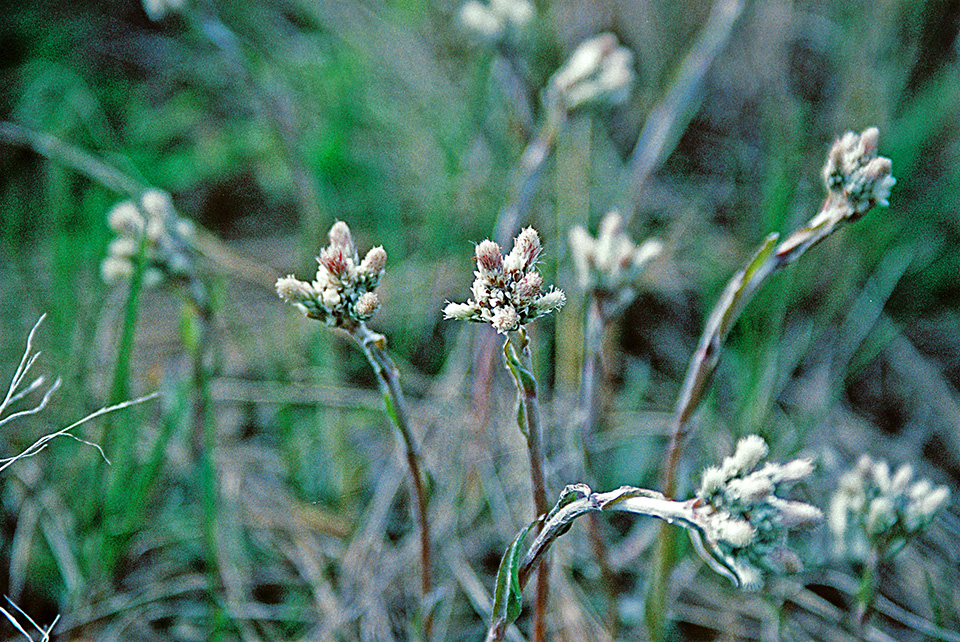
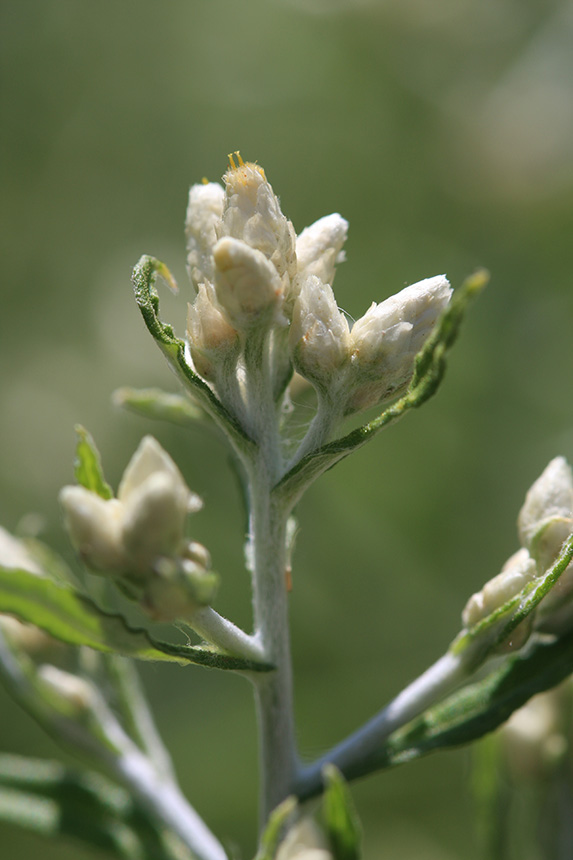
The flowering stem can be 1½″ to 12″ tall, though it usually reaches no more than 8″ in height. It is erect, sparsely leafy, and densely covered with white woolly hairs. It sometimes becomes hairless in patches with age. There are no purple glandular hairs near the top of the stem.
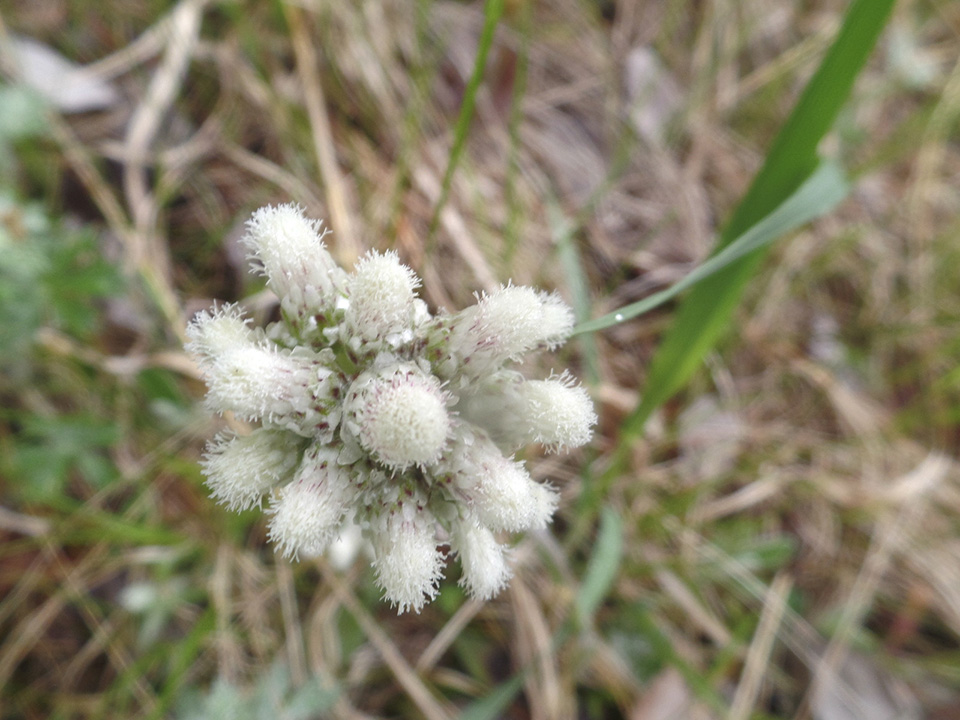
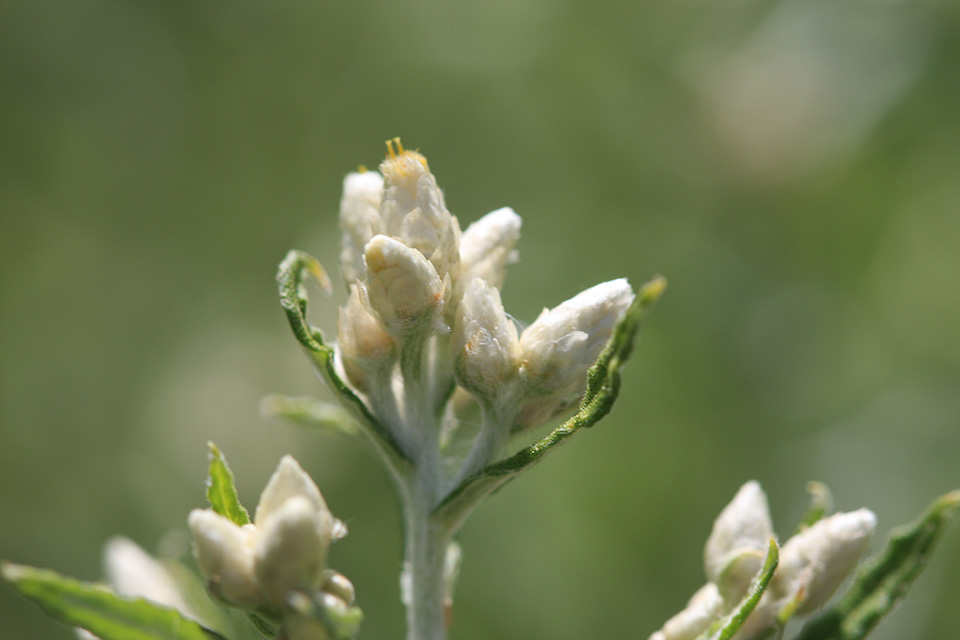
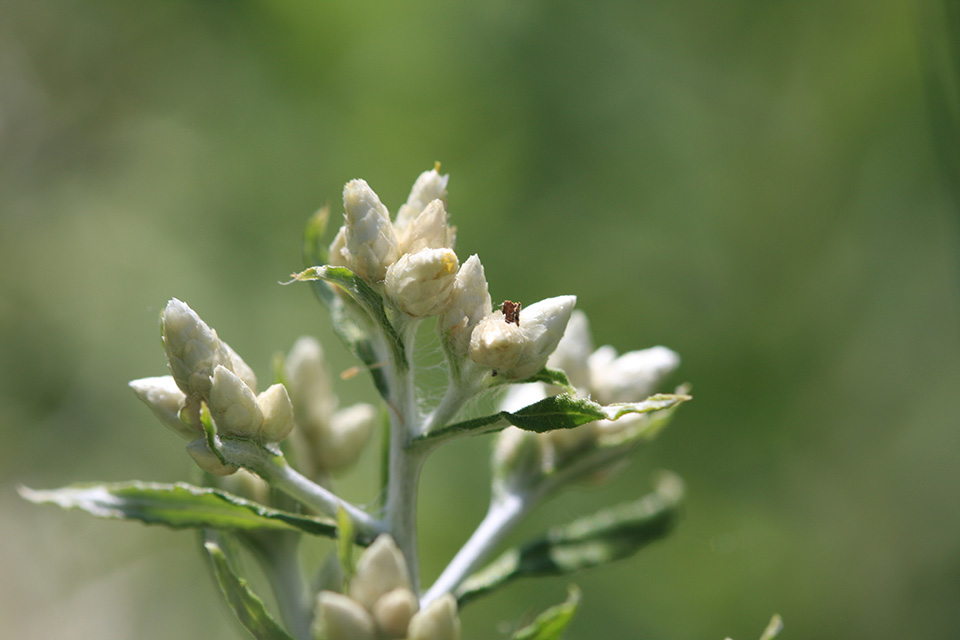
The inflorescence is a dense cluster of 2 to 8 flower heads at the end of the stem. Male and female flowers are borne on separate plants. A colony of plants may have all male plants or all female plants.
The whorl of bracts (involucre) subtending a male flower head is ⅛″ to ¼″ long. The involucre subtending a female flower head is ¼″ to ⅜″ long. The tips on the involucral bracts are white.
The flower head is ¼″ to ½″ in diameter. It has 20 to 100 or more white or yellow, tubular disk florets and no ray florets. Male florets are ⅛″ to 3 ⁄16″ long. They have 5 stamens with white filaments and brownish-purple anthers. The corollas are obscured by the numerous stamens. Female florets are ⅛″ to ¼″ long. They have one style with a forked, purplish tip. The corollas are obscured by the numerous styles. There is no floral scent.
The fruit is a small achene with hairs at the tip.
Height
1½″ to 8″
Flower Color
White or yellow
Similar Species
Parlin’s pussytoes (Antennaria parlinii) has a taller flowering stalk, up to 6″ tall. The basal leaves are longer and wider. They have 3 to 5 main, parallel veins that are prominent at least on the underside to the broadest part of the leaf.
Plantain-leaved pussytoes (Antennaria plantaginifolia) has shorter, wider, spoon-shaped basal leaves, each with 3 to 5 conspicuous veins. It's range in Minnesota is restricted to the southeast corner of the state.
Habitat
Dry to moderate moisture. Fields, woods, prairies.
Ecology
Flowering
April to June
Pests and Diseases
Use
Distribution
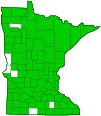
Sources
Biodiversity occurrence data published by: Minnesota Biodiversity Atlas (accessed through the Minnesota Biodiversity Atlas Portal, bellatlas.umn.edu. Accessed 2/13/2026).
Midwest Herbaria Portal. 2026. https://midwestherbaria.org/portal/index.php. Accessed 2/13/2026.
Antennaria neglecta Greene in GBIF Secretariat (2023). GBIF Backbone Taxonomy. Checklist dataset https://doi.org/10.15468/39omei accessed via GBIF.org. Accessed 2/13/2026.
Nativity
Native
Occurrence
Common
Taxonomy
Kingdom
Subkingdom
Pteridobiotina
Phylum
Tracheophyta (Vascular Plants)
Class
Order
Asterales (Sunflowers, Bellflowers, Fanflowers, and Allies)
Family
Asteraceae (Sunflowers, Daisies, Asters, and Allies)
Subfamily
Asteroideae
Tribe
Gnaphalieae (Paper Daisies)
Subtribe
Antennariinae
Genus
Antennaria (Pussytoes)
Subordinate Taxa
Synonyms
Antennaria angustiarum
Antennaria athabascensis
Antennaria campestris
Antennaria campestris var. athabascensis
Antennaria chelonica
Antennaria erosa
Antennaria howellii var. athabascensis
Antennaria howellii var. campestris
Antennaria longifolia
Antennaria lunellii
Antennaria nebraskensis
Antennaria neglecta var. athabascensis
Antennaria neglecta var. campestris
Antennaria parvula
Antennaria rousseaui
Antennaria wilsonii
Common Names
cat’s foot
field pussytoes