cecropia moth - Species Profile
Conservation • Description • Habitat • Ecology • Distribution • Taxonomy

Hodges #
7767
Conservation Status
IUCN Red List
not listed
NatureServe
N5 - Secure
Minnesota
not listed
Description
Cecropia moth is a common, extra large, giant silkworm moth. It is one of the two largest moths native to North America. The number of cecropia moths has decreased in recent decades due to parasitism of a tachinid fly (Compsilura concinnata). The fly was introduced into North America in 1906 in an attempt to control the gypsy moth (Lymantria dispar).
Adults have a wingspan of 45 ⁄16″ to 5⅞″.
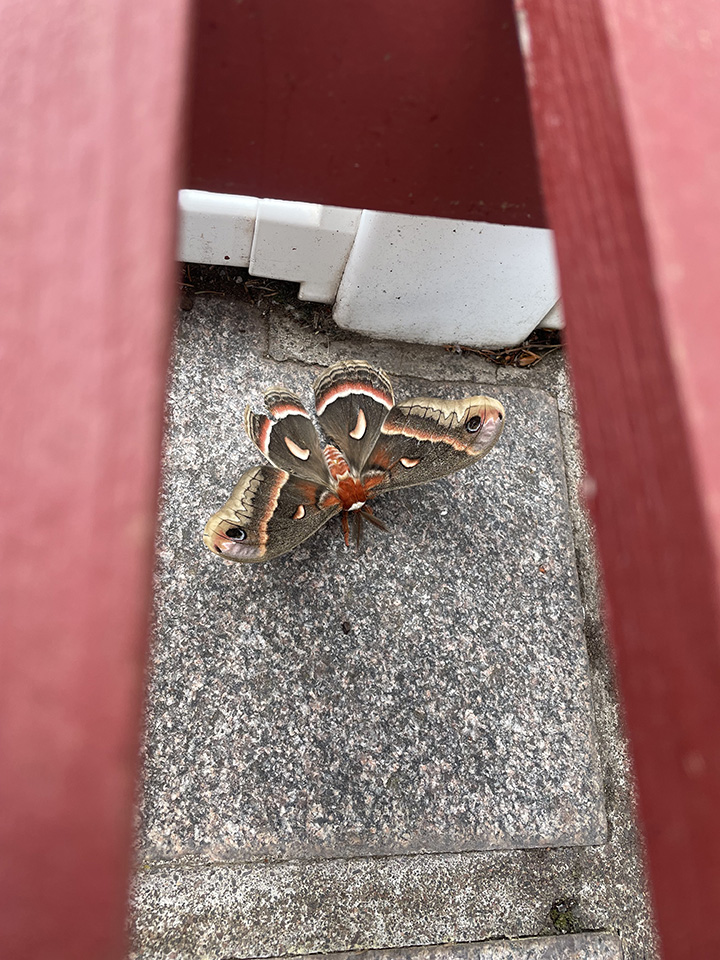
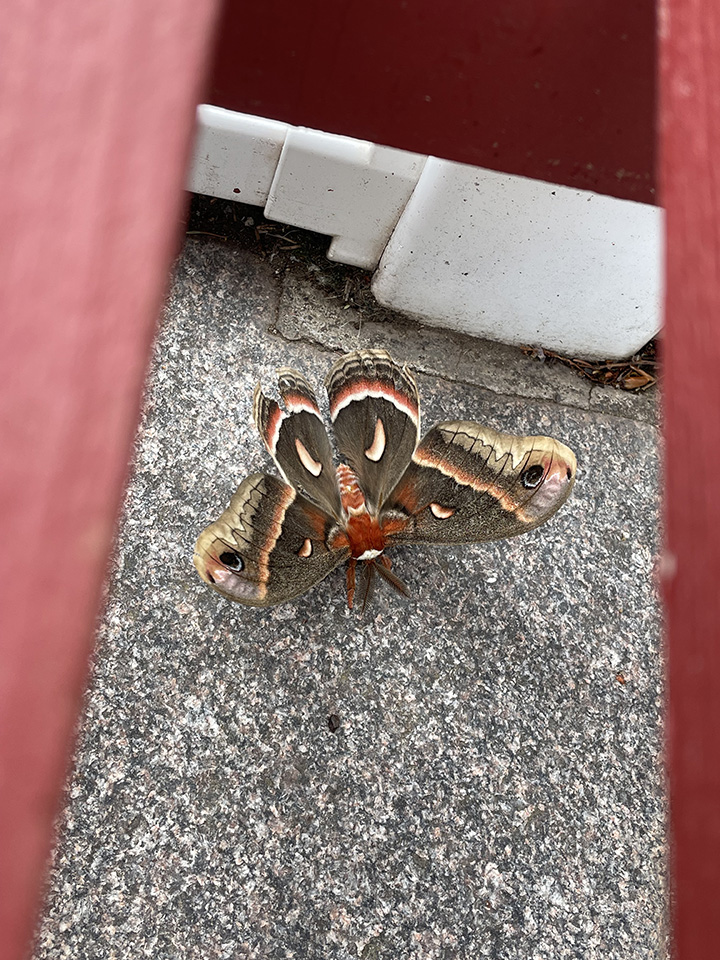
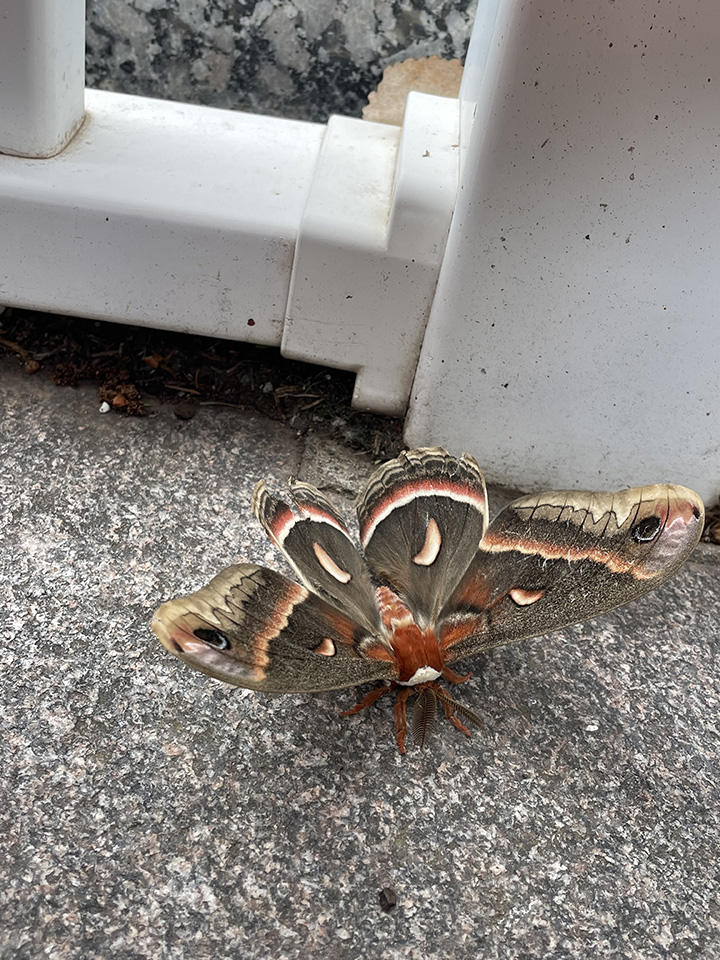
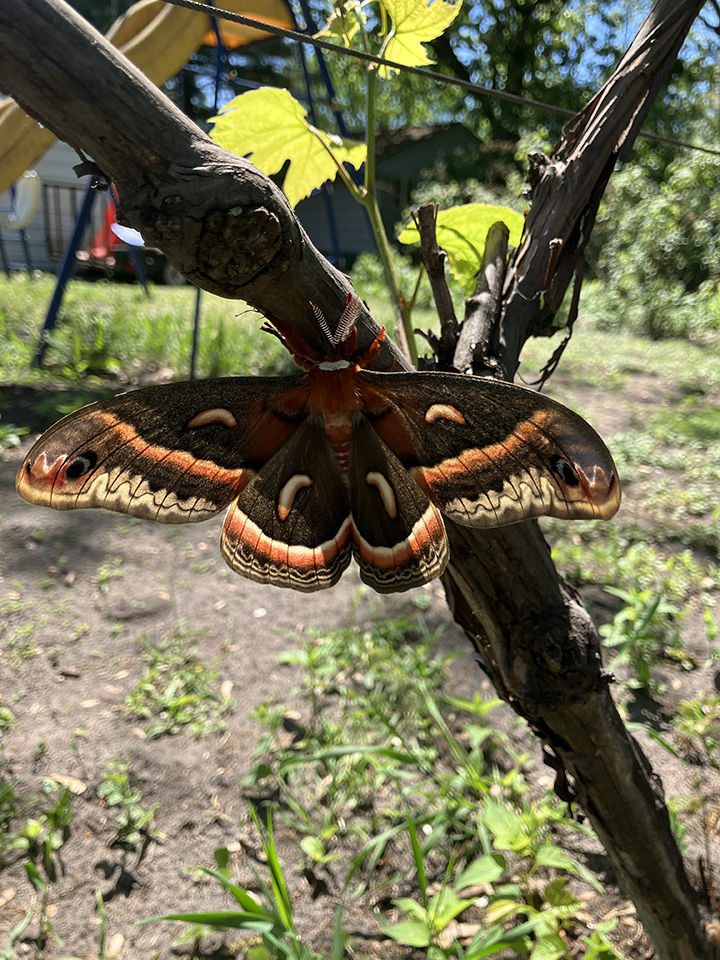
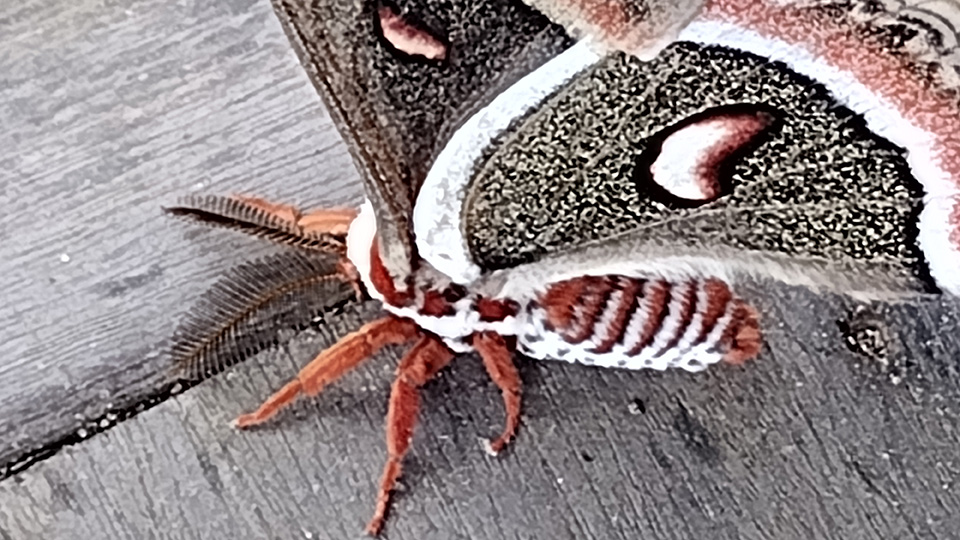
The thorax is red above with a conspicuous white collar. The white collar is the forward apex of a broad, white, lateral stripe that extends from the thorax to the last abdominal segment.
Each abdominal segment is red, outlined with a thin black line; has a fringe of white hairs at the end; and has a red spot in each lateral stripe.
The wings are dark brown, gray, and blackish with numerous white scales giving them a frosted appearance. The basal area of the forewing has at least some red shading and is bordered with a thin white and a thin black antemedial line. Both wings have red shading outside a strong white postmedial line. The forewing has a crescent-shaped spot in the median area near the leading edge. Each hindwing has a crescent-shaped spot near the outer margin of the discal cell. All four spots are red fading to white in the center and outlined with black. There is an eyespot in the subapical area near the tip of the forewing.
The head is red. There are no mouth parts and no hearing organs. The eyes are large and black. The antennae are feather-like and have branches on both sides of the central axis.
The legs are red.
Females have smaller, less bushy antennae and larger, more rounded abdomens.
The caterpillar is frosted green and up to 4″ long. There is a pair of prominent knobs in the dorsal area on thoracic segments 2 and 3 (T2 and T3) and on abdominal segments 1 through 7 (A1–A7). Abdominal segment 8 (A8) has a single dorsal knob. The dorsal knobs on T2, T3, and A1 are more or less globe shaped and have several tufts of minute black spines (spinules). The dorsal knobs on A2–A8 are elongated and cylindrical. The dorsal knobs on T2 and T3 are yellowish-orange. Those on T3 and A1–A7 are bright yellow. There is also a solitary knob in the subdorsal and spiracular areas of T1–T3 and A1–A8, and in the subspiracular area of T1 through T3. These knobs are pale blue and rise from a pale blue base. The leg-like structures (prolegs) on the abdomen are yellowish-green at the base and greenish-yellow at the tip. Mature caterpillars can be found from late June through August.
Size
Wingspan: 45 ⁄16″ to 5⅞″
Similar Species
Columbia silkmoth (Hyalophora columbia) is a similar species found mostly in the western half of North America. The area outside the postmedial band is gray and does not have any red shading. The crescent spots are white, not red fading to white. On the caterpillar, the dorsal knobs are yellowish-white to yellowish-pink, not bright yellow. The lateral knobs are more white and emerge from black bases.
Habitat
Woodlands, forests, fence rows, and suburbs
Ecology
Season
Late May to early August
Behavior
When the adult is at rest the wings are open and flat.
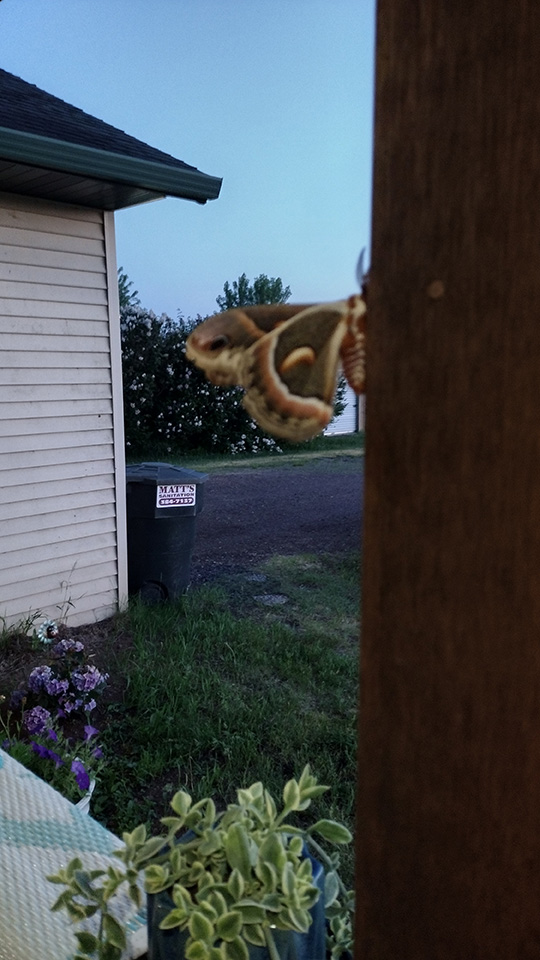
Adults are nocturnal, taking flight a few hours after sunset. They are attracted to lights.
Life Cycle
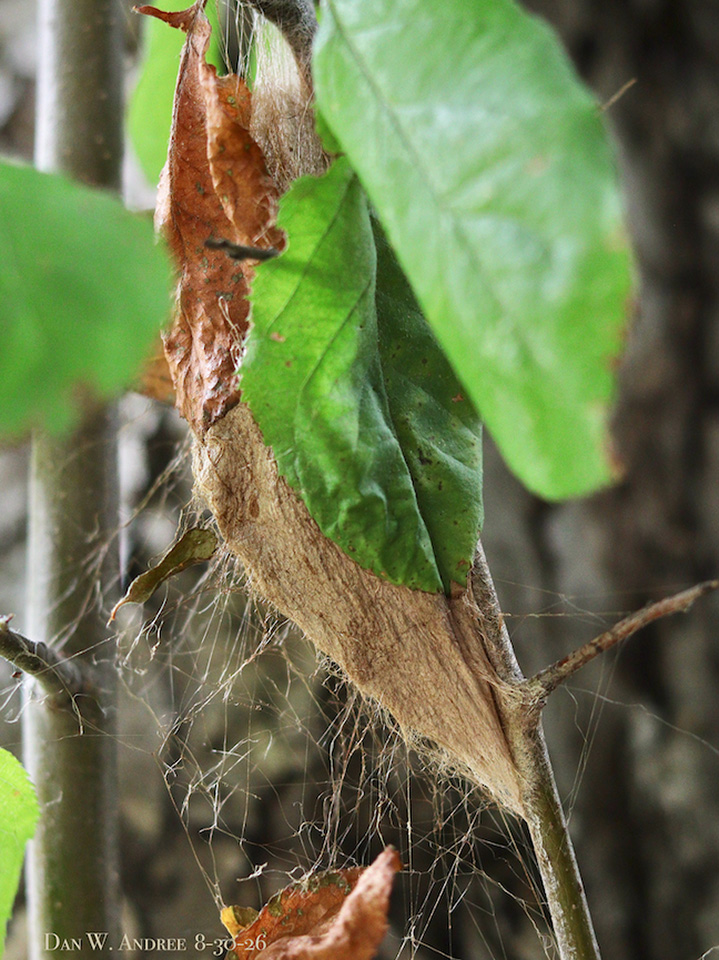
Cecropia moth is short-lived, lasting about two weeks, since it has no mouth parts and does not feed. There is one generation per year. The male uses its specialized antennae to detect pheromones released by the female. After breeding, the female lays a group of 3 to 30 large, somewhat flattened eggs in lines (rafts) of 3 to 10 eggs each on either side of a leaf of a host shrub or tree. The eggs hatch in 10 to 14 days and the newly emerged larvae begin feeding in groups on the leaves. Older caterpillars are solitary feeders. The larvae molt 5 or 6 times. In the fall the caterpillar spins a cocoon in which it will spend the winter. The cocoon is large and spindle-shaped. It is attached along its full length to a twig in a dark, protected area. The adult emerges in the spring.
Larva Food/Hosts
Deciduous trees and shrubs including apple, ash, boxelder, cherry, poplar, willow, birch, elm, tamarack, and maple.
Adult Food
Adults do not feed.
Distribution

Sources
Biodiversity occurrence data published by: Minnesota Biodiversity Atlas (accessed through the Minnesota Biodiversity Atlas Portal, bellatlas.umn.edu. Accessed 8/31/2026).
Hyalophora cecropia Linnaeus, 1758 in GBIF Secretariat (2023). GBIF Backbone Taxonomy. Checklist dataset https://doi.org/10.15468/39omei accessed via GBIF.org. Accessed 8/31/2026.
Occurrence
Common
Taxonomy
Order
Lepidoptera (Butterflies and Moths)
Superfamily
Bombycoidea (Hawk, Sphinx, Silk, Emperor, and Allied Moths)
Family
Saturniidae (Emperor and Giant Silk Moths)
Subfamily
Tribe
Attacini
Genus
Hyalophora
Subordinate Taxa
Synonyms
Hyalophora albofasciata
Hyalophora macula
Hyalophora obscura
Hyalophora uhlerii
Samia cecropia
Common Names
cecropia moth
cecropia silkmoth
robin moth