


American Beaver - Species Profile
Conservation • Description • Habitat • Ecology • Distribution • Taxonomy
Conservation Status |
|
|||
| IUCN Red List | LC - Least Concern |
|||
| NatureServe | N5 - Secure SNR - Unranked |
|||
| Minnesota | not listed |
|||
Description
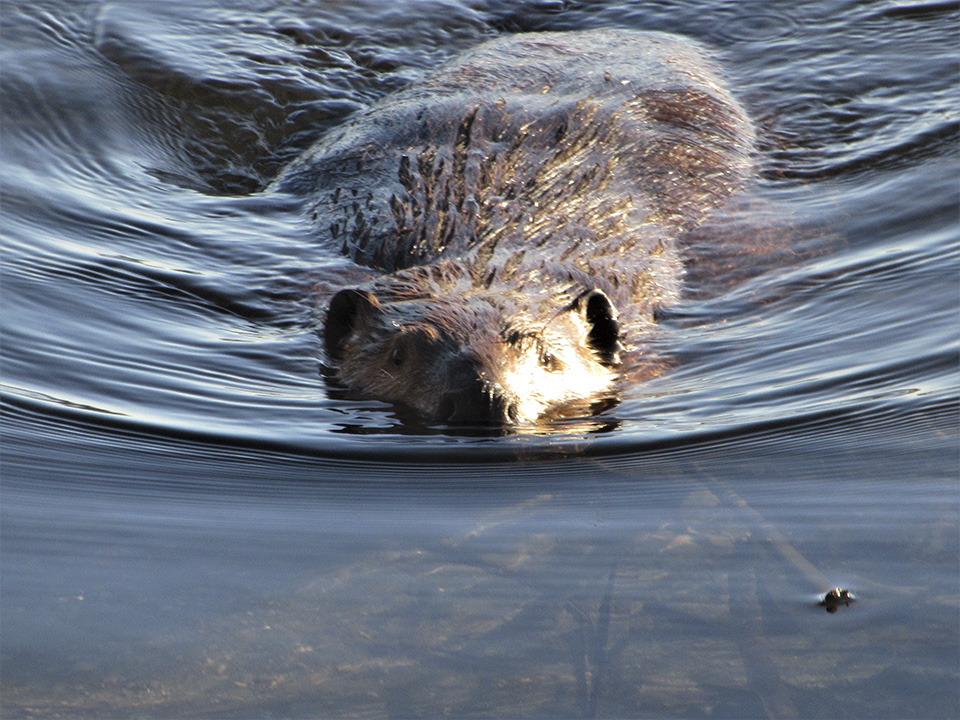
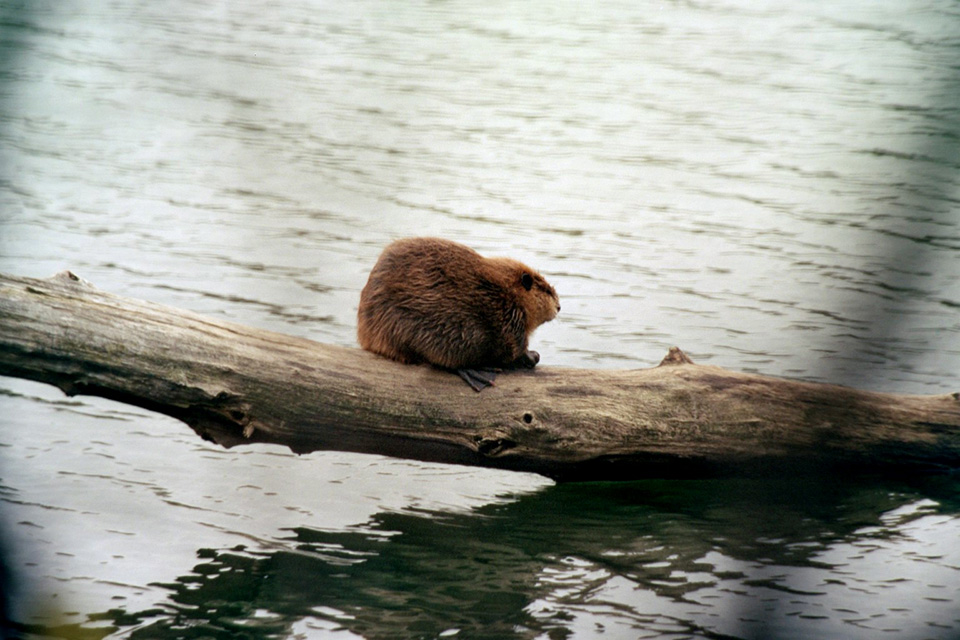
American Beaver is the largest rodent in North America. The head and body length is 25″ to 30″. A mature adult usually weighs 44 to 59 pounds, though they can be much larger.
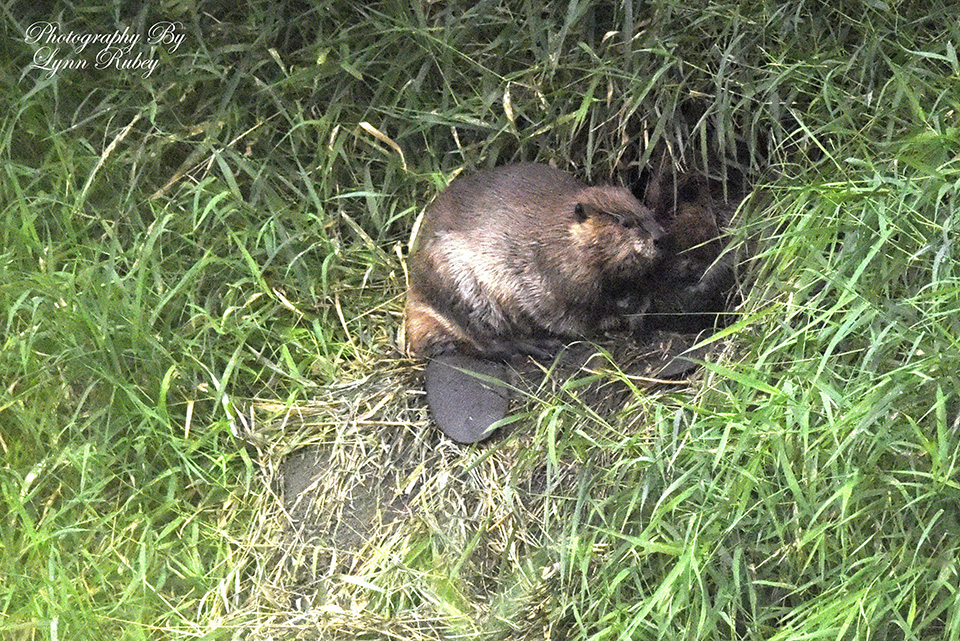
The body is stout. The powerful hind legs are longer than the front legs so the rear end is higher than the front end when the beaver walks. The coat is reddish-brown or blackish-brown, glossy, and thick. The hind legs and have webbed feet. The claw on the second toe is doubled and functions as a comb.
The skull is disproportionately large. There are 20 teeth, including disproportionately large upper and lower incisors. The incisors are ¾″ to 1″ long and about ¼″ wide, and have chestnut brown enamel. The ears and nostrils are closable.
The tail is broad and flat—paddle shaped. It is 9″ to 10″ long, naked, and scaly.
Size
Head and body: 25″ to 30″
Tail: 9″ to 10″
Sign
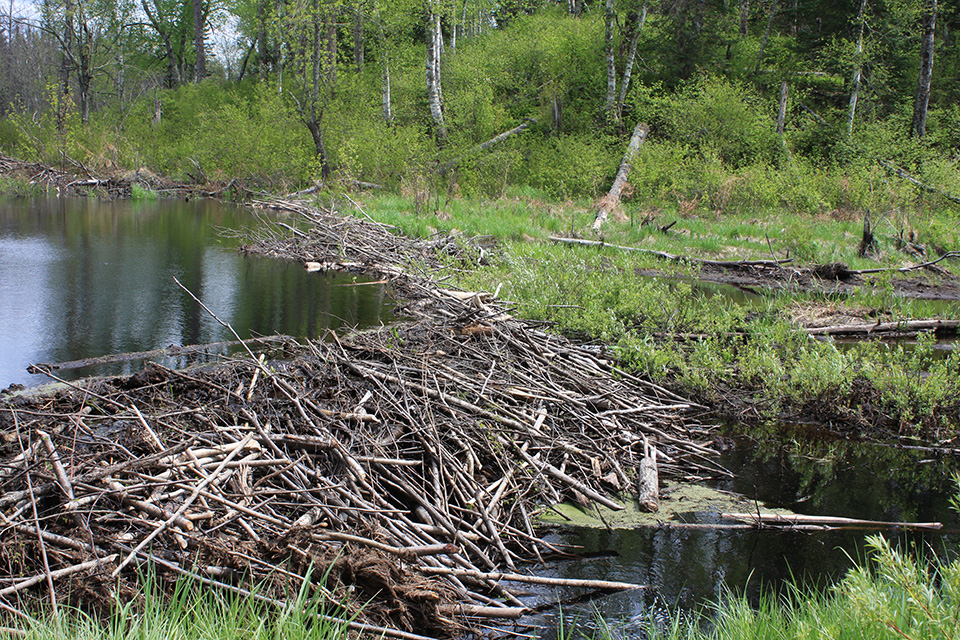
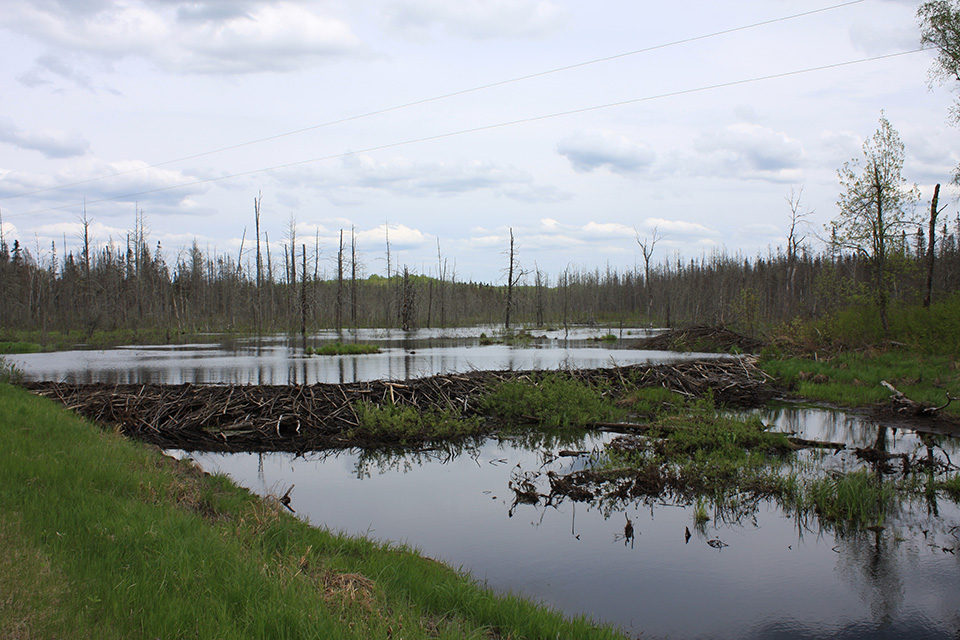
Dams – A beaver will build a dam in a stream or river to slow the flow of water. Where sufficient stable water is available it will not build a dam but rather burrow into the bank. The front (downstream) side of a dam consists of large branches with the but ends facing downstream. Mud and debris make up the center of the dam. The back (upstream) side is made up of small branches.
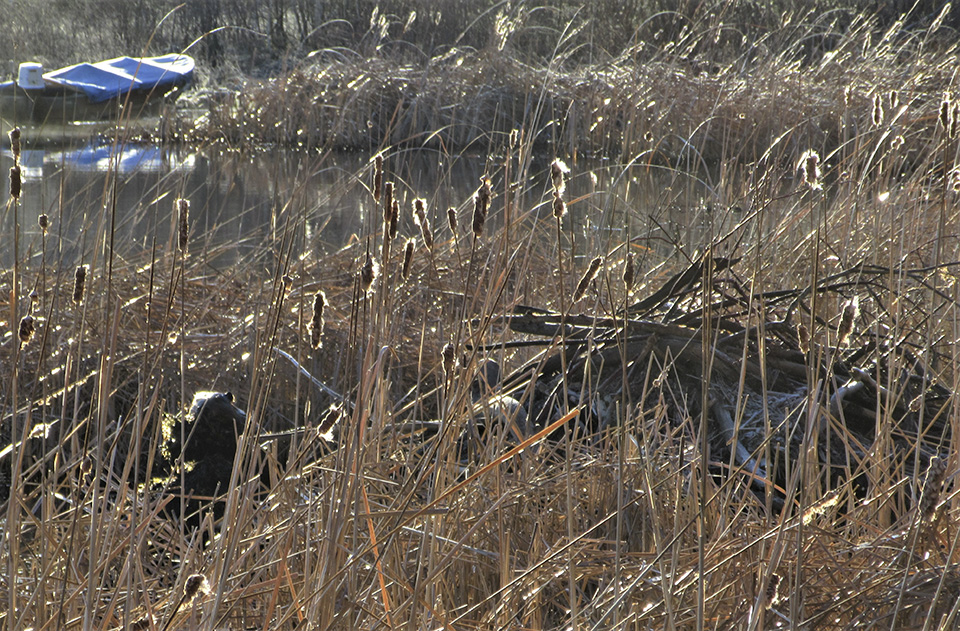
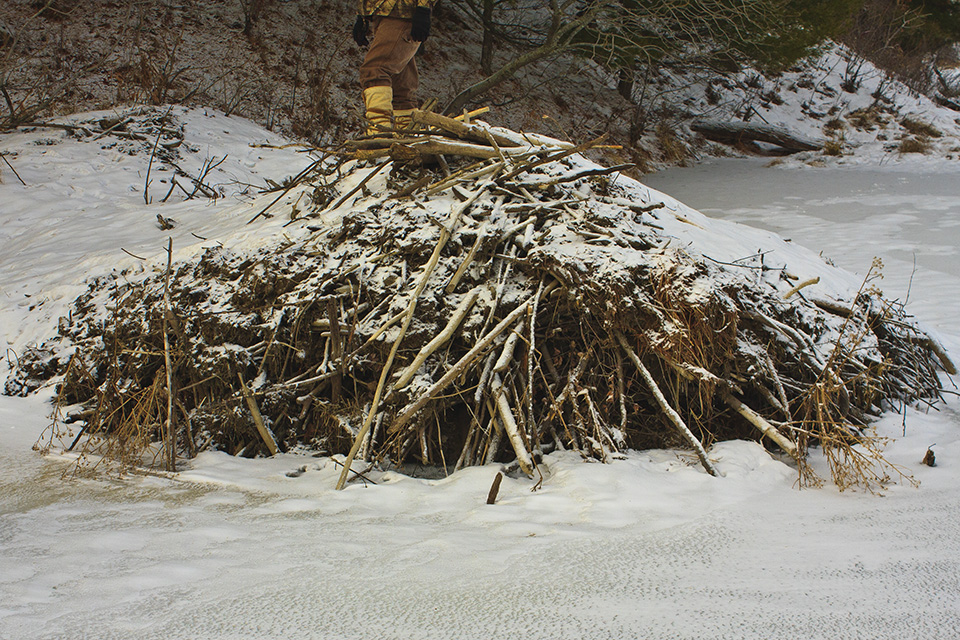
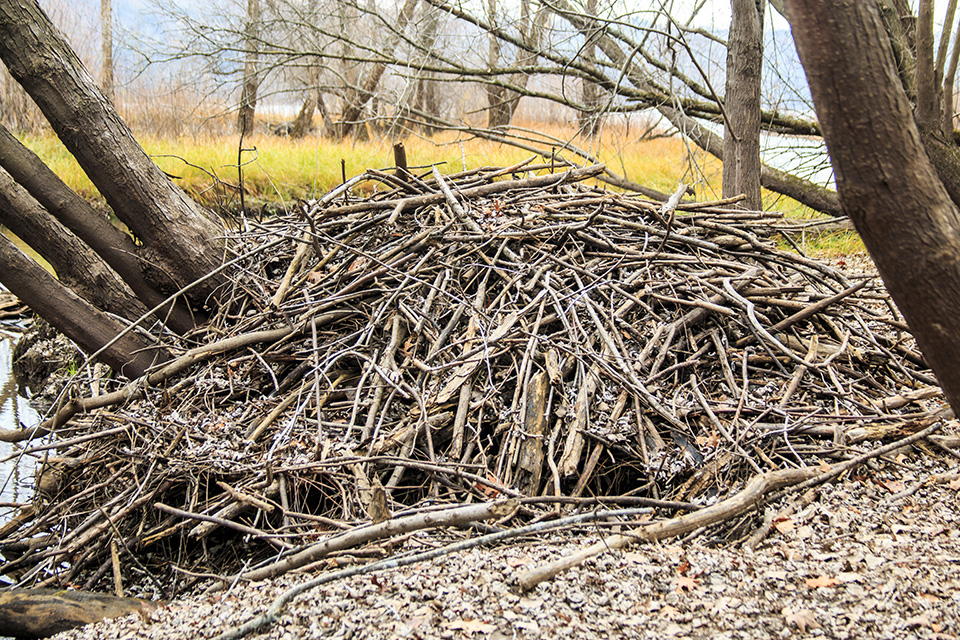
Lodges – A lodge is a large pile of branches covered with mud, debris, and aquatic vegetation. It can rise up to 10 feet above the pond floor. It is excavated from within. In the winter, vapor can often be seen rising from a thinly covered opening used for ventilation (smoke hole) at the top of the lodge. Lodges are usually built near or at the edges of lakes and ponds.
Canals – A canal may be up to two feet wide and deep. It provides a safe water passage and can be used to help transport felled trees to the pond.
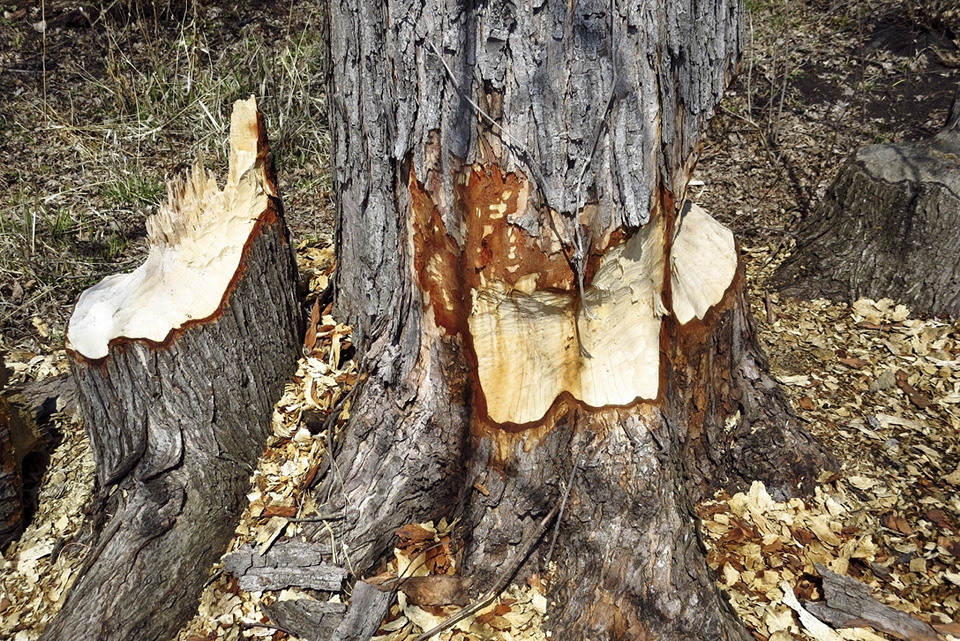
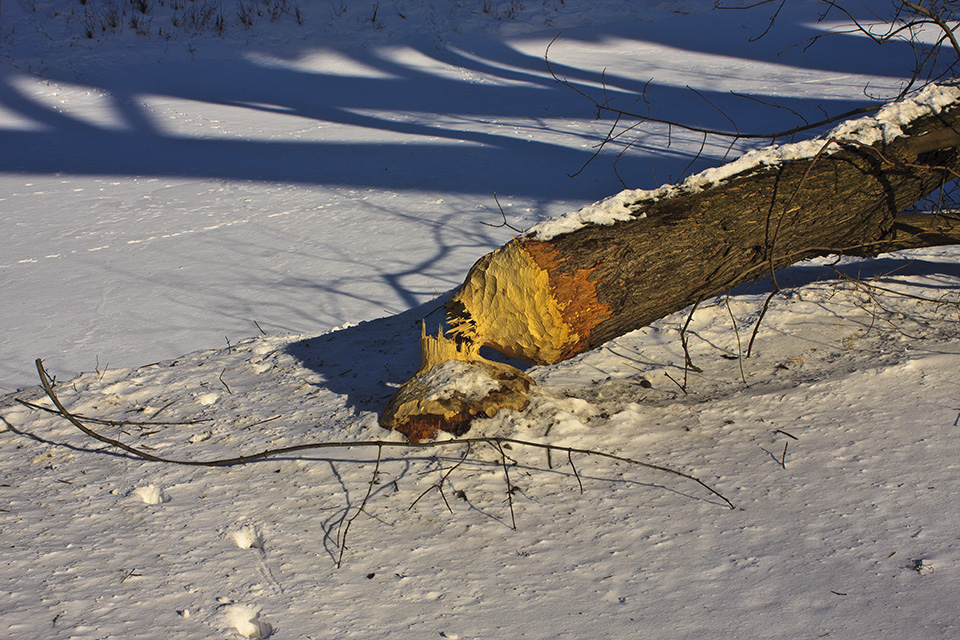
Cut trees – After downing a tree or branch a beaver may completely strip the outer bark to get at the cambium. Tree stumps near pond edges may show ¼″ wide incisor marks.
Scat – Beavers defecate in the water.
Similar Species
The stout build, brown fur, and flat, broad, scaly tail make identification unmistakable.
Habitat
Lodges built on islands, banks of ponds,and shores of lakes
Ecology
Behavior
Lifespan
10 to 12 years
Life Cycle
Beavers are mostly nocturnal, though they are occasionally seen during the day. They are usually found in colonies of 4 to 10 related individuals.
Females usually breed first in their second year, sometimes in their third year. Gestation is 100 to 128 days. Between April and June the give birth to usually four or more kits, averaging five in Minnesota. The young remain with the parents until their second year, when they are either driven out or choose to leave. They usually relocate within six miles. The average life span is 11 years.
Food
Bark, cambium, and small twigs of aspen, poplar, birch, maple, willow, beech, and alder. Aquatic vegetation.
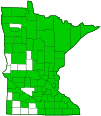
Distribution |
||
|
Sources Biodiversity occurrence data published by: Minnesota Biodiversity Atlas (accessed through the Minnesota Biodiversity Atlas Portal, bellatlas.umn.edu, 12/25/2025). Timm, R. M. 1975. Distribution, natural history, and parasites of mammals of Cook County, Minnesota. Occasional Papers, Bell Museum of Natural History, University of Minnesota 14:1–56. Hazard, Evan B. 1982. The Mammals of Minnesota. University of Minnesota Press, Minneapolis, Minnesota. 280 pp. The counties in light green lack modern records but have historic county or township specimens or records. |
|
| 12/25/2025 | ||
Occurrence |
||
Common |
||
Taxonomy
Class
Subclass
Theria
Infraclass
Placentalia (Placental Mammals)
Magnorder
Boreoeutheria
Superorder
Euarchontoglires (Primates, Rodents, and Allies)
Order
Rodentia (Rodents)
Suborder
Supramyomorpha
Infraorder
Castorimorphi
Superfamily
Castoroidea
Family
Castoridae (Beavers)
Subfamily
Castorinae
Genus
Castor (Beavers)
Suborder
The classification of the American Beaver above the family level is currently subject to revision based on modern phylogenetic research. The traditional classification places the family Castoridae (Beavers) in the suborder Castorimorpha.
Molecular DNA studies have established three monophyletic rodent clades, recognized as the suborders Hystricomorpha, Sciuromorpha, and Supramyomorpha, a new suborder that includes the family Castoridae.
The suborder Castorimorpha is currently the designation found in many online resources, including the Catalogue of Life. The suborder Supramyomorpha is the designation used by the Mammal Diversity Database (MDD) of the American Society of Mammalogists (ASM).
MinnesotaSeasons.com follows the classification adopted by the Mammal Diversity Database (MDD), as it represents the most current, scientifically vetted taxonomy (see Burgin et al., 2025).
Subordinate Taxa
Historically, up to 25 subspecies of the American Beaver (Castor canadensis) were described, often based on minor differences in size, pelage color, and skull morphology across their wide North American range.
However, recent comprehensive genetic studies have generally not supported these traditional subspecies classifications. Consequently, major modern taxonomic authorities, including the Integrated Taxonomic Information System (ITIS) and the Mammal Diversity Database (MDD), currently do not recognize any subspecies for Castor canadensis, treating it as a single, widespread species across its native range.
Synonyms
Castor caecator
Castor canadensis acadicus
Castor canadensis phaeus
Castor canadensis idoneus
Castor canadensis rostralis
Castor canadensis sagittatus
Castor canadensis baileyi
Castor canadensis carolinensis
Castor canadensis concisor
Castor canadensis repentinus
Castor canadensis belugae
Castor canadensis duchesnei
Castor canadensis subauratus
Castor canadensis labradorensis
Castor canadensis missouriensis
Castor canadensis caecator
Castor canadensis canadensis
Castor canadensis leucodontus
Castor canadensis pallidus
Castor canadensis mexicanus
Castor canadensis shastensis
Castor canadensis frondator
Castor canadensis taylori
Castor canadensis texensis
Castor canadensis pacificus
Castor canadensis michiganensis
Castor subauratus shastensis
Castor subauratus subauratus
Common Names
American Beaver
Canadian beaver
North American Beaver
Glossary
Cambium
A layer of softer growing tissue, one to several cells thick, under the bark of trees.