American elm - Species Profile
Conservation • Weed • Wetland • Description • Habitat • Ecology • Use • Distribution • Taxonomy
Conservation Status
IUCN Red List
EN - Endangered
NatureServe
N4 - Apparently Secure
SNR - Unranked
Minnesota
not listed
Wetland Indicator Status
Great Plains
FAC - Facultative
Midwest
FACW - Facultative wetland
Northcentral & Northeast
FACW - Facultative wetland
Description
American elm is a fast growing deciduous tree in the White Elm group. In Minnesota mature trees are usually 50′ to 70′ tall. Large individuals can reach up to 125′ in height and 60″ in diameter at breast height. It was once a long-lived tree, often reaching 200 years. However, the wilt fungus Dutch Elm Disease (Ceratocystis ulmi) usually kills most trees before they are 30 years old. Saplings are immune to the disease.
The trunk is buttressed at the base with prominent root flares. It extends to the base of the crown, dividing there into a few large, upright, spreading limbs. The branches are gracefully spreading and droop at the ends. The crown is broad and rounded or vase-shaped.
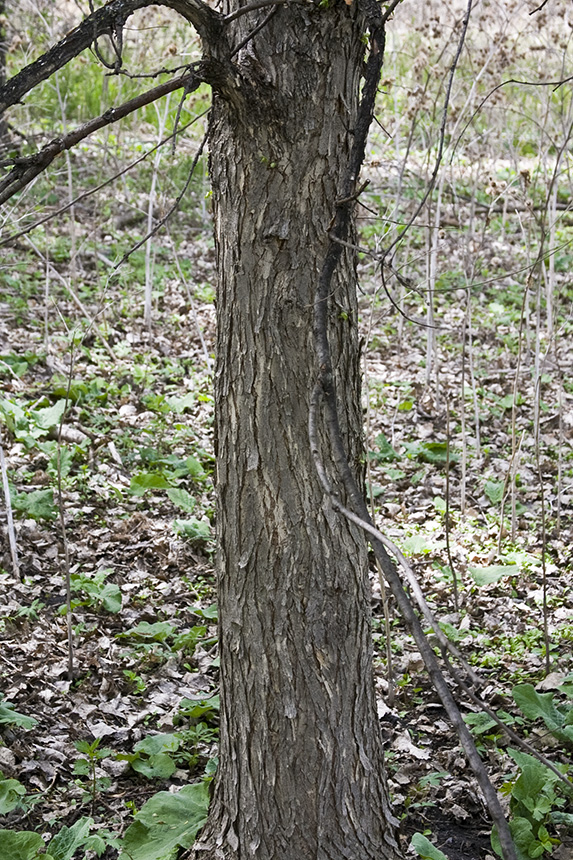
The bark on young trees is dark grayish-brown and corky, with broad, shallow, intersecting ridges. On older trees it is mottled ash gray, deeply furrowed, and sometimes scaly. In cross section outer bark shows alternating layers of white and reddish brown.
The twigs are brown, often zigzagging, and hairless or slightly hairy, with conspicuous lenticels. Older twigs are never corky. The buds are reddish-brown, somewhat flattened, pointed but not sharply pointed, and slightly hairy. The end bud is bent, other buds are pressed against the twig.
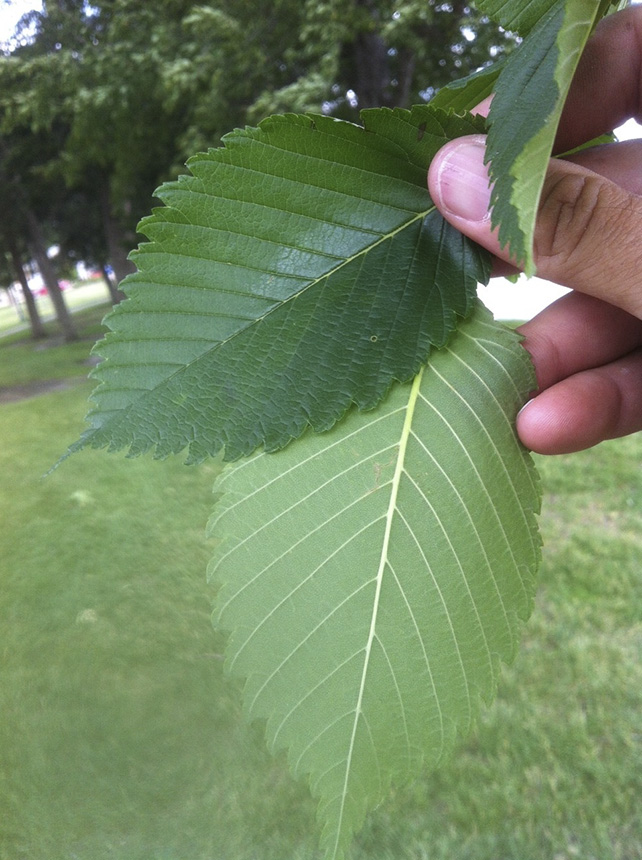
The leaves are deciduous, alternate, and simple, and are attached to the twig on a 3 ⁄16″ long leaf stalk. The blades are thick, elliptic to egg-shaped, 2¾″ to 5½″ long, and 1⅛″ to 2¾″ wide. They taper gradually to a point at the tip with straight or concave sides along the tip. The base is asymmetrical, rounded on one side, tapering on the other. The upper surface is dark green and smooth or slightly rough. The lower surface is paler green and slightly hairy, often fuzzy. The margins are doubly toothed from the tip to the base, the major teeth deeper and forward pointing. There are 15 to 20 prominent veins on each side of the central axis. The veins are straight and end in a large tooth. No more than 2 or 3 veins per side are forked. In the fall the leaves turn yellow.
The flowers have both male and female parts. They are borne in small, loose, tassel-like clusters on previous year’s twigs. They appear in early April to early mid-May before the leaves. They have no petals, 7 to 9 stamens with red anthers, and deeply-divided stigmas covered with short, white hairs. They are on ⅜″ to ¾″ long flower stalks.
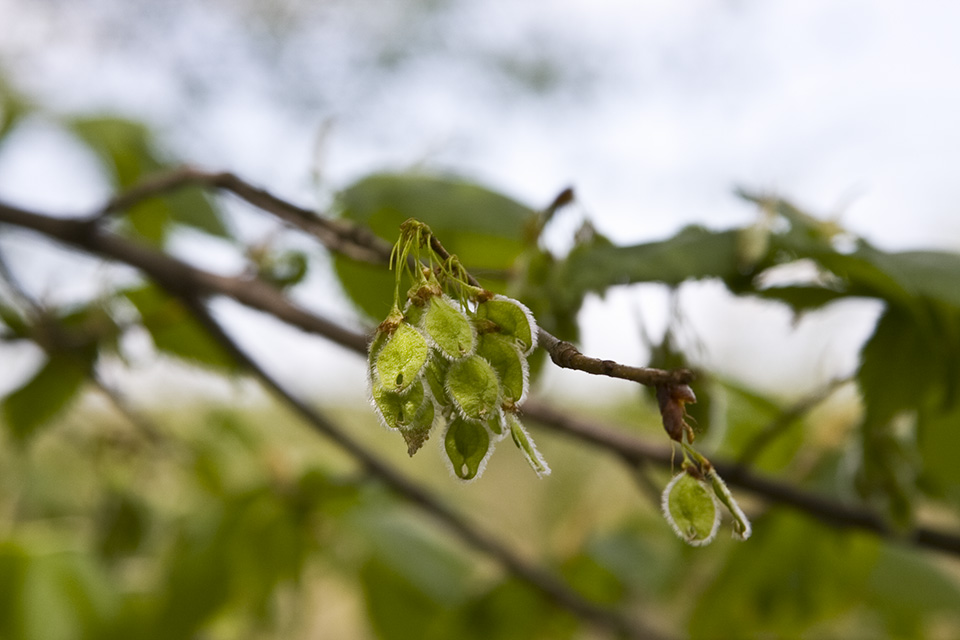
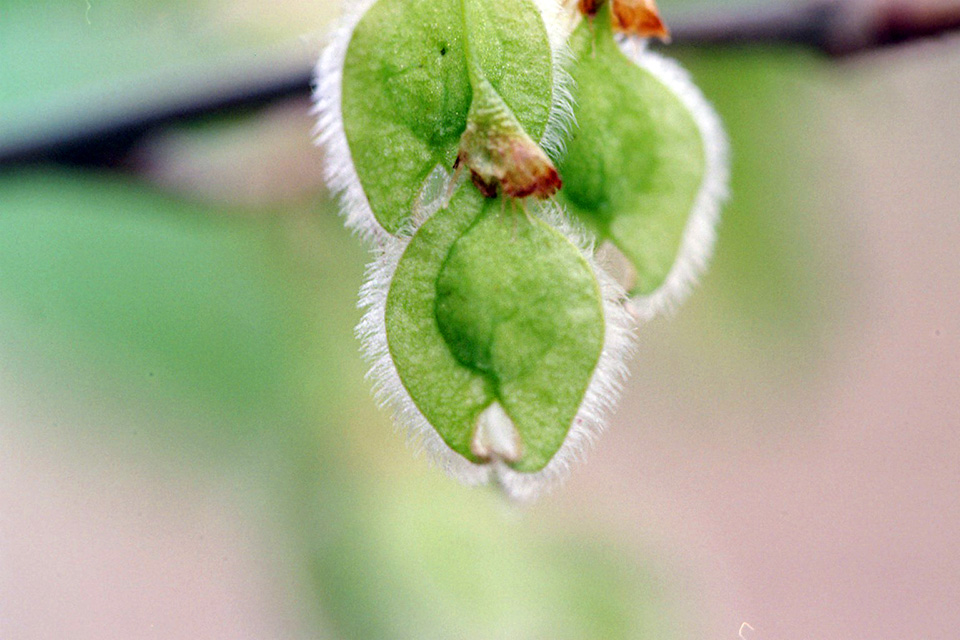
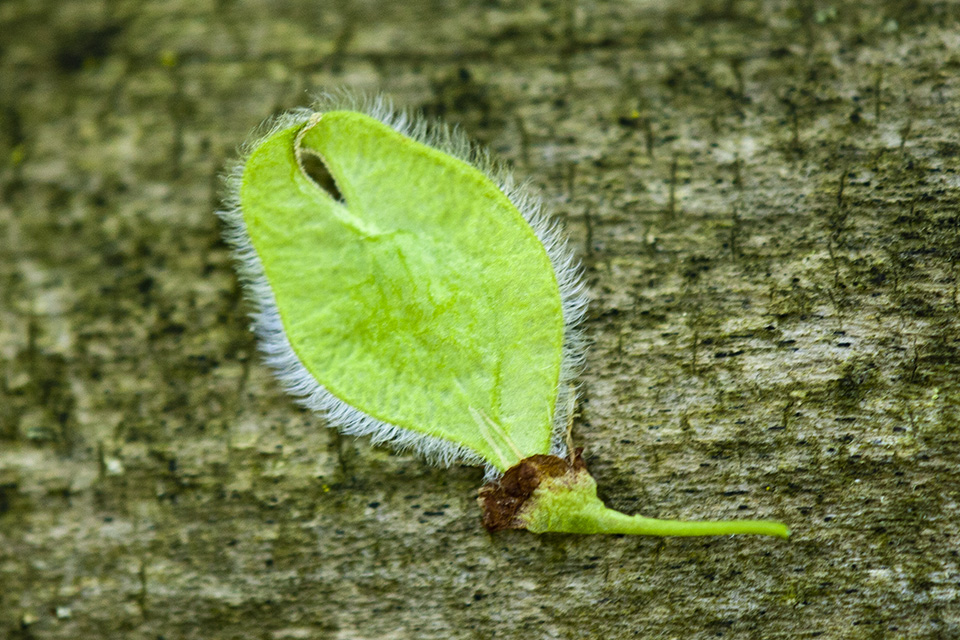
The fruit is a samara consisting of a dry, flattened, papery, oval, ⅜″ to ½″ in diameter wing surrounding a seed seed case containing 1 seed. It has a fringe of yellow or white hairs along the margin but is otherwise hairless. The tip is deeply notched. The wing is not inflated and the seed case is distinct from the wing.
Height
50′ to 70′
Record
The champion American elm in Minnesota is on private property near Minneapolis, in Hennepin County. In 2010 it was measured at 80′ tall and 228″ in circumference (72½″ in diameter), with a crown spread of 87′.
Flower Color
Similar Species
Rock elm (Ulmus thomasii) trunk is distinct almost to the top of the tree. The branches are often crooked and gnarled. Older twigs have prominent corky ridges. The leaves are shiny and smooth to the touch. The margins have incurved teeth. The leaf veins are rarely forked. The buds diverge from the twig, are sharp pointed, and are plump, not flattened. Flowers and fruits are in clusters with a central stem. The samara is pointed, shallowly notched, and hairy, not just fringed with hairs. It is inflated, the seed case not distinct.
Slippery elm (Ulmus rubra) bark layers in cross section are uniformly brown. The leaves have several forked veins. The upper leaf surface is hairy and very rough to the touch. The buds are blunt, not pointed, dark brown, and covered with conspicuous orange or reddish-brown hairs. The samara is round with a slightly notched tip and a line that extends from the base to the notch at the tip. It does not have a fringe of hairs on the margin.
Habitat
Moist. Deciduous forests, well-drained floodplains. Moderately shade tolerant.
Ecology
Flowering
Early April to early mid-May
Pests and Diseases
Elm finger gall mite (Aceria parulmi) creates erect, finger-like galls, up to ½″ in height, on the upper leaf surface.
Elm bead gall mite (Aceria campestricola) creates low, bead-like galls on the upper leaf surface.
Elm leafminer (Fenusa ulmi) creates mines in the leaves in the spring. The damaged portion turns brown and falls off.
Use
Distribution
Sources
Biodiversity occurrence data published by: Minnesota Biodiversity Atlas (accessed through the Minnesota Biodiversity Atlas Portal, bellatlas.umn.edu. Accessed 5/11/2009).
Midwest Herbaria Portal. 2026. https://midwestherbaria.org/portal/index.php. Accessed 5/11/2009.
Ulmus americana L. in GBIF Secretariat (2023). GBIF Backbone Taxonomy. Checklist dataset https://doi.org/10.15468/39omei accessed via GBIF.org. Accessed 5/11/2009.
Smith, Welby R. 2008. Trees and Shrubs of Minnesota: The Complete Guide to Species Identification. The University of Minnesota Press, Minneapolis, MN.
Nativity
Native
Occurrence
Common
Taxonomy
Kingdom
Subkingdom
Pteridobiotina
Phylum
Tracheophyta (Vascular Plants)
Class
Order
Rosales (Roses, Elms, Figs, and Allies)
Family
Ulmaceae (Elm)
Genus
Subgenus
Oreoptelea
Section
Blepharocarpus
Subordinate Taxa
Numerous varieties and forms of Ulmus americana have been described. Most authoritative sources treat all of them as synonyms and recognize no subordinate taxa.
Synonyms
Ulmus alba
Ulmus americana var. alba
Ulmus americana var. aspera
Ulmus americana var. aurea
Ulmus americana var. bartramii
Ulmus americana var. floridana
Ulmus americana var. glabra
Ulmus americana var. incisa
Ulmus americana var. pendula
Ulmus americana var. scabra
Ulmus dentata
Ulmus floridana
Common Names
American elm
soft elm
water elm
white elm