Common mullein - Species Profile
Conservation • Weed • Wetland • Description • Habitat • Ecology • Use • Distribution • Taxonomy
Conservation Status
IUCN Red List
not listed
NatureServe
NNA - Not applicable
SNA - Not applicable
Minnesota
not listed
Weed Status
Common mullein is listed as an invasive species in West Virginia, Kentucky, Georgia, and Oregon, and it is regulated as a noxious weed in Wyoming. It is not listed in Minnesota.
Wetland Indicator Status
Great Plains
UPL - Obligate upland
Midwest
UPL - Obligate upland
Northcentral & Northeast
UPL - Obligate upland
Description
Common mullein is an exotic, tall, common weed. It is native to Africa, Asia, and Europe. It was first introduced into Virginia in the mid-1700’s as a fish poison. It soon became naturalized and it spread quickly, reaching the Pacific coast by 1876.
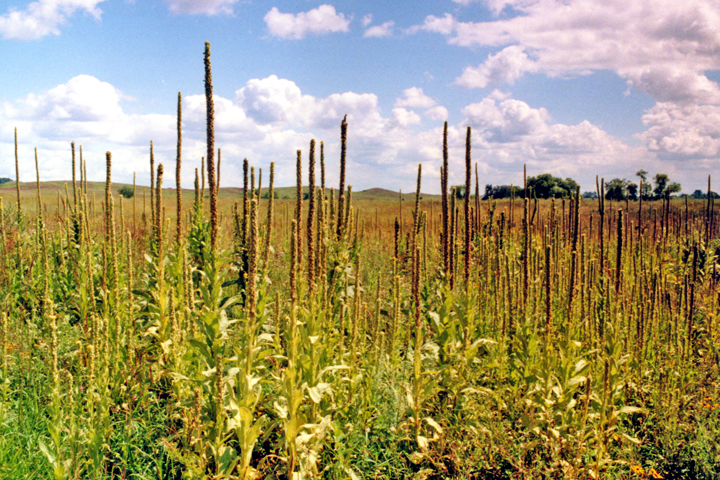
Common mullein is found in pastures, meadows, woodland openings, roadsides, railroads, vacant lots, and other disturbed sites. It grows under full sun in moderately moist to dry soil.
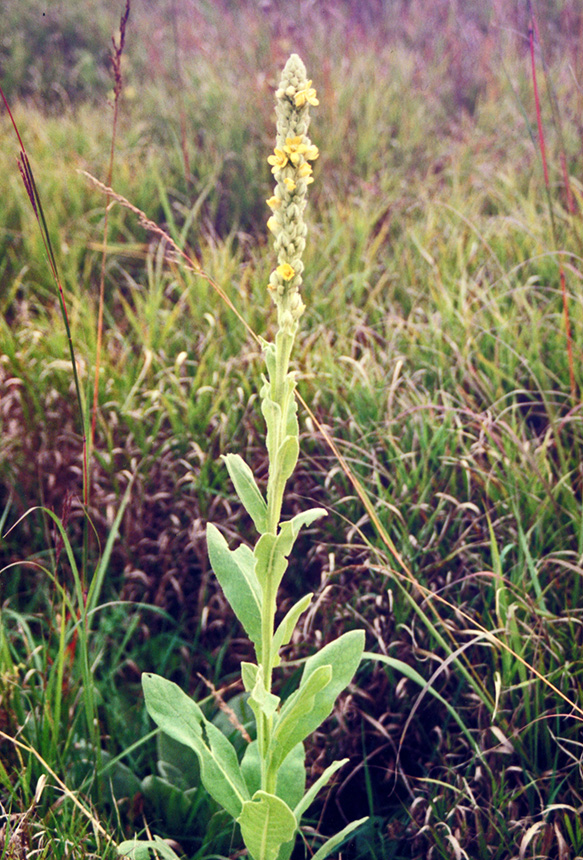
Common mullein is a 12″ to 80″ tall, erect, biennial forb that rises from a deep, stout taproot and fibrous roots. In the first year it produces a basal rosette of large fuzzy leaves. In the second year it produces a single flowering stalk.
The basal rosette is often showy and can be up to 40″ in diameter, though it is usually much smaller. Basal leaves are soft to the touch, bluish grayish-green, stalked, oblong or inversely lance-shaped, 4″ to 18″ long, and 1″ to 5″ wide. They are tapered at the base and rounded or tapered at the tip. The upper and lower surfaces are densely covered with gray hairs that are branched at the tip in a star-shaped pattern. The margins are wavy and untoothed or shallowly toothed with rounded teeth.
The stems are erect, stout, leafy, and densely covered with gray, star-shaped hairs. They are unbranched below the middle but sometimes branched near the top.
Lower stem leaves are alternate, stalked, oblong to oblong egg-shaped, and mostly untoothed. The blade continues down the leaf stalk as wings. They are otherwise similar to basal leaves. Stem leaves become progressively smaller and shorter stalked as they ascend the stem. Upper stem leaves are stalkless with the leaf blade continuing down the stem to the next leaf below as narrow wings.
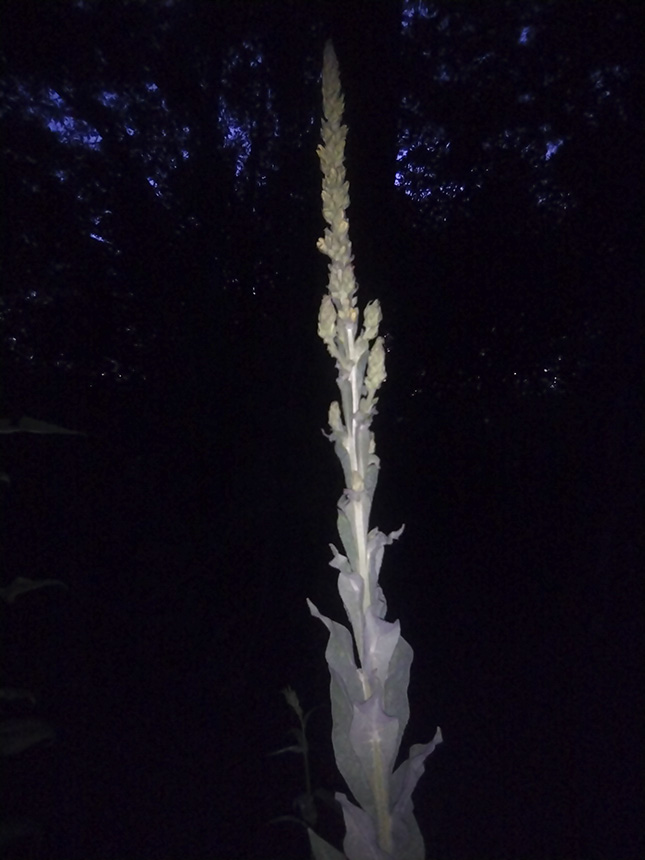
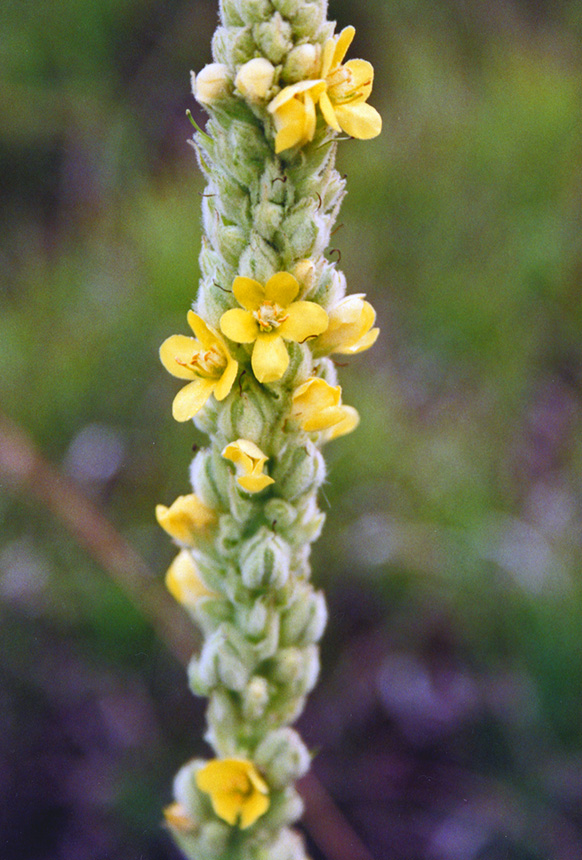
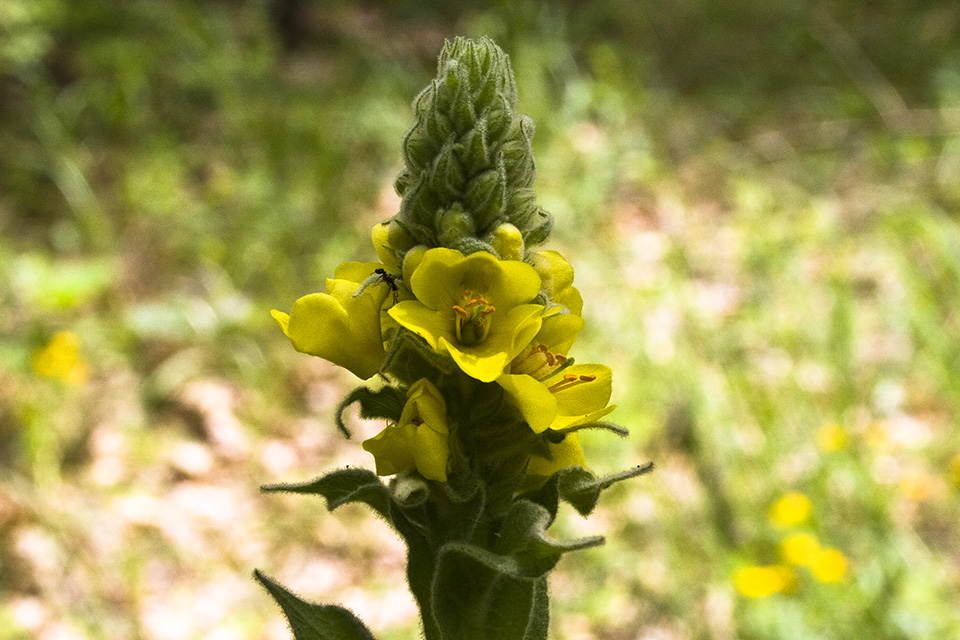
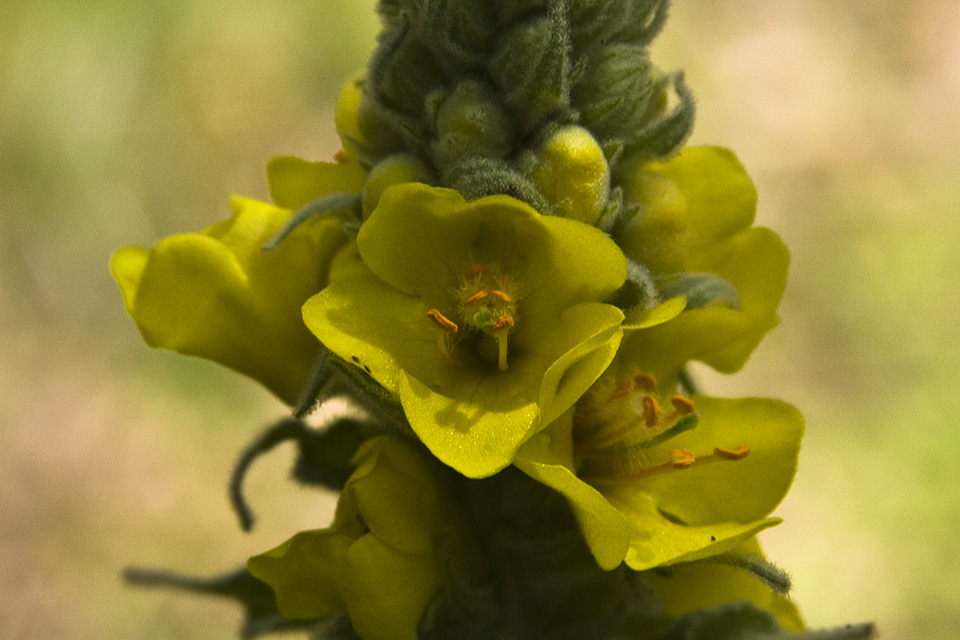
The inflorescence is a spike of many flowers at the end of the stem. The spike is densely flowered, cylinder-shaped, 8″ to 20″ long, and ¾″ to 1¼″ wide. It continues to lengthen as the season progresses. It is unbranched but there is sometimes more than one spike. The flowers mostly appear in short-stalked clusters (fascicles). Each fascicle is few-flowered and is subtended by a leaf-like or scale-like, densely hairy appendage (bract).
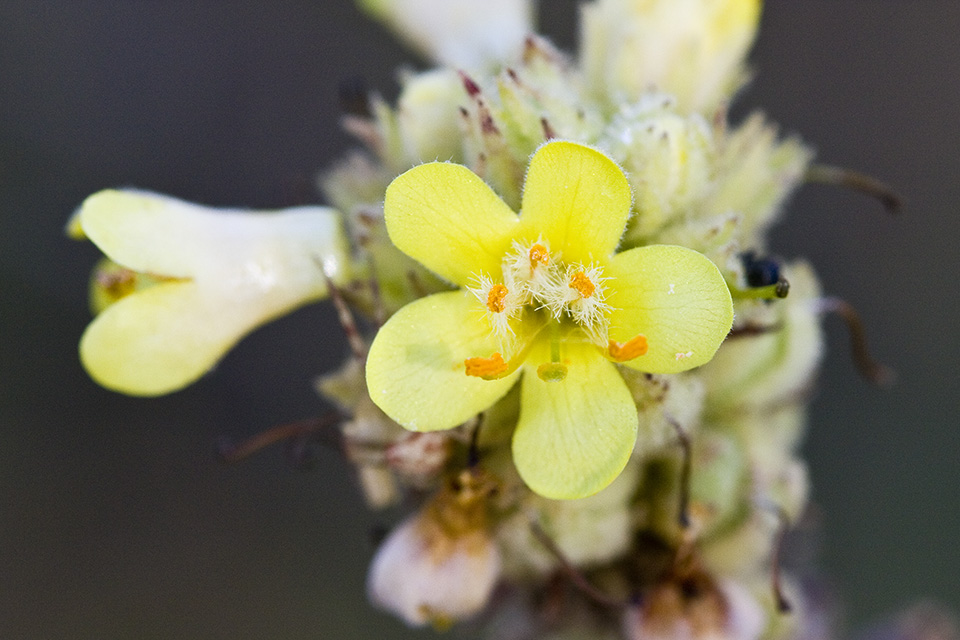
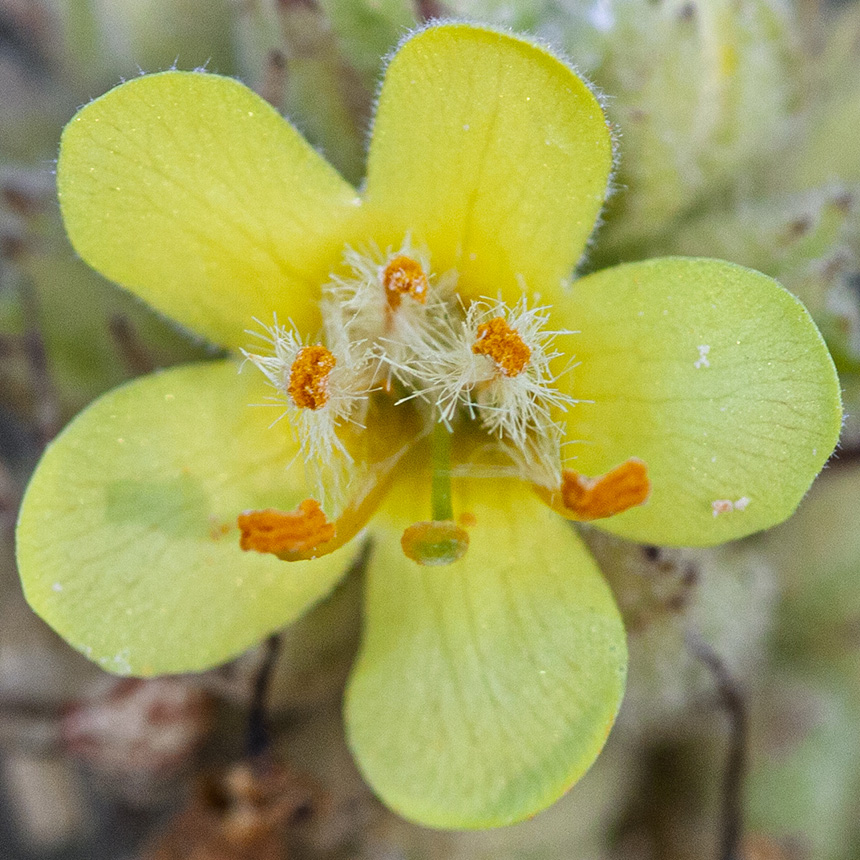
The flowers are ⅜″ to 1″ in diameter. There are 5 sepals, 5 petals, 5 stamens, and 1 style. The sepals (calyx) are green and densely hairy. They are fused at the base into an approximately 1 ⁄16″ long tube, then separated into 5 lobes. The calyx lobes are lance-shaped, 3 ⁄16″ to ¼″ long, and 1 ⁄16″ to ⅛″ wide at the base. They are shorter than the subtending bracts. The petals are yellow, fused at the base into an approximately 5 ⁄16″ long tube, then separated into 5 rounded, spreading lobes. The 3 lower lobes are somewhat longer than the 2 upper. The stamens have yellow filaments and orange anthers, and are unequal in length. The 3 upper stamens have short, densely hairy filaments and short anthers. The 2 lower stamens have much longer, hairless or nearly hairless filaments and long anthers. The style is green.
The fruit is a broadly egg-shaped, ⅜″ long, hairy capsule with many seeds. The style persists in fruit and is as long as the capsule. The seeds are brown, tiny, and ridged. They are dispersed by wind. The leaves fall away as the fruits ripen but the stalk and fruiting head persist through the winter.
Height
12″ to 80″
Flower Color
Yellow
Similar Species
Habitat
Moderate moisture to dry. Pastures, meadows, woodland openings, roadsides, railroads, vacant lots, and other disturbed sites. Full sun.
Ecology
Flowering
June to October
Pests and Diseases
Use
Distribution
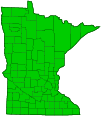
Sources
Biodiversity occurrence data published by: Minnesota Biodiversity Atlas (accessed through the Minnesota Biodiversity Atlas Portal, bellatlas.umn.edu. Accessed 2/17/2026).
Midwest Herbaria Portal. 2026. https://midwestherbaria.org/portal/index.php. Accessed 2/17/2026.
Verbascum thapsus subsp. thapsus in GBIF Secretariat (2023). GBIF Backbone Taxonomy. Checklist dataset https://doi.org/10.15468/39omei accessed via GBIF.org on 2026-02-17.
EDDMapS. 2013. Early Detection & Distribution Mapping System. The University of Georgia - Center for Invasive Species and Ecosystem Health. Available online at www.eddmaps.org/. Accessed 2/17/2026.
Nativity
Native to Africa, Asia, and Europe. Introduced and naturalized in North America.
Occurrence
Common and abundant
Taxonomy
Kingdom
Subkingdom
Pteridobiotina
Phylum
Tracheophyta (Vascular Plants)
Class
Order
Lamiales (Mints, Plantains, Olives, and Allies)
Family
Scrophulariaceae (Figwort)
Tribe
Scrophularieae
Genus
Verbascum (Mulleins)
Species
Verbascum thapsus (Common Mullein)
Subordinate Taxa
Synonyms
Leiosandra cuspidata
Thapsus linnaei
Thapsus schraderi
Verbascum alatum
Verbascum angustius
Verbascum bicolle
Verbascum bracteatum
Verbascum canescens
Verbascum crassifolium var. pseudothapsiforme
Verbascum decurrens
Verbascum elongatum
Verbascum indicum
Verbascum intermedium
Verbascum kickxianum
Verbascum lanatum
Verbascum linnaei
Verbascum lychnitis
Verbascum majus
Verbascum mas
Verbascum neglectum
Verbascum officinarum
Verbascum pallidum
Verbascum phlomoides var. cuspidatum
Verbascum plantagineum
Verbascum pseudothapsiforme
Verbascum salisburgense
Verbascum schraderi
Verbascum schraderi var. album
Verbascum schraderi var. angustifolium
Verbascum schraderi var. pallidum
Verbascum seminigrum
Verbascum simplex ssp. valentinum
Verbascum spectabile
Verbascum subalpinum
Verbascum tapsus
Verbascum thapsiforme ssp. cuspidatum
Verbascum thapsum
Verbascum thapsus f. candicans
Verbascum thapsus f. elongatum
Verbascum thapsus f. pallidum
Verbascum thapsus ssp. langei
Verbascum thapsus ssp. neglectum
Verbascum thapsus var. albiflora
Verbascum thapsus var. australe
Verbascum thapsus var. boreale
Verbascum thapsus var. bracteatum
Verbascum thapsus var. cuspidatum
Verbascum thapsus var. elongatum
Verbascum thapsus var. glabrum
Verbascum thapsus var. gymnostemon
Verbascum thapsus var. intermedium
Verbascum thapsus var. leiostemmum
Verbascum thapsus var. leucanthum
Verbascum thapsus var. pseudothapsiforme
Verbascum thapsus var. subapterum
Verbascum thapsus var. sylvaticum
Verbascum thapsus var. thapsoides
Verbascum ×adulterinum ssp. seminigrum
Common Names
Aaron’s-rod
beggar’s blanket
big taper
blanketweed
candlewick plant
Charmin of the woods
common mullein
cowboy’s toilet paper
flannel mullein
flannel plant
flannelleaf
flannelplant
great mullein
grey mullein
hag taper
mullein
toilet paper plant
torches
velvet dock
velvet-dock
velvet plant
velvetplant
wild tobacco
woolly mullein