Chokecherry

(Prunus virginiana var. virginiana)

Information

chokecherry - Species Profile

chokecherry - Featured photo

Conservation Status

IUCN Red List

not listed

NatureServe

N5 - Secure
SNR - Unranked

Minnesota

not listed

Wetland Indicator Status

Great Plains

FACU - Facultative upland

Midwest

FACU - Facultative upland

Northcentral & Northeast

FACU - Facultative upland

Description

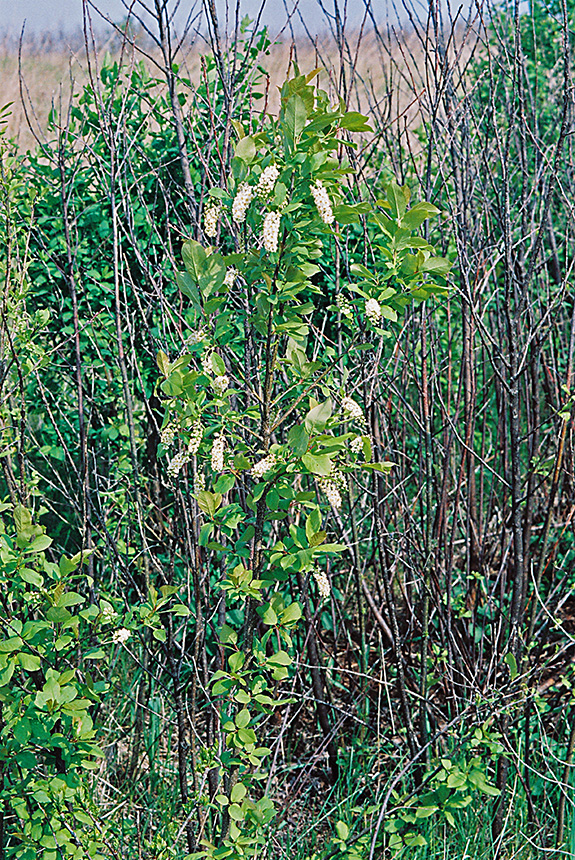
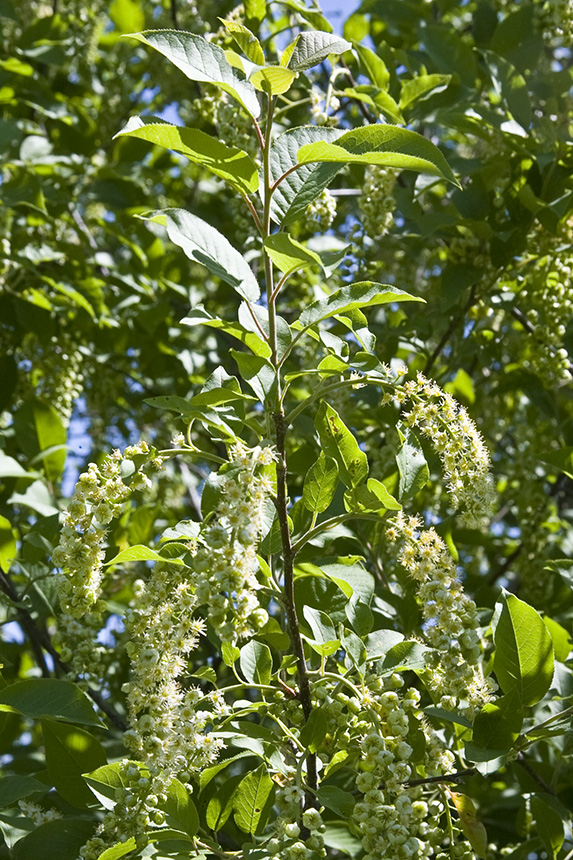
Chokecherry is a deciduous, relatively slow-growing, short lived, 8 to 25 tall, up to 6 in diameter woody plant that rises from a network of shallow, to ½ in diameter rhizomes. It is usually a tall shrub with multiple stems, though on favorable sites it may be a small tree with a single trunk. It is short-lived and relatively slow growing. Roots occur at intervals along the rhizomes and may extend vertically 6 or more. The root system extends horizontally 35 or more. The plant often forms colonies (thickets) by producing aerial stems from buds on the spreading roots (suckering).

The stems are slender, erect to slightly spreading, often leaning, often crooked, and often twisted. They are often branched near the base. The branches are slender and upright to slightly spreading

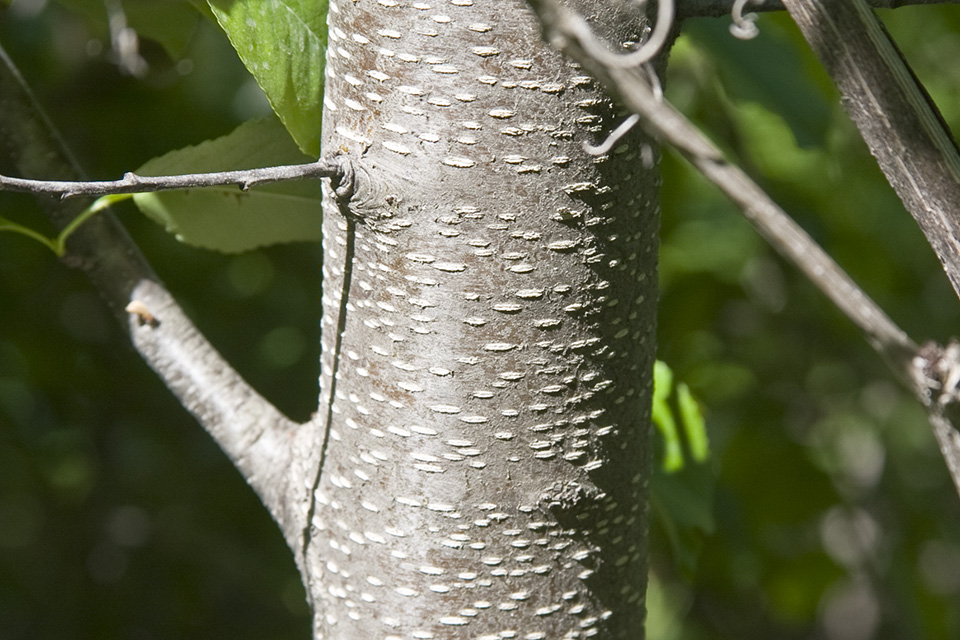
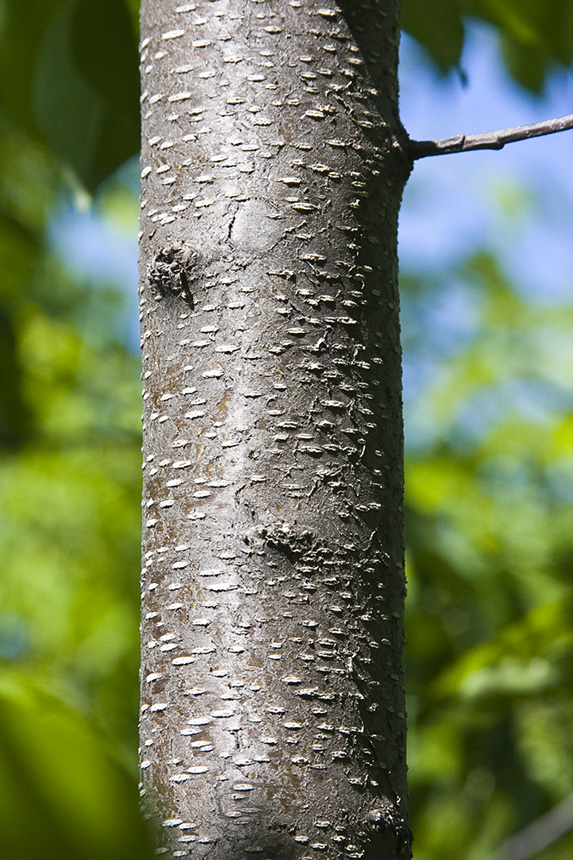
The bark on young stems is smooth and dark grayish-brown. It is covered with numerous, pale, horizontal lines (lenticels). As it ages it becomes darker and rough; the outer layers develop tight, curled peeling edges; and the lenticels become shallow fissures.

Twigs are slender to moderately stout, hairless, and brown to grayish-brown or reddish-brown, soon becoming dark reddish-brown. They do not have an outer grayish skin that wears off. When scratched the twigs have a bitter almond odor and taste.

Buds are reddish-brown, sharply pointed, and small, only about long. They are held slightly away from the twig. They are covered with about 10 scales. The scales are pointed, dark brown at the base, and gray at the margins. The leaf scars are small, raised, and semi-circular. They have 3 bundle scars. The pith is solid.

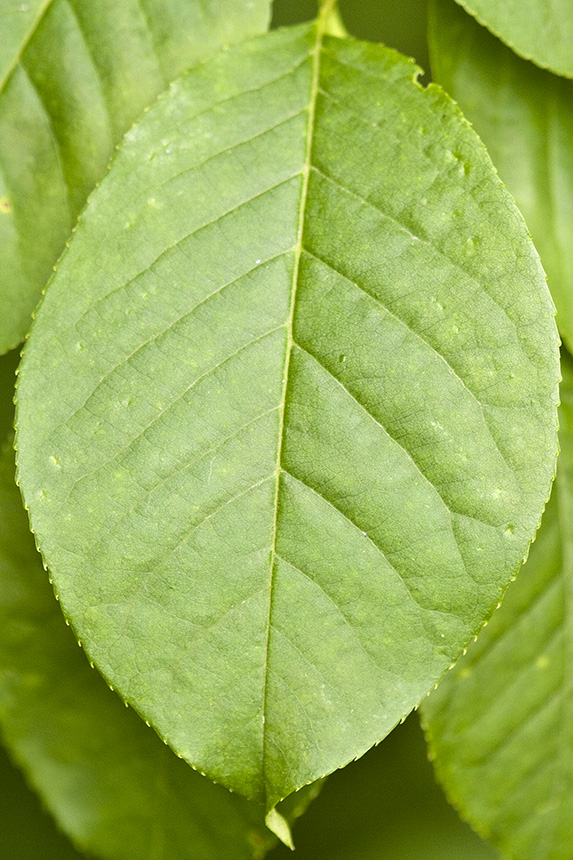
The leaves are alternate, broadly elliptic or inversely egg-shaped, 2¼ to 4long, and 1¼ to 2 wide. They are 1.4 to 2 times as long as wide. They are attached to the twig on to ¾ long leaf stalks (petioles). The petiole is usually hairless and has 1 or a few stalkless glands near the point where the blade attaches to the stalk. The blade is rounded at the base and tapers to a short point at the tip with concave sides along the tip. The upper surface is dark green and hairless. The lower surface is pale green with whitish or yellowish hairs mostly on the axils of the lateral veins. The margins are finely, singly toothed. The teeth are short and straight. They are not tipped with a minute, hard, gland-like thickening. The leaves turn yellow in autumn.

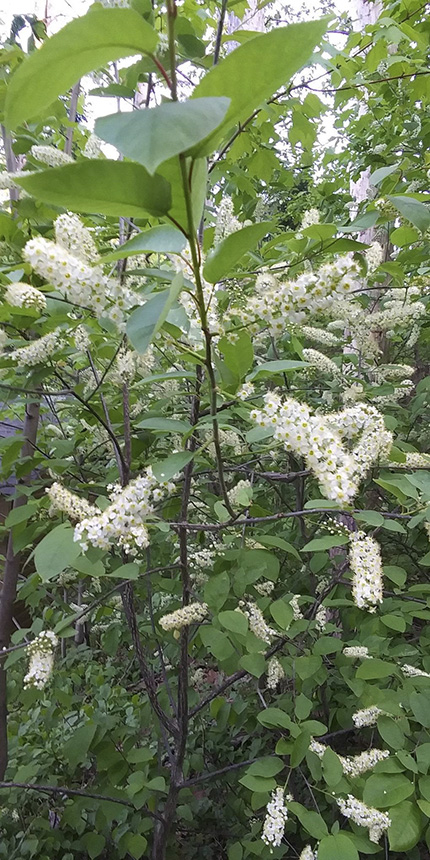
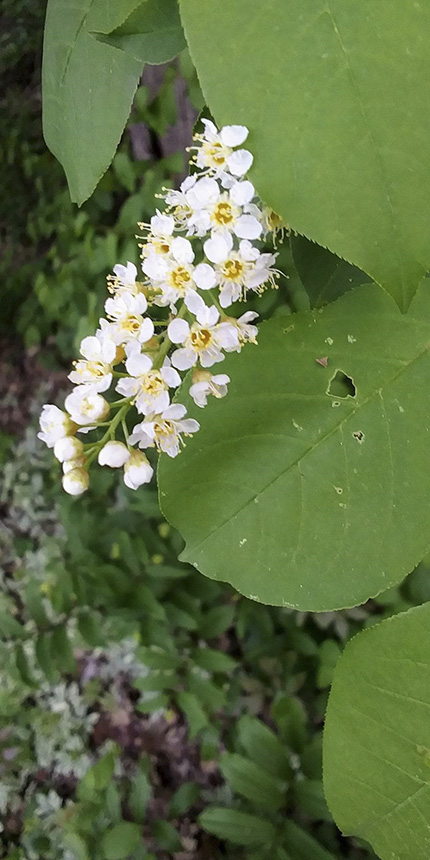
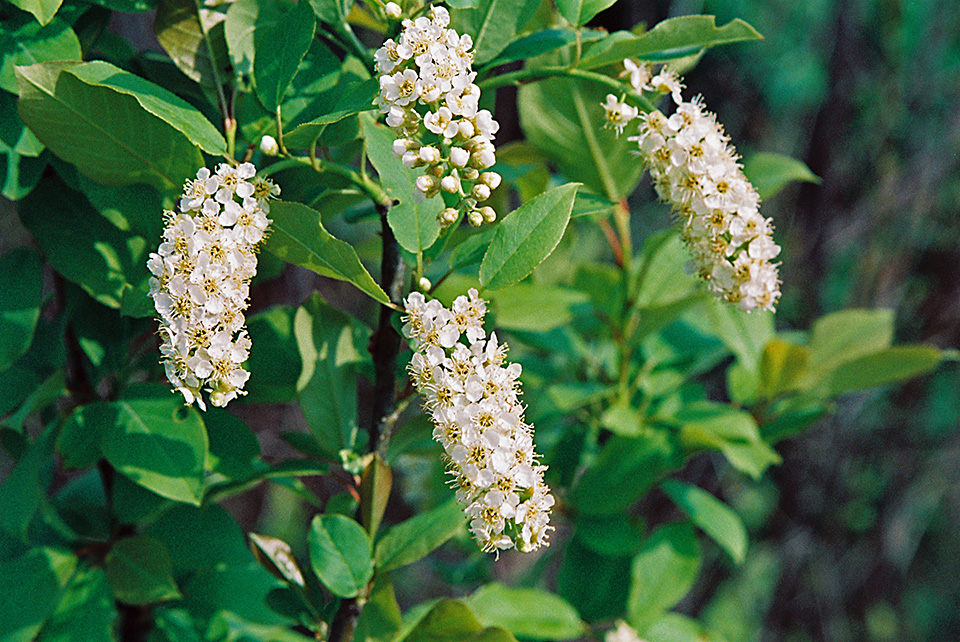
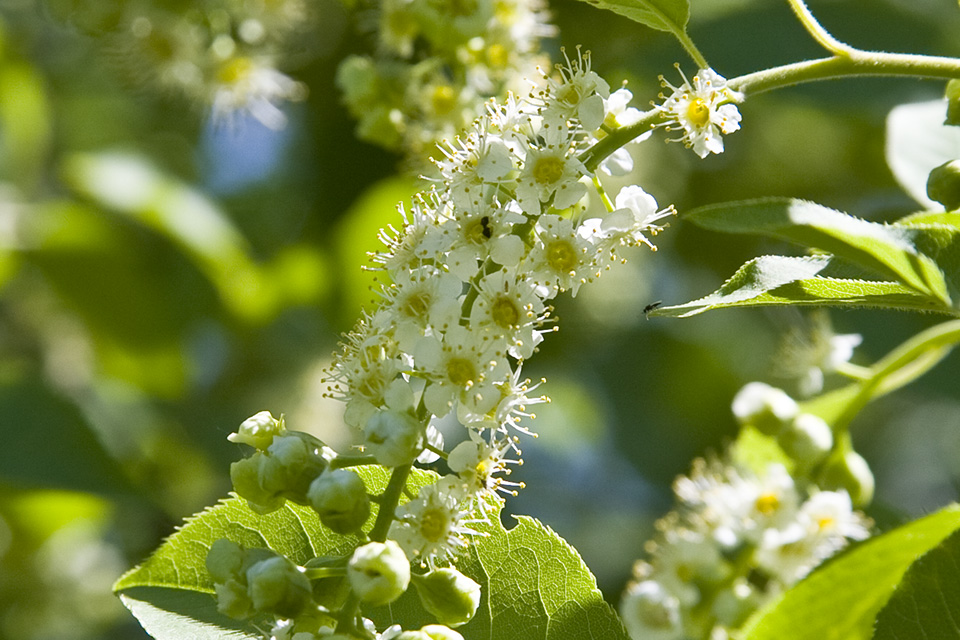
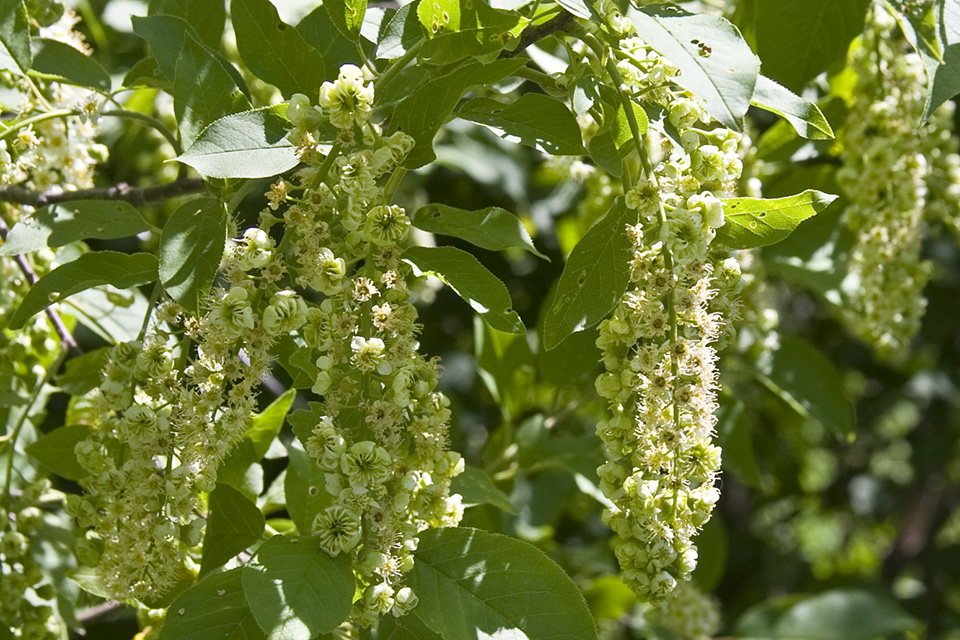
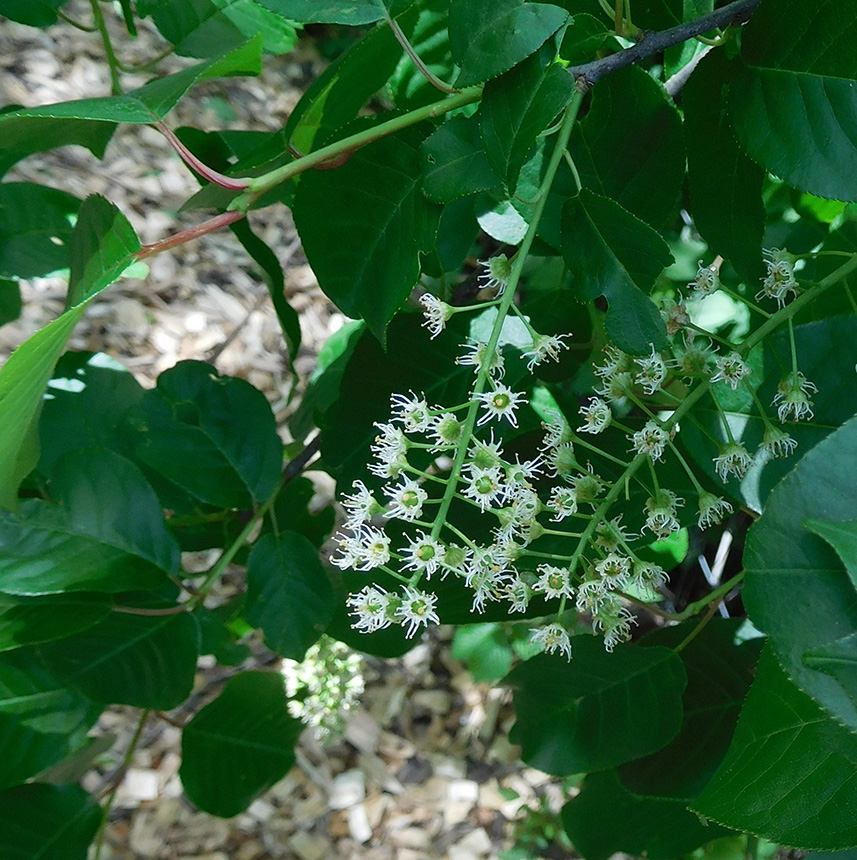
The inflorescence is a dense, elongated, unbranched cluster (raceme) of 20 to 50 flowers at the end of short, leafy shoots of the current season. The racemes are cylinder shaped, 2 to 4 long, and about ¾wide. Each flower is on a hairless, to 5 16 long stalk.

The flowers are to ½ in diameter. They open in early May to mid-June before the leaves reach full size. There are 5 sepals, 5 petals, about stamens, and 1 style. The sepals are green and 1 64 to 1 16 long. They have 10 or more minute, red glands or glandular teeth on the margin. The petals are white, to 316 long, and conspicuously narrowed at the base (clawed). The claw is about 1 32 long. The expanded portion of the petal is circular, cupped, and about wide. The stamens have long, translucent green filaments and yellow anthers.

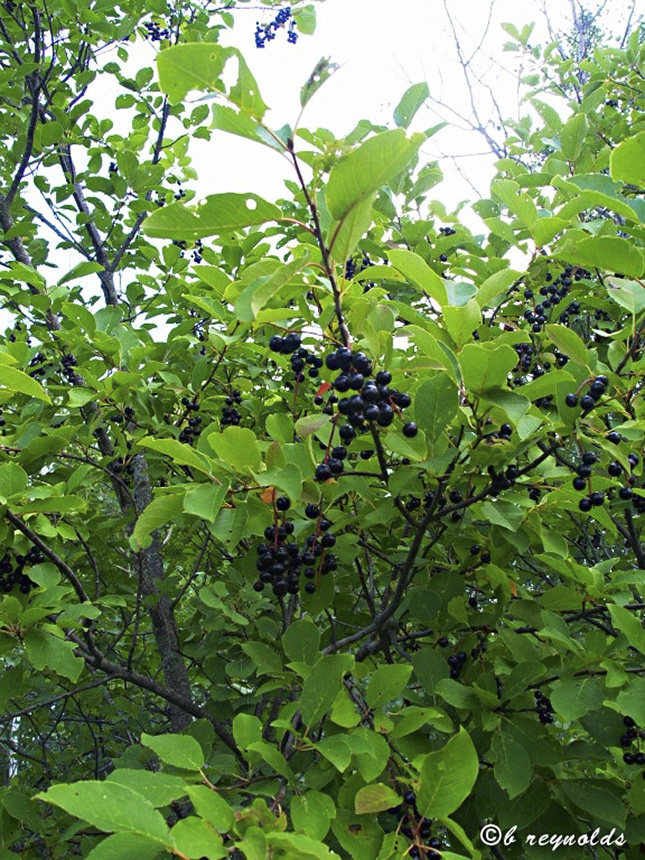
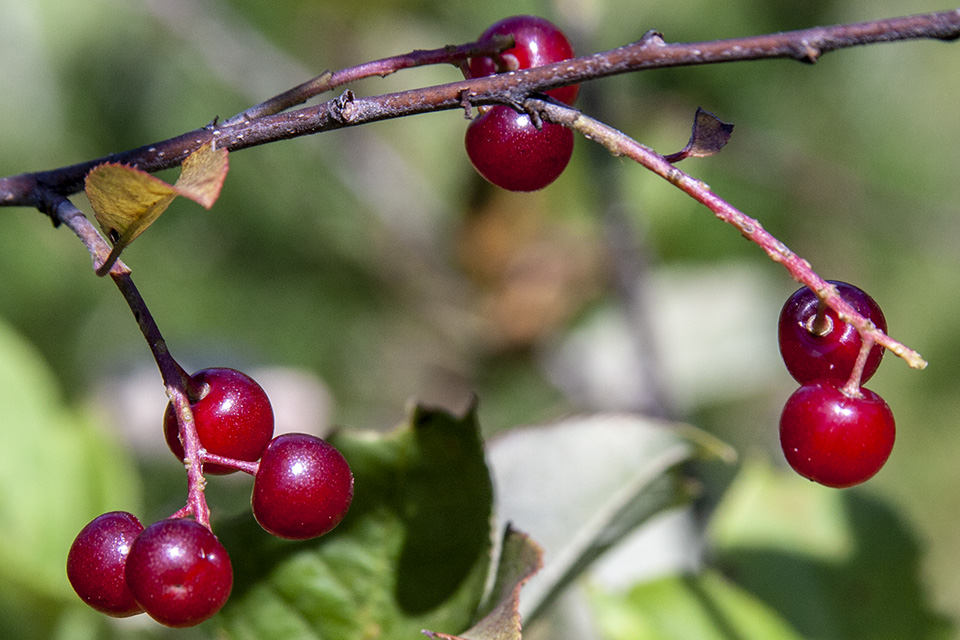
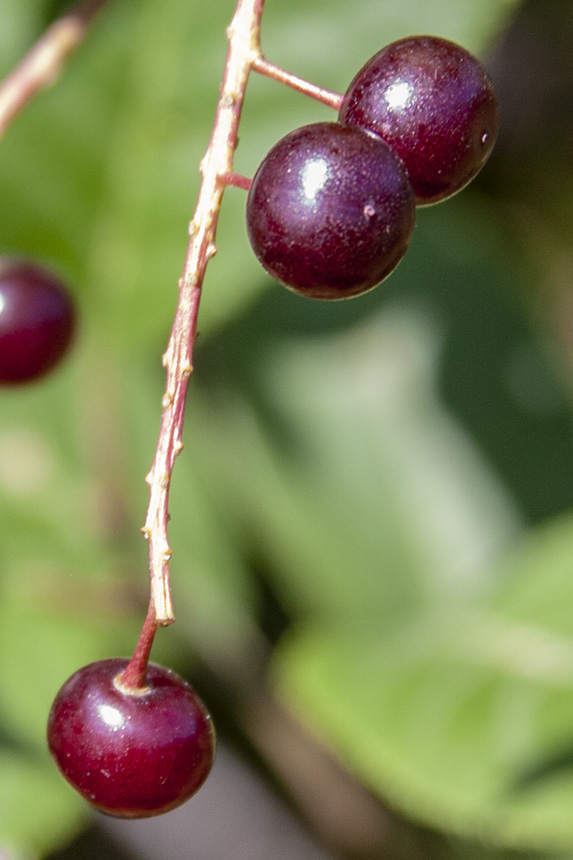
The fruit is a fleshy, one-seeded, spherical or inversely egg-shaped, 5 16to 7 16 in diameter drupe. It is green at first, red later in the season, and finally dark reddish-purple to blackish when it matures in mid-July to late August. The sepals do not persist in fruit. The ripe fruit is very astringent but edible when ripe.

Height

8 to 25

Flower Color

White

Similar Species

Black cherry (Prunus serotina var. serotina) is a tree with a single trunk. The bud scales are green at the base and reddish-brown at the tip. The leaves are narrower, 2 to 3 times as long as wide. The lower leaf surface is hairless except for a narrow patch of rust-colored hairs along both sides of the midvein on the lower ½ or of the blade. The teeth on the margins are curved inward. They have a gland-like thickening at the tip. The sepals persist in fruit.

Habitat

Forest edges and openings; interiors or forests with thin to moderate canopies; thickets; old fields; and roadsides. Full to partial sun.

Ecology

Flowering

Early May to mid-June

Pests and Diseases

Cherry Leaf Spot (Blumeriella jaapii) causes small purple spots on the leaves. Later, the spots turn brown, separate from the green tissue, and drop off, leaving a “shot hole”. Eventually, the infected leaf turns yellows and falls off.

Chokecherry finger gall mite (Eriophyes emarginatae) causes a small, narrow, erect, finger-like gall on the upper side of leaves. When present, there are usually many galls on each infected leaf.

Use


Distribution
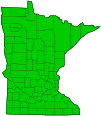
Distribution Map
2/15/2025

Sources

2, 3, 5, 7, 24, 28, 30, 83.

Biodiversity occurrence data published by: Minnesota Biodiversity Atlas (accessed through the Minnesota Biodiversity Atlas Portal, bellatlas.umn.edu. Accessed 2/15/2025).

Midwest Herbaria Portal. 2026. https://midwestherbaria.org/portal/index.php. Accessed 2/15/2025.

Prunus virginiana var. virginiana L. in GBIF Secretariat (2023). GBIF Backbone Taxonomy. Checklist dataset https://doi.org/10.15468/39omei accessed via GBIF.org. Accessed 2/15/2025.

Smith, Welby R. 2008. Trees and Shrubs of Minnesota: The Complete Guide to Species Identification. The University of Minnesota Press, Minneapolis, MN.

Nativity

Native

Occurrence

Common and widespread

Taxonomy

Kingdom

Plantae (Plants)

Subkingdom

Pteridobiotina

Phylum

Tracheophyta (Vascular Plants)

Class

Magnoliopsida (Dicots)

Order

Rosales (Roses, Elms, Figs, and Allies)

Family

Rosaceae (Rose)

Subfamily

Amygdaloideae

Tribe

Amygdaleae

Genus

Prunus (Plums, Cherries, and Allies)

Subgenus

Padus (Bird Cherries)

Species

chokecherry (Prunus virginiana)

Subordinate Taxa


Synonyms

Amygdalus besseriana

Padus virginiana var. typica

Prunus virginiana f. deamii

Prunus virginiana ssp. culta

Prunus virginiana var. deamii

Prunus virginiana var. pendula

Prunus virginica

Common Names

chokecherry

common chokecherry
Photos

Visitor Photos

Share your photo of this plant.

This button not working for you?
Simply email us at info@MinnesotaSeasons.com.
Attach one or more photos and, if you like, a caption.

Nancy Lundquist

chokecherry 18

Can you tell me what this is?

I saw it at the Dakota Woods Dog Park

Luciearl

Found this growing on the shore in my buffer.

chokecherry 15
chokecherry 19

Minnesota Seasons Photos

chokecherry plant
Plant
chokecherryinflorescence 1
Inflorescence
chokecherry inflorescence 2
Inflorescence
chokecherry inflorescence 3
Inflorescence
chokecherry inflorescence 4
Inflorescence
chokecherry inflorescence 5
Inflorescence
chokecherry leaves
Leaves
chokecherry leaf 1
Leaf
chokecherry leaf 2
Leaf
chokecherry young bark 1
Young bark
chokecherry young bark 2
Young bark
chokecherry fruit 1
Fruit
chokecherry fruit 2
Fruit

Slideshows

Slideshows

Prunus virginiana
Matt Lavin

About

Fruit: drupe. Prunus is the only genus with a single ovary per flower that develops into a drupe. Shrubs to small trees, up to 6m tall, usually riparian and site with high water table, common throughout Montana and sometime entering open understory, sagebrush steppe, and rangeland near riparian areas.

Chokecherry
DianesDigitals

About

Copyright DianesDigitals

Chokecherry (Wild Cherry) (Prunus virginiana)
Andree Reno Sanborn

Videos

Visitor Videos

Share your video of this plant.

This button not working for you?
Simply email us at info@MinnesotaSeasons.com.
Attach a video, a YouTube link, or a cloud storage link.

Other Videos

Honey Bees (Apis mellifera) and Chokecherry (Prunus virginiana), Montana, USA
Rob Mutch

About

Uploaded on Jan 8, 2012

Wikipedia: http://en.wikipedia.org/wiki/Apis_mellifera

Encyclopedia of Life (EOL): http://eol.org/pages/3787799/overview

[taxonomy:binomial=Apis mellifera]

Wild edibles, ChokeCherry tree Identification.
JoeandZachSurvival

About

Uploaded on Jun 2, 2011

The Chokecherry tree can be a big tree, the berries while tart and mouth numbing, they ere edible, a bit sour, but they make great jellies and jams.

Here is a springtime view of the tree as a cross reference for anyone interested. Thank You.

Sightings

Visitor Sightings

Report a sighting of this plant.

This button not working for you?
Simply email us at info@MinnesotaSeasons.com.
Be sure to include a location.

Nancy Lundquist
Summer 2025

chokecherry

Location: Rosemount, MN

Can you tell me what this is?

I saw it at the Dakota Woods Dog Park

Luciearl
May 2023

chokecherry

Location: Cass County

Bill Reynolds
8/7/2016

chokecherry

Location: Numedal Township, Pennington Co., Minnesota

Olga Zenteno
8/8/2015

Location: Scenic State Park

chokecherries ripe all over the park- alongside lakes and on trails as well.

Minnesota Seasons Sightings

Avon Hills Forest SNA, North Unit

Baker Park Reserve

Big Stone Lake State Park

Big Woods Heritage Forest WMA

Blackhoof River WMA

Blaine Preserve SNA

Blaine Wetland Sanctuary

Blanket Flower Prairie SNA

Blue Devil Valley SNA

Blue Mounds State Park

Boot Lake SNA

Brownsville Bluff SNA

Bunker Hills Regional Park

Bur Oak WMA

Butternut Valley Prairie SNA

Cannon River Trout Lily SNA

Cannon River Wilderness Area

Carpenter St. Croix Valley Nature Center

Carver Park Reserve

Chamberlain Woods SNA

Charles A. Lindbergh State Park

Chimney Rock SNA

Cleary Lake Regional Park

Clifton E. French Regional Park

Clinton Falls Dwarf Trout Lily SNA

Cottonwood River Prairie SNA

Crow-Hassan Park Reserve

Crystal Spring SNA

Des Moines River SNA

Edward Velishek Memorial WMA

Elm Creek Park Reserve

Englund Ecotone SNA

Falls Creek SNA

Forestville/Mystery Cave State Park

Frenchman’s Bluff SNA

Frontenac State Park

Glacial Lakes Preserve

Glacial Lakes State Park

Glendalough State Park

Gneiss Outcrops SNA

Grey Cloud Dunes SNA

Hampton Woods WMA

Hardscrabble Woods / MG Tusler Sanctuary

Hastings SNA

Hastings Sand Coulee SNA

Hayes Lake State Park

Helen Allison Savanna SNA

Holthe Prairie SNA

Hyland Lake Park Reserve

Iron Horse Prairie SNA

Iron Springs Bog SNA

Itasca State Park

Itasca Wilderness Sanctuary SNA

Jay Cooke State Park

John A. Latsch State Park

John Murtaugh Memorial WMA

John Peter Hoffman Spring Brook Valley WMA

Kasota Prairie

Keller Regional Park

Kilen Woods State Park

La Salle Lake SNA

Lake Alexander Woods SNA, South Unit

Lake Bemidji State Park

Lake Byllesby Regional Park

Lake Carlos State Park

Lake Elmo Park Reserve

Lake Maria State Park

Lawrence Creek SNA

Lebanon Hills Regional Park

Leif Mountain

Lester Lake SNA

Lost Valley Prairie SNA

Malmberg Prairie SNA

Maplewood State Park

Mary Schmidt Crawford Woods SNA

McKnight Prairie

Mille Lacs Kathio State Park

Mille Lacs Moraine SNA

Mille Lacs WMA

Minneopa State Park

Minnesota Valley State Recreation Area, Lawrence Unit

Mississippi River County Park

Monson Lake State Park

Moose Lake State Park

Morton Outcrops SNA

Mound Prairie SNA

Mound Spring Prairie SNA, North Unit

Murphy-Hanrehan Park Reserve

Nerstrand Big Woods State Park

Ney Nature Center

Northern Tallgrass Prairie NWR, Rengstorf Unit

Old Mill State Park

Oronoco Prairie SNA

Oxbow Park & Zollman Zoo

Paul Bunyan Savanna

Pigeon River Cliffs

Plover Prairie, East Unit

Prairie Bush Clover SNA

Prairie Creek WMA, Koester Prairie Unit

Prairie Creek Woods SNA

Prairie Smoke Dunes SNA

Quarry Park SNA

Rice Lake Savanna SNA

Ripley Esker SNA

Ritter Farm Park

River Terrace Prairie SNA

River Warren Outcrops SNA

Robert Ney Memorial Park Reserve

Rock Ridge Prairie SNA

Rockville County Park

St. Croix Savanna SNA

St. Croix State Park

Sakatah Lake State Park

Sand Prairie Wildlife Management and Environmental Education Area

Sandstone WMA

Savage Fen SNA

Savanna Portage State Park

Scenic State Park

Schoolcraft State Park

Seven Mile Creek County Park

Seven Sisters Prairie

Seven Springs WMA

Sheepberry Fen

Shooting Star Prairie SNA

Sibley State Park

Split Rock Creek State Park

Spring Creek Prairie SNA

Spring Lake Park Reserve

Spring Lake Regional Park

Stanley Eddy Memorial Park Reserve

Sunfish Lake Park

Swedes Forest SNA

Tamarack Nature Center

Thompson County Park

Thorson Prairie WMA

Tiedemann WMA

Tribute WMA

Twin Lakes SNA

Uncas Dunes SNA

Upper Sioux Agency State Park

Vermillion River WMA

Whitetail Woods Regional Park

Whitewater State Park

Whitney Island SNA

Wild Indigo SNA

Wild River State Park

William O’Brien State Park

Wood-Rill SNA

Woodbury WMA

Woodland Trails Regional Park

Zumbro Falls Woods SNA