Green Ash - Species Profile
Conservation • Wetland • Description • Habitat • Ecology • Use • Distribution • Taxonomy
Conservation Status
IUCN Red List
not listed
NatureServe
N5 - Secure
SNR - Unranked
Minnesota
not listed
Wetland Indicator Status
Great Plains
FAC - Facultative
Midwest
FACW - Facultative wetland
Northcentral & Northeast
FACW - Facultative wetland
Description
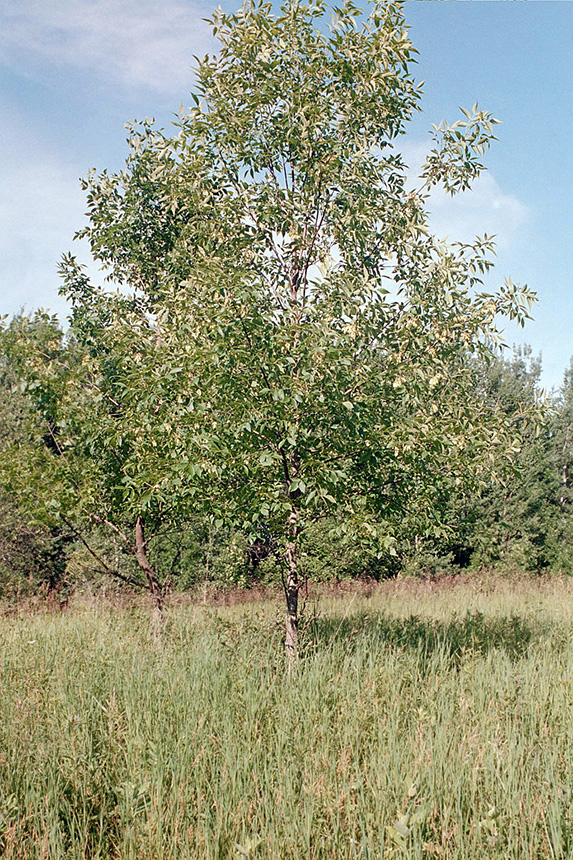
Green ash is a fast-growing deciduous tree. In Minnesota mature trees are usually 40′ to 60′ tall and 18″ to 24″ in diameter at breast height. Large individuals can reach over 80′ in height and 38″ in diameter. It is a moderately long-lived tree.
The size and form are variable. It may appear as a shrub or a tree. When it is a tree the trunk may be leaning, twisted, or straight. It rises from a shallow, wide-spreading root system. The crown is dense and usually rounded, sometimes irregular. The branches are upright.
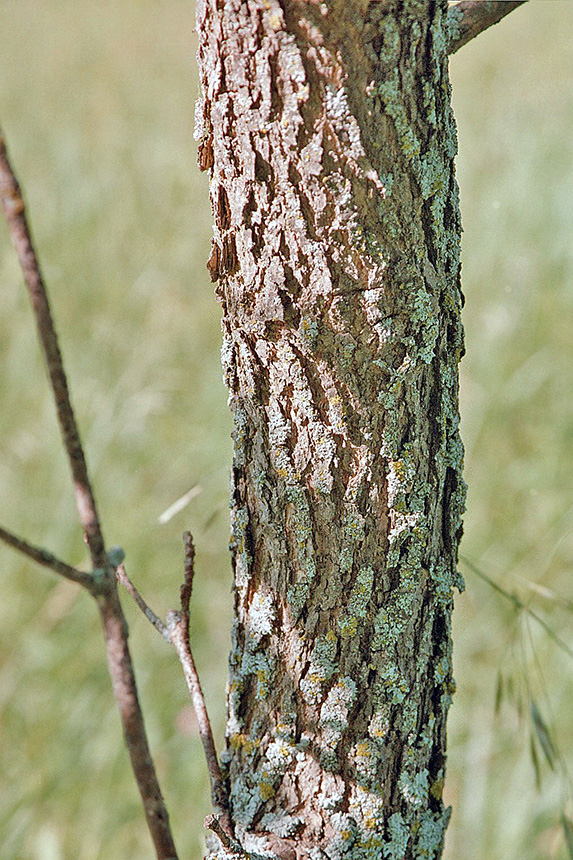
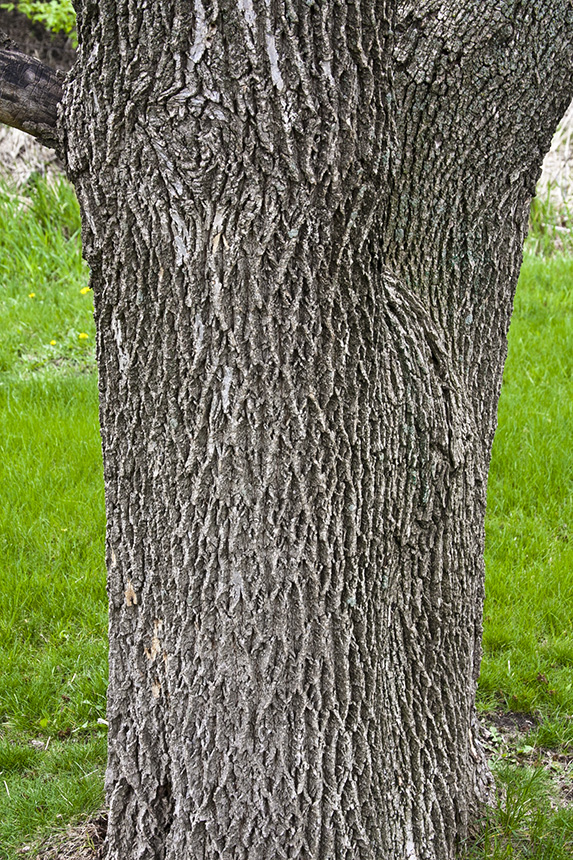
The bark on young trees is smooth or slightly flaky, and is brown to dark gray with reddish streaks. As it ages it develops firm, narrow, raised, corky ridges. The ridges are interlaced and form a diamond-shaped pattern.
The twigs are moderately stout, round or oval in cross section, greenish-gray to reddish-brown, with light-colored dots (lenticels). First season twigs are densely hairy, velvety to the touch. They are less hairy in the winter. The buds are reddish-brown, small, rounded, and covered with fine hairs. The terminal bud is ⅛″ to 5 ⁄16″ long, reddish-brown, and hairy. The uppermost pair of lateral buds occurs at the base of the terminal bud. The leaf scars are half-round and are straight along the upper edge, like a capital letter D lying on its side.
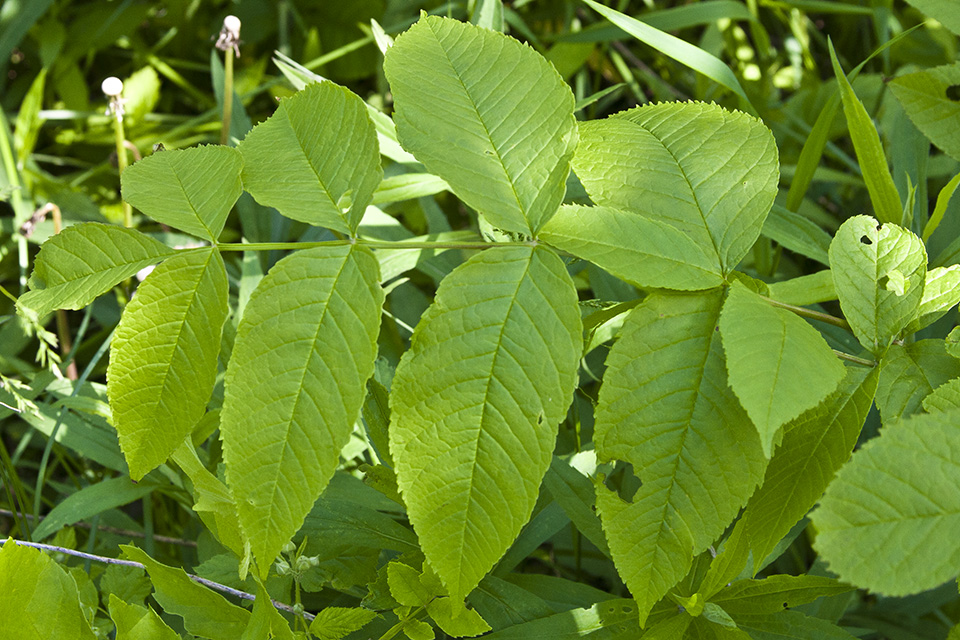
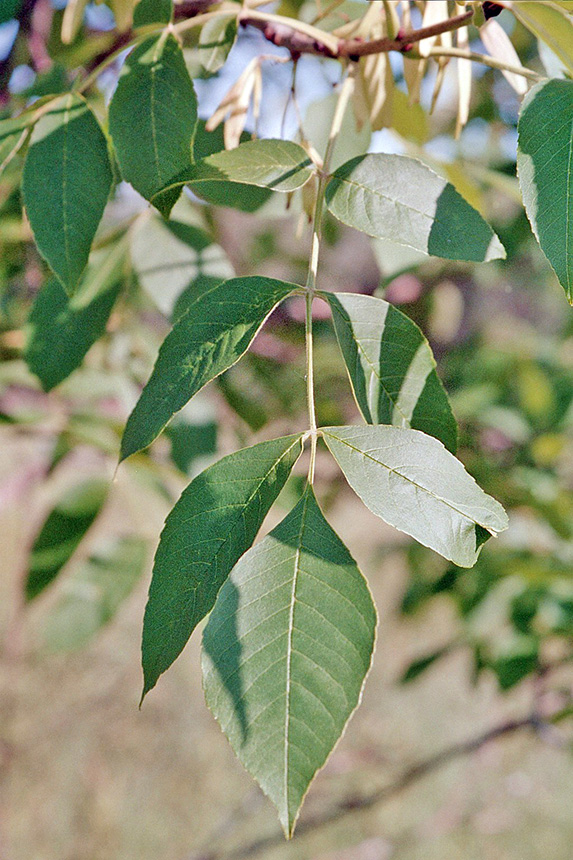
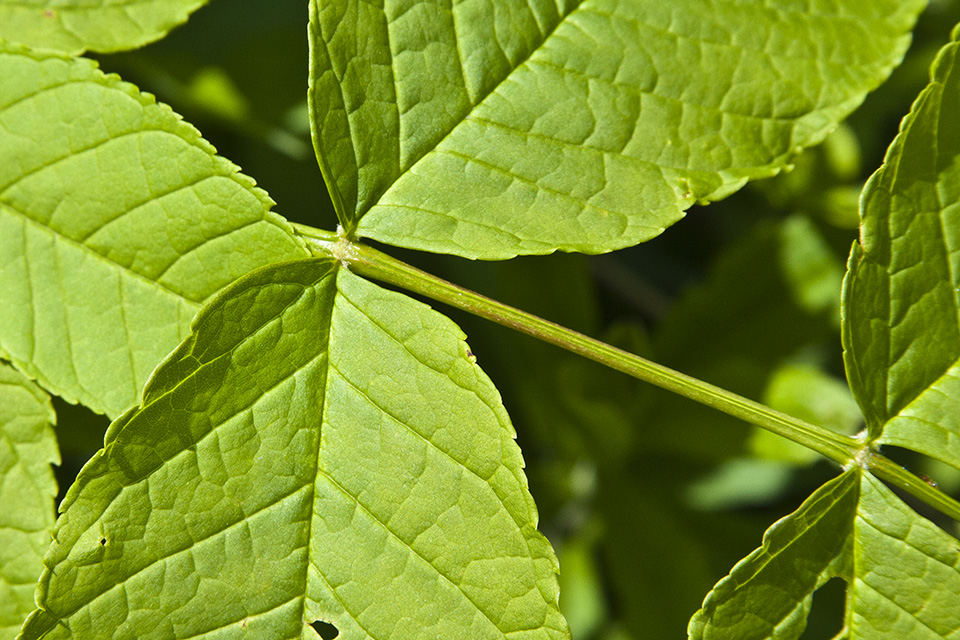
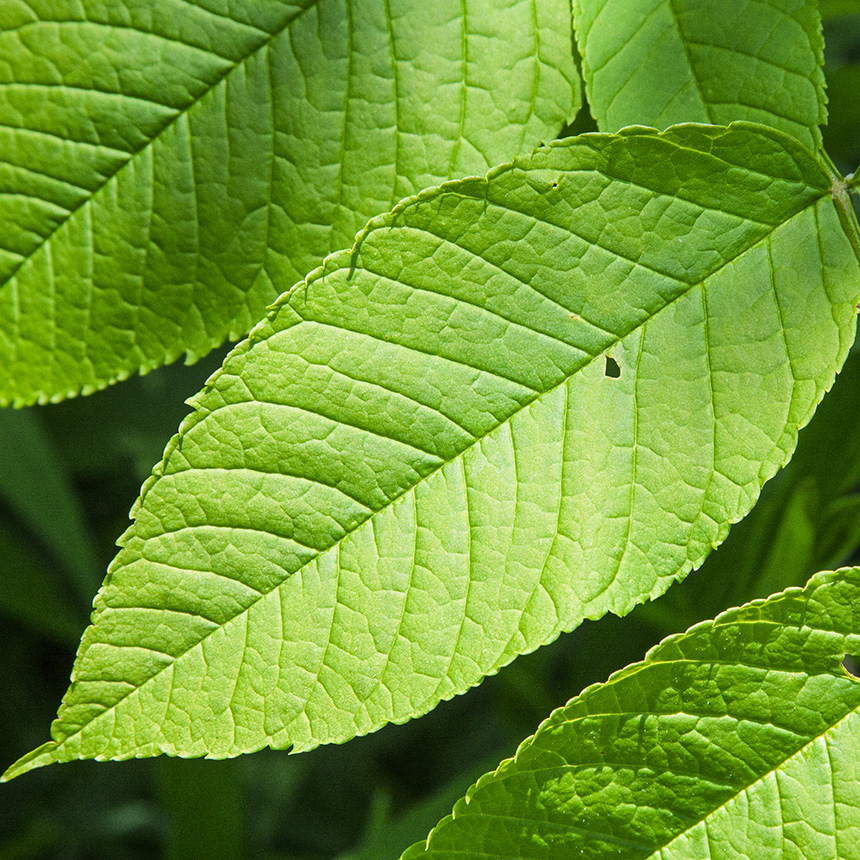
The leaves are deciduous, opposite, and pinnately compound. They are 6″ to 12″ long and are divided into 5 to 9, usually 7, leaflets. The central stalk of the compound leaf is hairy. The leaflets are all stalked. They are arranged in opposite pairs with 1 terminal leaflet. They are lance-shaped, 2¾″ to 5″ long, and 1″ to 1¾″ wide. They are tapered at the base and taper to a point at the tip. The upper surface is yellowish green and hairy to hairless. The lower surface is paler green and densely hairy. The margins are finely toothed above the middle, untoothed near the base. In autumn they turn yellowish-brown and are shed as individual leaflets, not entire leaves. The tips of the leaflets do not droop.
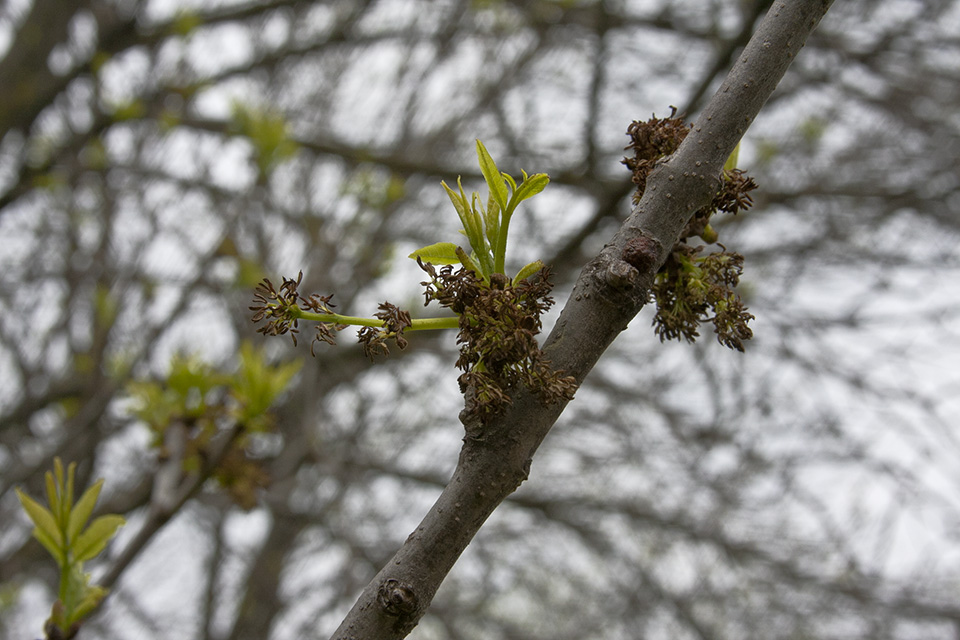
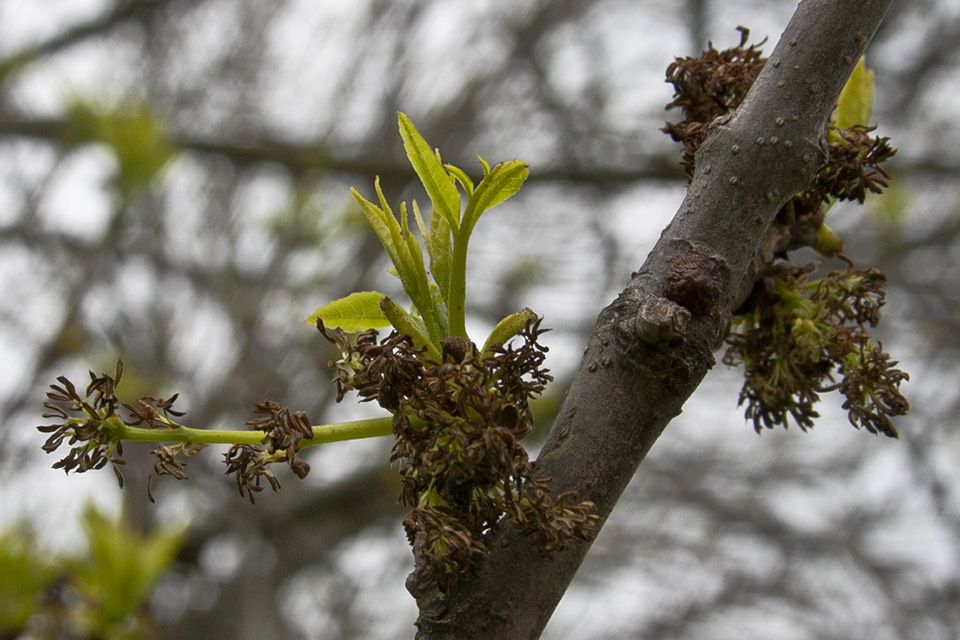
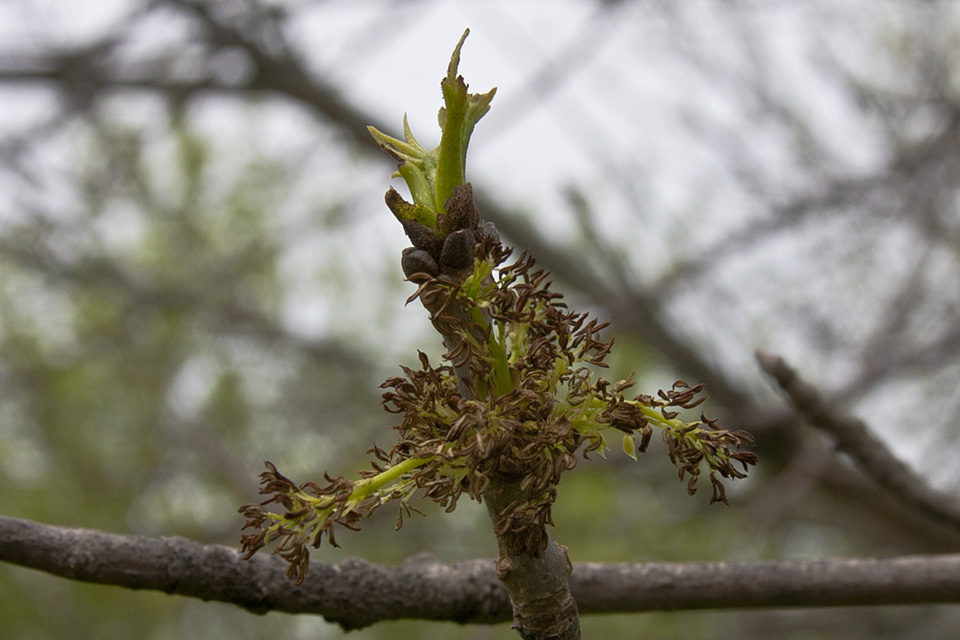
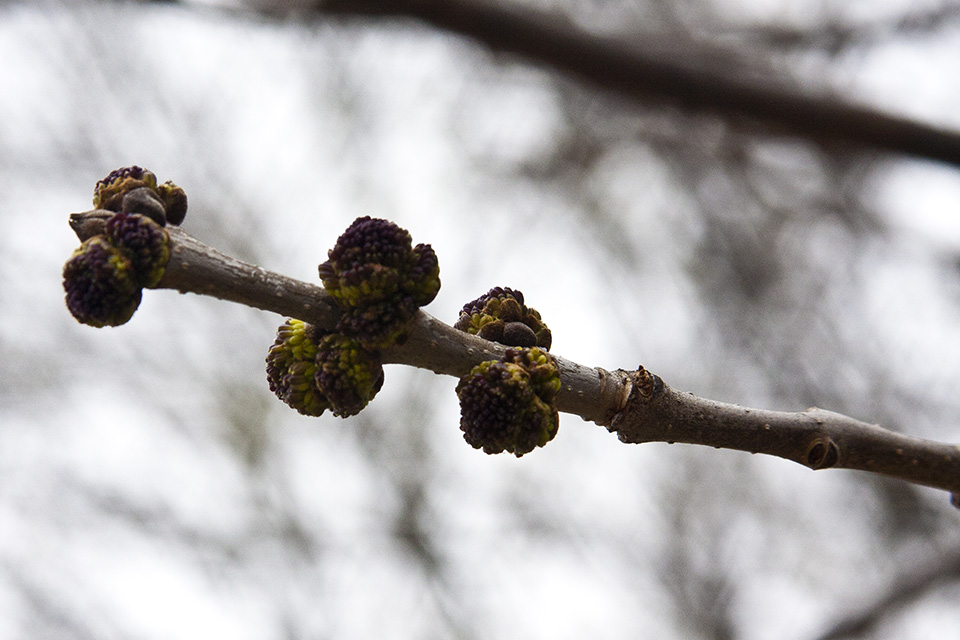
Male and female flowers are borne on separate trees. They are borne in branched clusters over the outer part of the crown. They are purplish, small, and inconspicuous, and have no petals. They appear in late April to early May just before or at the same time as the leaves.
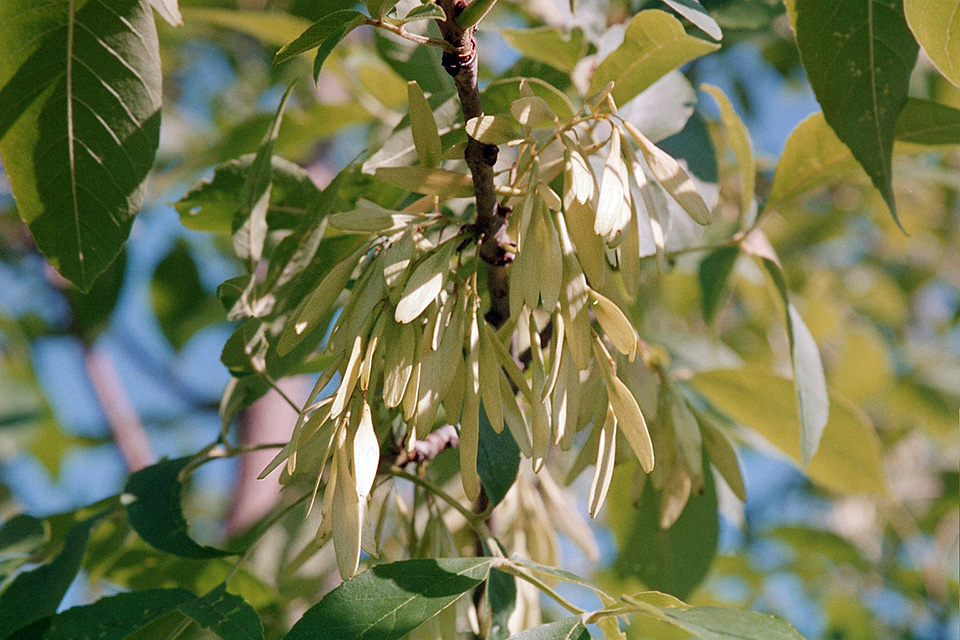
The fruit is a 1″ to 2″ long, ⅛″ to 5 ⁄16″ wide samara consisting of a flattened seed case with a dry, flattened, papery, wing. The wing is pointed or notched at the tip, and encloses half or more of the seed case. The seed case is nearly as thick as wide, more than 7½ times as long as wide, and much thicker than the wing. It contains a single seed. The samara ripens from late September to early October and is dispersed from October throughout the winter.
Height
40′ to 60′
Record
The champion green ash in Minnesota is on public property near the Minnesota Landscape Arboretum in Carver County. In 2021 it was measured at 112.5′ tall and 184″ in circumference (58.6″ in diameter), with a crown spread of 60′.
Flower Color
Similar Species
Blue ash (Fraxinus quadrangulata) twigs are 4-angled, or winged.
Black ash (Fraxinus nigra) twigs are hairless. The leaf scars are elliptic to oval. The terminal bud is distinctly separated on the twig from the uppermost pair of flowering buds. The leaves have 7 to 11, sometimes 13, leaflets. The tips of the leaflets tend to droop. The wing of the samara extends to or almost to the base of the seed case.
White ash (Fraxinus americana) leaf scars are deeply notched at the top. The leaflets are pale or whitish on the underside.
Habitat
Highly adaptable, but prefers moist bottomlands.
Ecology
Flowering
Late April to early May
Pests and Diseases
Ash bead gall mite (Aceria fraxini) causes small, greenish-yellow galls on the leaves of ash trees. The galls are sometimes numerous and are scattered randomly on lateral veins.
Ash flower gall mite (Aceria fraxiniflora) causes the growth of a dense, cauliflower-like cluster of flower buds on the inflorescence stalk of male ash trees and trees with hermaphroditic flowers (with both male and female functional parts). They are green at first, eventually turning brown.
Mycosphaerella Leaf Spot (Mycosphoerello effiguroto) produces tiny, 1 ⁄32″ to ⅛″ in diameter spots on the upper leaf surface. The spots are yellow at first soon turning dark purple.
Phyllosticta Leaf Spot (Mycosphoerello fraxinicola) produces irregular, ⅜″ to ⅝″ in diameter spots on the upper leaf surface. The spots are pale green at first, soon turning dark purple with a tiny tan center, eventually turning light brown or tan by early September.
Use
Distribution
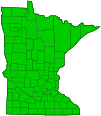
Sources
Biodiversity occurrence data published by: Minnesota Biodiversity Atlas (accessed through the Minnesota Biodiversity Atlas Portal, bellatlas.umn.edu. Accessed 2/7/2026).
Midwest Herbaria Portal. 2026. https://midwestherbaria.org/portal/index.php. Accessed 2/7/2026.
Fraxinus pennsylvanica Marshall in GBIF Secretariat (2023). GBIF Backbone Taxonomy. Checklist dataset https://doi.org/10.15468/39omei accessed via GBIF.org. Accessed 2/7/2026.
Smith, Welby R. 2008. Trees and Shrubs of Minnesota: The Complete Guide to Species Identification. The University of Minnesota Press, Minneapolis, MN.
Nativity
Native
Occurrence
Common
Taxonomy
Kingdom
Subkingdom
Pteridobiotina
Phylum
Tracheophyta (Vascular Plants)
Class
Order
Lamiales (Mints, Plantains, Olives, and Allies)
Family
Oleaceae (Olive)
Tribe
Oleeae
Subtribe
Fraxininae
Genus
Fraxinus (Ashes)
Subordinate Taxa
Two varieties have been described: red ash (var. pennsylvanica), with hairy leaves and broad leaflets; and green ash (var. lanceolata), with hairless leaves and narrower leaflets. However, the two varieties intergrade completely, and most taxonomists reject the distinction.
Synonyms
Calycomelia campestris
Calycomelia elliptica
Calycomelia expansa
Calycomelia lancea
Calycomelia lanceolata
Calycomelia ovata
Calycomelia pennsylvanica
Calycomelia pubescens
Calycomelia richardii
Fraxinus americana ssp. pennsylvanica
Fraxinus americana var. normale
Fraxinus americana var. pennsylvanica
Fraxinus americana var. pensylvanica
Fraxinus americana var. pubescens
Fraxinus americana var. rubicunda
Fraxinus americana var. subpubescens
Fraxinus arbutifolia
Fraxinus aucubifolia
Fraxinus campestris
Fraxinus cerasifolia
Fraxinus cinerea
Fraxinus concolor
Fraxinus darlingtonii
Fraxinus elliptica
Fraxinus expansa
Fraxinus fusca
Fraxinus glabra
Fraxinus juglandifolia var. aucubifolia
Fraxinus juglandifolia var. subintegerrima
Fraxinus lancea
Fraxinus lanceolata
Fraxinus lanceolata var. lindheimeri
Fraxinus lanceolata var. macrocarpa
Fraxinus lanceolata var. viridis
Fraxinus lancifolia
Fraxinus lindheimeri
Fraxinus longifolia
Fraxinus media
Fraxinus nigra var. pubescens
Fraxinus oblongocarpa
Fraxinus ovalis
Fraxinus ovata
Fraxinus pennsylvanica ssp. subintegerrima
Fraxinus pennsylvanica var. aucubaefolia
Fraxinus pennsylvanica var. aucubifolia
Fraxinus pennsylvanica var. austini-megaphylla
Fraxinus pennsylvanica var. austinii
Fraxinus pennsylvanica var. campestris
Fraxinus pennsylvanica var. integerrima
Fraxinus pennsylvanica var. lanceolata
Fraxinus pennsylvanica var. ovata
Fraxinus pennsylvanica var. pennsylvanica
Fraxinus pennsylvanica var. pubescens
Fraxinus pennsylvanica var. subintegerrima
Fraxinus pennsylvanica var. typica
Fraxinus pennsylvanica var. viridis
Fraxinus pensylvanica f. austinae
Fraxinus platyphylla
Fraxinus pubescens
Fraxinus pubescens var. boscii
Fraxinus pubescens var. coriacea
Fraxinus pubescens var. lindheimeri
Fraxinus pubescens var. nana
Fraxinus pubescens var. ovata
Fraxinus pubescens var. subpubescens
Fraxinus richardii
Fraxinus rubicunda
Fraxinus rufa
Fraxinus smallii
Fraxinus subvillosa
Fraxinus trialata
Fraxinus viridis
Fraxinus viridis var. pubescens
Fraxinus viridis var. trialata
Leptalix cinerea
Leptalix elliptica
Leptalix expansa
Leptalix fusca
Leptalix lancifolia
Leptalix longifolia
Leptalix media
Leptalix ovata
Leptalix pubescens
Leptalix richardii
Leptalix rubicunda
Leptalix rufa
Common Names
downy ash
green ash
red ash
swamp ash
water ash