red clover - Species Profile
Conservation • Weed • Wetland • Description • Habitat • Ecology • Use • Distribution • Taxonomy
Conservation Status
IUCN Red List
not listed
NatureServe
NNA - Not applicable
SNA - Not applicable
Minnesota
not listed
Weed Status
Red clover is on the Exotic Invasive Plants Watchlist in Kentucky, it is listed as a common weed in Oregon, it is on the Occasionally Invasive Plant Species list on West Virginia, and it is on the Invasive Plants Association of Wisconsin (IPAW) Working List of Invasive Plants of Wisconsin. It is not listed in Minnesota.
Wetland Indicator Status
Great Plains
FACU - Facultative upland
Midwest
FACU - Facultative upland
Northcentral & Northeast
FACU - Facultative upland
Description
Red clover is an exotic perennial forb. It is native to Northern Africa, Europe, and Western Asia. It was widely introduced for agricultural use, has escaped cultivation, and is now widely naturalized in North America.
Red clover rises on multiple stems from a taproot with rhizomes.
The stems are light green, hairy, and branching. They can be nearly erect, ascending, or reclining on the ground with just the tip ascending.
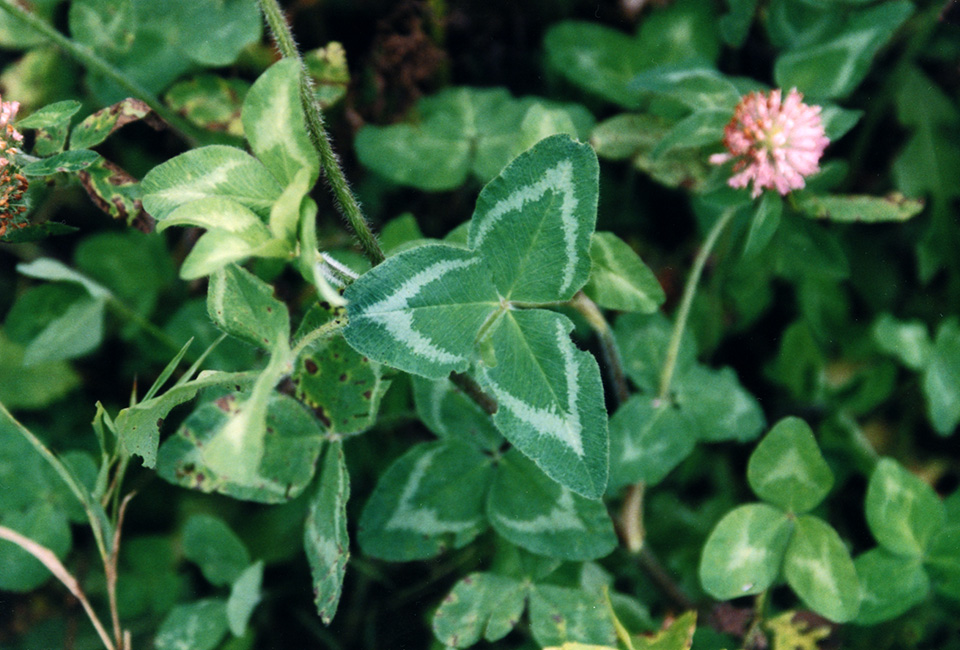
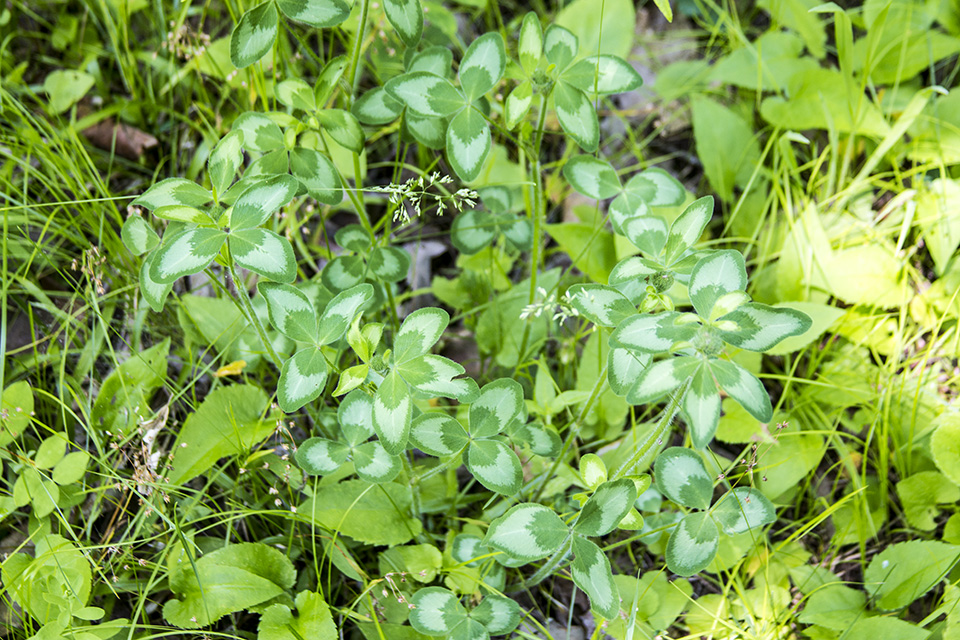
The leaves are alternate and compound, divided into 3 leaflets. The lower leaves are on long, hairy leaf stalks. The upper leaves are on short stalks or on no stalks at all. The leaflets are lance-shaped or egg-shaped, hairless, ⅜″ to 1⅛″ long, and ¼″ to ⅔″ wide. The margins are finely-toothed or untoothed. The upper leaf surface is silky-hairy and has a pale V-shaped marking.
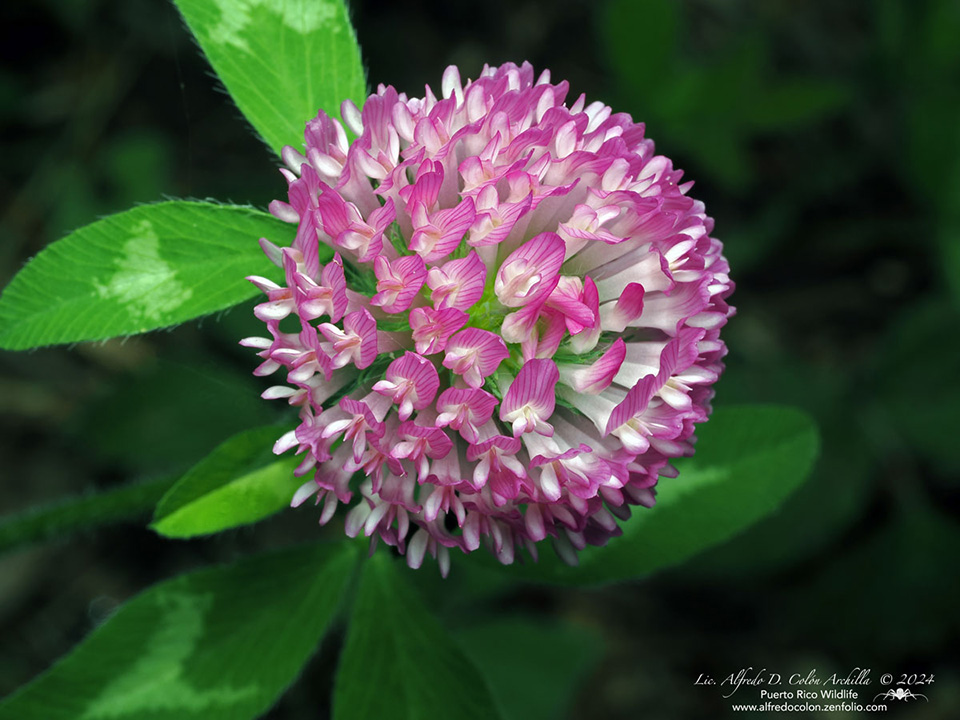
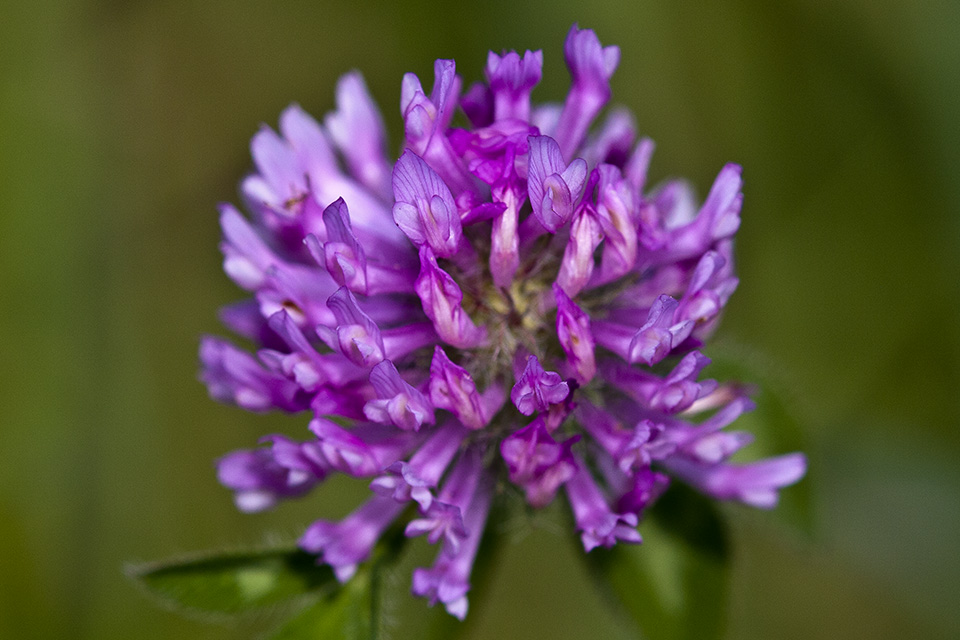
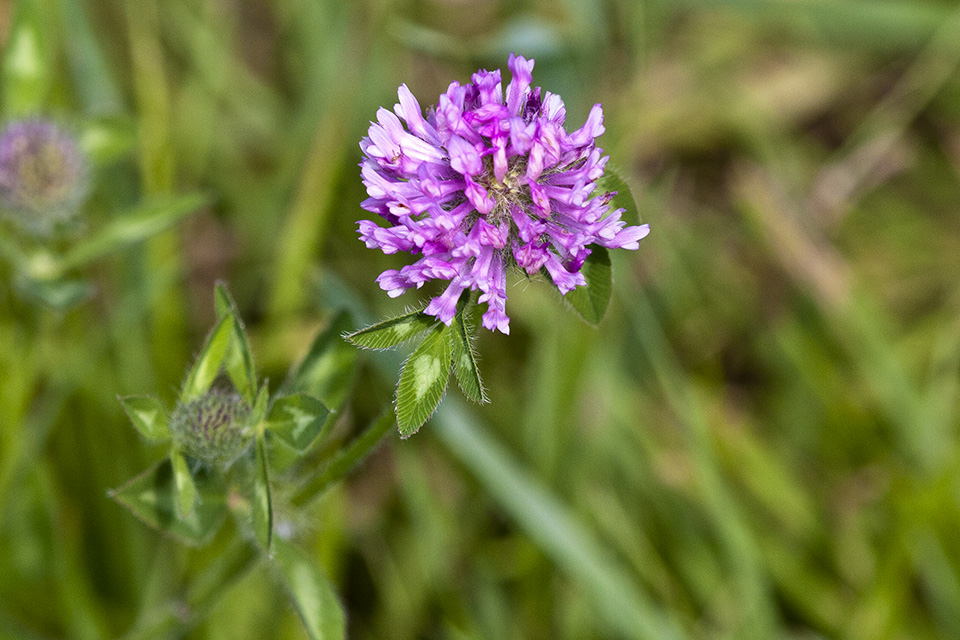
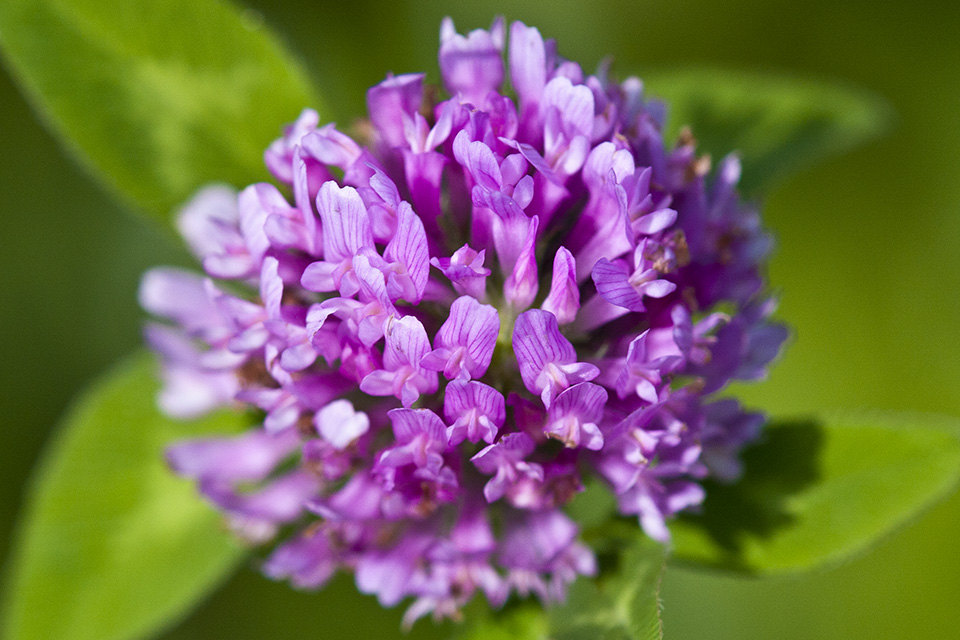
The inflorescence is several dense, globular, head-like clusters at the end of the stems. The flower heads are ½″ to 1⅛″ tall and about 1″ across. Each head has up to 25 to 80 flowers. There are usually 1 to 3 stalkless leaflets immediately below the flower head.
The flowers are pea-like, with 5 petals organized into a banner, 2 wings, and a keel formed by two petals fused together at the tip. The banner is longer than the wings and the keel. The individual flowers are stalkless. The petals are magenta to pink to nearly white, but never red. They gradually turn darker pink to rose as they age.
The fruit is a seed pod containing 1 or 2 seeds.
Height
1′ to 2½′
Flower Color
Magenta to pink to nearly white, but never red
Similar Species
Alsike clover (Trifolium hybridum) stems are hairless or nearly hairless. The leaflets have no markings on the upper surface and are not indented or pointed at the tip. The petals are pale pink to pinkish-white.
Crimson clover (Trifolium incarnatum ssp. incarnatum) stems are more hairy. The leaflets have no markings on the upper surface. The petals are crimson red.
White clover (Trifolium repens ssp. repens) is a much smaller plant, 4″ to 10″ tall. The stems are creeping and they root at the nodes. Flowers and leaves are borne on separate stalks. The leaflets have have a pale, crescent-shaped, not V-shaped, marking on the upper surface. The petals are white or white tinted with pink.
Habitat
Disturbed sites
Ecology
Flowering
May to September
Pests and Diseases
Use
Red clover is an important forage crop. It has been cultivated since the third and fourth centuries.
Red clover is the state flower of Vermont.
Distribution

Sources
Biodiversity occurrence data published by: Minnesota Biodiversity Atlas (accessed through the Minnesota Biodiversity Atlas Portal, bellatlas.umn.edu. Accessed 3/6/2026).
Midwest Herbaria Portal. 2026. https://midwestherbaria.org/portal/index.php. Accessed 3/6/2026.
Trifolium pratense L. in GBIF Secretariat (2023). GBIF Backbone Taxonomy. Checklist dataset https://doi.org/10.15468/39omei accessed via GBIF.org. Accessed 3/6/2026.
EDDMapS. 2013. Early Detection & Distribution Mapping System. The University of Georgia - Center for Invasive Species and Ecosystem Health. Available online at www.eddmaps.org/. Accessed 3/6/2026.
Nativity
Native to Northern Africa, Europe, and Western Asia. Introduced and naturalized.
Occurrence
Very common and widespread
Taxonomy
Kingdom
Subkingdom
Pteridobiotina
Phylum
Tracheophyta (Vascular Plants)
Class
Order
Fabales (Legumes, Milkworts, and Allies)
Family
Fabaceae (Legumes)
Subfamily
Faboideae
Tribe
Trifolieae
Subtribe
Fabeae
Genus
Trifolium (Clovers)
Subgenus
Trifolium
Section
Trifolium
Tribe
While the genus Trifolium has traditionally been placed within the tribe Trifolieae, current phylogenetic standards—including those maintained by World Plants—reclassify the genus into the tribe Fabeae. Molecular data indicates that Trifolium lacks the “inverted repeat” in its chloroplast DNA, a genetic characteristic that identifies it as a member of the monophyletic clade containing the Fabeae (vetches and peas) rather than the Trifolieae.
Subordinate Taxa
At least eleven varieties or subspecies (infraspecies) of red clover have been described based on habits, calyces, stipules, and patterns of pubescence. In North American populations there is much intergradation, making determining the variety of some individual plants difficult or impossible.
The following infraspecies are currently recognized by at least one highly respected taxonomic source. No source accepts all of them. Some North American sources do not recognize any infraspecies.
Trifolium pratense ssp. baeticum
Trifolium pratense ssp. kotulae
Trifolium pratense ssp. pratense
Trifolium pratense var. americanum
Trifolium pratense var. frigidum
Trifolium pratense var. luteopurpureum
Trifolium pratense var. pratense
Trifolium pratense var. sativum
Trifolium pratense var. villosum
Synonyms
Lagopus pratensis
Trifolium boeticum
Trifolium brachystylum
Trifolium bracteatum
Trifolium heterophyllum
Trifolium pensylvanicum
Trifolium pratense ssp. boeticum
Trifolium pratense ssp. expansum
Trifolium pratense ssp. lenkoranicum
Trifolium pratense ssp. sativum
Trifolium pratense ssp. spontaneum
Trifolium sativum
Trifolium sativum ssp. praecox
Trifolium silvestre
Trifolium ukrainicum
Trifolium ukranicum
Triphylloides pratensis
Common Names
peavine clover
purple clover
red clover